you are here [x]: Scarlet Star Studios > the Scarlet Letters > Q&D - photo storyboard
<< before someone keeps stealing my letters...
after >> superNOVember - 5

November 8, 2006

Q&D - photo storyboard

by sven at 8:10 pm

(Q&D = "quick and dirty" - an ongoing animation project)

Last night I took 90 test photos of the new pups in their sets. The puppets and props, as material objects, don't cooperate entirely with my imagination... But that's OK. This is an experimental project -- and I wound up finding all kinds of interesting solutions that I never would have thought of if I weren't working with my hands.

As I took photos, I began to re-write the "script" in my mind. Today I worked on assembling a new storyboard -- a "photo storyboard" -- which you'll see below.

It's funny: I have a hard time reminding myself that I haven't actually shot the film yet. These photos totally look like still shots excerpted from a film that's already been made... But no! Filming is yet to come -- and the final product will still probably wind up looking very different from what I've got here.

'Nuf said. On to the storyboard!
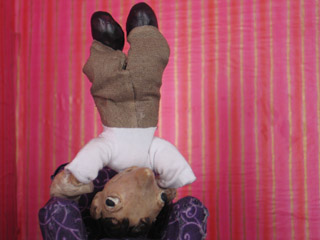
(1)

Jimmy's standing on his head in the comfy chair.
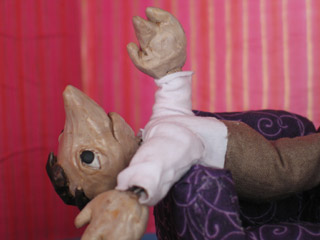
(2)

Close-up on his face as he flops down playfully.

(Shot should probably be even more of a close-up, to avoid the awkardness of animating him getting down. Let it be implied.)
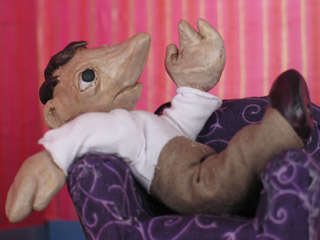
(3)

Jimmy: Ah, the joy that is Saturday.

(Characters won't actually speak -- at least not in English. I'm writing out their thoughts to help motivate pantomime acting. When dialogue is in quotation marks, the puppets' voices will be a squeaky sound for Jimmy, and growly nonsense words for Dad.)
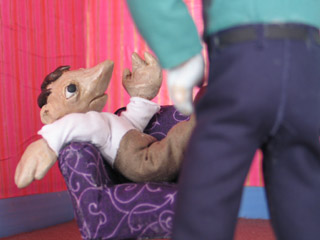
(4)

Jimmy: What could possibly go wrong?

Dad walks into the foreground.
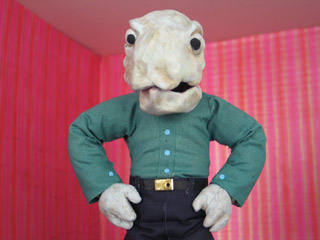
(5)

Dad stands with his hands on hips, growling in irritation.
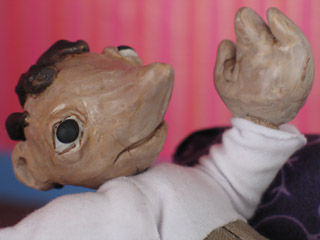
(6)

Jimmy: "Uh, hi dad!" He waves hello.

(7)

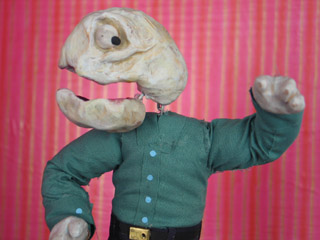
Dad: "What are you doing just sitting here?"
(8)

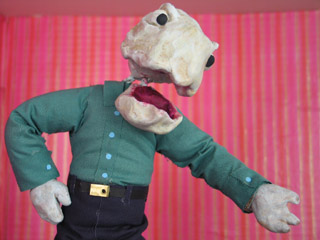
Dad: "Didn't you promise to do a really boring chore?"
(9)

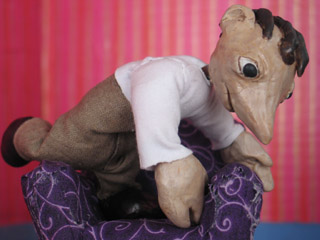
Dad: "And yet, here we are, several seconds into this film, and you still haven't done the work!" He indicates offscreen. Maybe there are leaves to be raked outside.
(10)

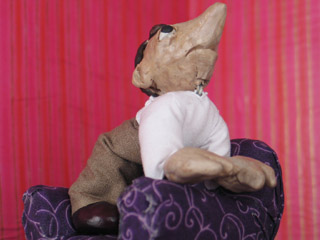
Jimmy changes position in the chair.

(I'm worried about how I'm going to pull off a transitional shot like this without a solid rig for Jimmy...)
(11)

Jimmy: "Aw, Dad... I don't wanna. Prettyprettypretty please?"
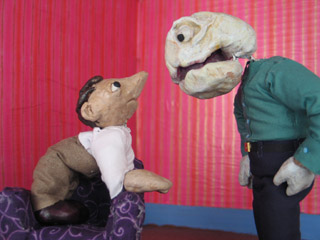
(12)

Jimmy: "Have you ever considered that assigning me this chore might just be a manifestation of your bitterness about the soul-sapping, nose-to-the-grindstone life that you find yourself in now? ...That maybe deep down, part of you is jealous of my ability to still be playful and relax -- and is trying to punish me for it?"
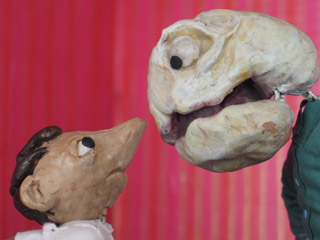
(13)

They stare each other down in silence. Is Dad going to fall for that excuse? I mean, it sounded pretty good, right?
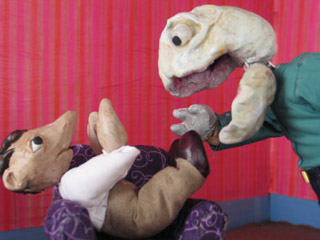
(14)

Dad: "OH GIVE ME A BREAK!"

Jimmy topples backwards in the chair.
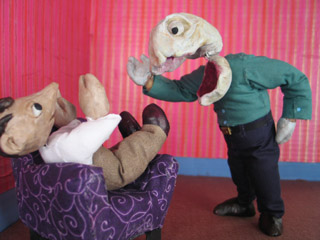
(15)

Dad: "That is the most irritating, lazy-bones, psycho-babble excuse I've ever heard, young man!"
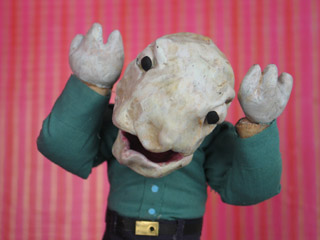
(16)

Dad: "You promise me that you're going to do something..."
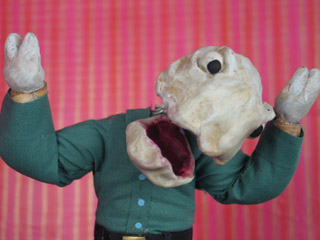
(17)

Dad: "And then I go to the kitchen and eat a little strawberry pie..."
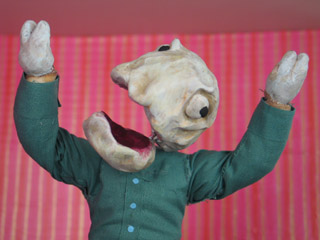
(18)

Dad: "And do you do the chore? ...No!"
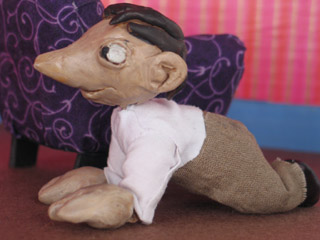
(19)

Jimmy: While Dad's talking to himself, I think I'll just slip away.

Jimmy crawls around toward the back of the chair. Dad continues ranting in the background.
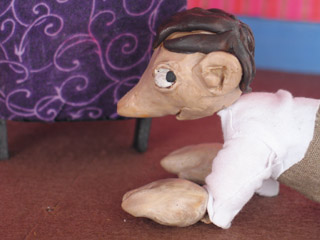
(20)

Jimmy: Good thing Dad doesn't know about my secret escape route!
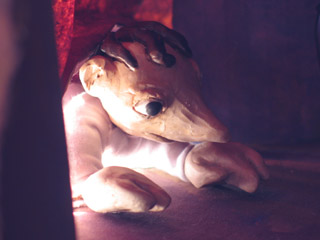
(21)

Jimmy crawls into the cave set through a little crack in the wall.
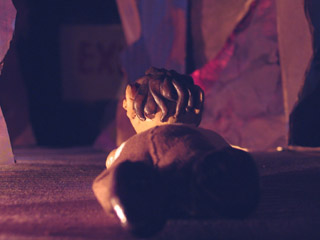
(22)

He crawls through this secret, magical cave tunnel.
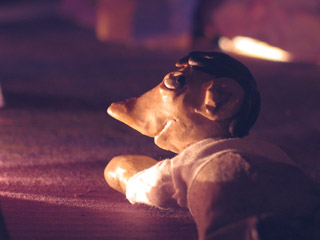
(23)

He looks over his shoulder. Perhaps we can still hear Dad off in the distance...
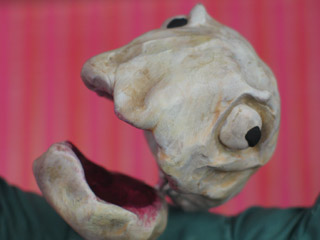
(24)

(Meanwhile:)

Dad: "And what's more, the strawberries were rather tart and unsatisfying..."
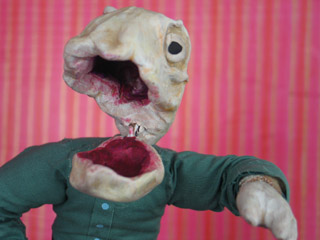
(25)

Dad: "Which brings me to my point: which is that..."
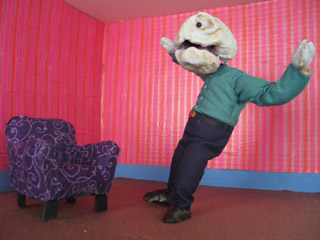
(26)

Dad does a big startle response, realizing that Jimmy's chair is now empty.
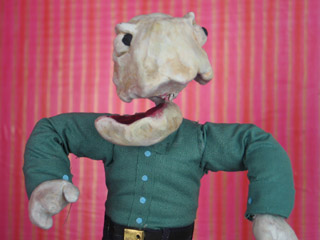
(27)

Dad: I'm confused and unsettled!

(28)

Dad: Oh! I'm going to go get that boy!!

He growls through gritted teeth and storms off.
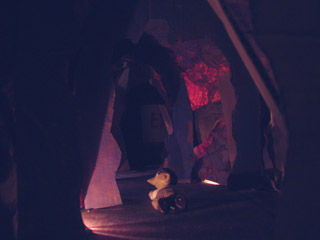
(29)

(Meanwhile:)

Jimmy is crawling through the cave tunnel. It's silent, like a natural cathedral. Perhaps a good moment for a music cue?
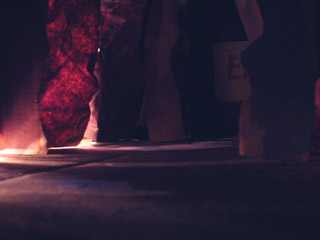
(30)

We have a POV shot, the camera shuffling through the tunnel...
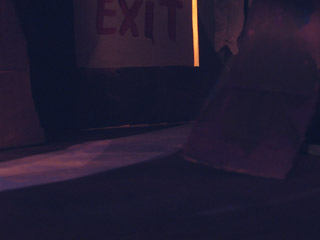
(31)

Still in the POV shot, we come to a door in the wall marked "Exit."

End of photo storyboard.

I'd like to add a further sequence at the end: We see a shot of a painting hanging on the wall back in the house. The painting opens up like a door, and Jimmy jumps down to the floor, having escaped Dad and the dreaded chores.

The problem with this epilogue, though, is that at this point I haven't made a dining room set for Jimmy to emerge into. It requires more fabrication.

In the last version of the storyboard I had a whole 'nother sequence again, where Dad finds Jimmy and then Jimmy escapes into a second secret tunnel. I think at this point I'm just going to jettison that part of the story. But I believe I still need a scene in the dining room -- otherwise the nature of the secret tunnel is too unclear. It's not just a mysterious cave; it's a tunnel to another part of the house.

posted by sven | November 8, 2006 8:10 PM | comments (5) | categories: stopmo

Comments

I love the picture storyboard, Sven. You're right it does look like finished stills! The tunnel set really feels spacious and an altered reality. I'm glad about your editing the 3rd act, it doesn't need it now that you've made the father more intense in act 1. Great job!

Posted by: shelley Noble at November 8, 2006 11:20 PM

i'm glad you're removing the third act, too. this is sweet and we get to root for him to escape!

Posted by: gl. at November 8, 2006 11:51 PM

Wow, I almost missed this completely! I read your post above it and didn't realize this one was here. Good thing I checked back a little ;later and happened to scroll just a bit farther down!

This is excellent Sir Svennington! I want to cry watching you crank out the Q&D while I'm laboring (well, some days anyway) on the Slow and Clean! I want to be quick and dirty too!

Alas, but anyway, my comments:

A true closeup means the face pretty much fills the screen. Shoulders can be there, but if the chest is included it's not truly a closeup. Just a technical terminology thing. But I agree with you that a closer closeup would solve technical problems as well as providing a different perspective momentarily to throw something different into the film.

For little Spebl (Um, I mean Jimmy! ;)) struggling around in the chair you could just use a piece of wire that runs behind the chair and goes down to a screw securing it to the floor. It would be hidden behind his body and the chair. You'd have to probably jam it right into the foam of his torso, or maybe lift up the bottom of the shirt and tightly wrap a wire loop or two around his waist, then cover it with the shirt again. I know.... the shirt and pants are glued in place..... so were Busters. I just kind of ripped them apart and actually had to tear through the foam to get to the rigging hole I had made in his pelvis block. The jacket covered it all.

I understand what you're doing with writing out what they're saying, but I think it might be better to instead write only what they're DOING.... only what can be communicated through motion and pantomime. Ino other words, screen directions should consist only of what can be conveyed in the film itself. This will force you to envision it clearly as you write. It can be too easy to write something like "Aren't you suppposed to be doing some boring chore?", but how do you convey that clearly onscreen? The viewer won't know if maybe he';s yelling about a mess the boy made, or possibly just berbally abusing him for no reason. How fdo you clearly convey that it's a chore in question? These are the questions to ask yourself. He could indicate a pile of laundry in the next room visible through the doorway, or maybe a broom or rake leaning against the wall. Prop use can help make things clear. Or (and this option makes things a bit less quick if maybe even dirtier) there could be a quick cutaway shot diuring the harangue showing Jimmy raking leaves, in some way that makes it clear it's tjhe dad/s vision, likae possibly inside a thought ballon, or the image coulsd be wavering, and you still hear the harangue going on, maybe a little muffled, to indicate we're still in the "here and now" opf the living room, then opf course when the living room image comes back and the dad is still yelling, it would be clear it was a cutaway. It could be preceded by a closeup on the dad's face, or better yet a slow zoom in on it, crossfading to the leaf raking scene and crossfading back to the closeup. And if the raking scene is rippling like a dream image, well, you get the picture. Then you might show junior's reactio for a while, you know, nodding his head distractedly like "yeah yeah, whatever" and fidgeting in the chair, then maybe a similar zoom in on his face, cut to a dreamy rippling vision of him running and playing, maybe jumping in the leaves rather than raking them, or climbing a tree (ok, too difficult in terms of rigging, just conjecturing here).

You've got a very nice scenario storyboarded here, but I think with a little more development it could become a very well told little story. For that to be the case, the conflict needs to be clearly defined. The viewer needs to know who he's to identify with (seems to be Jimmy) and exactly what the problem is he needs to overcome. Is he just trying to escape from the shouting, or to avoid doing the chore altogether? Then it's best (not necessary but preferable) if he can somehow solve his problem through cleverness and action of his own.

A question to ponder.... what exactly is the tunnel? Is it really there or just representative of his own inner escape, perhaps through not listening to his dad as he yells? Or are you making an Absurdist film, where questions like this have no real answer? It doesn't feel absurdist to me (which would be more crazy, like Monty Python or Bunuel). It seems to me the tunnel probably represents some inner escape for the boy. You should definitely know the answer.

Here's my critique of the scenario as you've storyboarded it (and of course the whole point behind storyboarding is to work out story structure before beginning filming) -

I'm not sure what the tunnel represents, whether it's actually there - some secret passage he's discovered, or if it represents some mental escape on his part (which seems more likely to me). But either way, to me it seems he doesn't REALLY escape anything. In the end, most likely his dad will still make him do the boring chore. And maybe that's the story? Just a momentary pleasant vacation from a nagging parent before having to do the work anyway? If so it would be nice to show him having fun in the tunnel..... maybe a secret playroom there full of toys, or some kind of mine train running on tracks over swoopy hills etc. Yeah, I know... lots of fabrication there... again, just conjecturing for the sake of discussing story structure.

Or maybe by going into the tunnel he actually somehow escapes having to do the chore? Not sure how that would work. Might depend on what the chore is... it might be something that would have to be done by a certain time or it becomes obsolete... maybe rather than raking leaves it's talking to Grandma in the other room (just thinking off the top of my head here) and by the time he emerges from the tunnel (could be from a picture in the living room?) she's already gone home. If it were a scenario like that. you'd still want to set it up earlier, to clearly indicate that he finds grandma unpleasant and doesn't want to talk to her. Maybe flashbacks of her pinching his cheek or kissing himm with him flinching back as if she has bad breath.

A goods solution to the problem that arises through clever action on the part of the protagonist is always more satisfying than one that presents itself through no effort of his own. Example, the "hero" in Corpse Bride is really wishy-washy, and really takes no action other than to always go along with whatever female is currently in his presence. It results in a weak character and no sense of him "doing" anything. The resolution just kind of happens with no action from him. Gromit on the other hand often takes matters into his own paws and, like the classic silent slapstick comedians, manages to through clever and hilarious action turn the tables against all the odds. It's always fun to watch the little guy turn the tables on a mean anatagonist. In fact, it would be an even stronger scenario if Jimmy could somehow make his dad end up having to do the chore himself! But that might not be the film you want to make (I realize you probavbly just want to do a little quick and dirty animation, and these solutions are beyond your scope at the current time, but I thinm it's important that you start to think about really powerful storytelling, which is really the pure esence of filmmaking).

And finally (wow, how much have I written?) I love the tunnel set! I wasn't sure at first, I thought it looked too fake. I was imagining it covered entirely with crumpled paper, including the floor. But now that I see it in the context of the storyboard, it looks right, specifically because I think it represents a 'dream' or fantasy illusion of the boy, and as such it looks like a stage set, simple props obviously made of cardboard and stood on the stage floor.

Wow, must stop writing now... fingers turning to bleeding stumps......

Posted by: Darkstrider at November 9, 2006 12:27 AM

Ok, the bleeding has stopped enough to write one more little note. As you work out storyboard ideas, you should frequently run through the movie in your head.... exactly as you think it will be onscreen, with the full complement of sound effects, music, transitions and effects you ahve planned. Try to imagine it as if you're a viewer seeing it for the first time, and see if it makes sense. But all you have to use are the visuals and the soundtrack.... no dialogue, no voice-over (unless you're planning to use one in the film). Try to decide if your intentions are coming across clearly, or if maybe with a few changes they can be made more clear. Also decide if each scene is necessary - does it contribute to the story or is it extrea baggage? Or worse yet, will it confuse people? Beginning filmmakers usually just string together a bunch of scenes that kind-of sort-of get their story across, but with a bunch of other (unnecessary) scenes added in just because they look cool, but that conflict with the actual story.

Make good use of your "virtual editing station" in your head... it's probably the best tool you've got! Start with the first scene, imagine the opening shot coming up from darkness with the credits and music rolling, and then into the next scene..... how does your character make his entrance? How is he presented? What can the viewers tell about his personality and his situation? Then, how can you set up the story? In a short film you need to rapidly sketch out the details of his dilemma so people know what it is he's going to need to accomplish.

Keep in mind, every time you introduce a new element into the film it's a new thread that needs to be neatly tied up by the end. don't bring in something and then leave it unresolved. And it's best if elements brought in seemingly innocently toward the beginning can somehow be used cleverly by the hero to solve his problem. People love to see things get tied up cleverly like that.

Um, ok... sorry. Going into lecture mode. Somebody STOP me!

Heh!

Posted by: Darkstrider at November 9, 2006 4:06 AM

A fantastic lecture, Mike. You give excellent advice for all of us.

Posted by: shelley Noble at November 10, 2006 9:06 AM

Post a comment


Remember Me?


You may use HTML tags or Markdown syntax in your comments:
*emphasized*, **strong**, & [link](http://www.foo.com).

No need for <p> or <br> tags.