February 14, 2013

ottawa international animation festival 2012 - review

by sven at 11:05 am

1. Ottawa International Animation Festival 2012 poster

Last year I had the pleasure of attending the 2012 Ottawa International Animation Festival (Sept 19-23). After a good deal of thought, I've decided that too much took place to tell the story chronologically. Instead, I'll organize my review geographically — giving a guided tour of the locations I visited. Being a festival director myself, I'll also be peppering in observations about event management.

2. thank you Regional Arts & Culture Council!

But first: THANK YOU to the Regional Arts & Culture Council! This trip was funded in part by a Professional Development grant. I'm very grateful for the opportunity, and hope that what I've learned from this trip will help me to give back to the Portland community in the form of higher quality arts events.

I. GETTING TO OTTAWA

3. flying to Canada

I flew to Ottawa by way of Toronto. The Toronto airport was mammoth in scale and labyrinthine. I really half-expected to meet a minotaur in there. On the way back, I went via Vancouver, which much more laid-back.

4. meeting Barry Purves and Chris Robinson

Immediately upon arriving in Ottawa I discovered an OIAF table. The festival's artistic director, Chris Robinson, was waiting there to meet incoming film jurors. What a stroke of luck! Before almost anyone else had arrived, I got to ask Chris some questions about his role with the fest. Then Barry Purves arrived. He was to be one of the Feature Film Jurors... He's a master stopmo animator who's written a few books, and is a bit of an idol to me. I felt a little star struck, catching a ride into town in a van with these two (and a few others).

5. staying at the Quality Hotel

I stayed at the Quality Hotel, which is on downtown Ottawa's main drag, Rideau (ree-doh) street. It was fairly bare-bones in terms of amenities — but within easy walking distance of all the theaters, which was the whole point.

6. view of Rideau street from the hotel

Up on the 9th floor, I could go out to the hallway and get a good view of the ByTowne Cinema just below. In the photo, you can also see that there was major construction going on all up and down Rideau street. I was told by other attendees that this project wasn't going on during their last visit... And that the whole area is pretty torn up compared to past years.

II. THE ARTS COURT

The main hub of the festival is the Arts Court, which houses the OIAF offices, the festival lounge area, and a small black box theater.

7. the Arts Court

The Arts Court, as I understand it, was Ottawa's first courthouse. At some point it was decommissioned — and then later, the city renovated it and made it a space for arts organizations. It houses quite a few groups besides OIAF.

8. OIAF banner

As I approached the Arts Court, I was interested to see a big OIAF banner. The artwork that OIAF used this year is pretty telling... A man whose face is contorted in shock/disgust, with the slogan "You can't unsee this stuff." It's true — despite being the oldest and largest animation festival in North America, Ottawa is known for its decidedly in-your-face attitude... And I did indeed see films that I. Can't. Unsee.

III. THE ARTS COURT STUDIO

The Arts Court Studio is up on the second floor...

9. Arts Court Studio

It's a big multi-purpose room that was set up with tables and chairs for lounging. A food bar dubbed "Chez Ani" was set up along one wall to serve chips, cookies, bottled water and small snacks.

10. registration

The Arts Court Studio is where you go to get registered for the festival and pick up your festival pass. I learned that OIAF has decided not to use a service like Ticketmaster; they've decided deal with registrations in-house. Shu Zhang, box office coordinator, told me about how she'd spent days upon days going through those boxes of festival passes making sure everything was alphabetized and in perfect order before the start of the event.

11. festival passes

There were four festival pass designs, each specified for a different package deal. Bright yellow lanyards made it easy to pick out festival participants while traversing Ottawa's streets.

12. Shu Zhang, box office coordinator

Immediately outside the Arts Court Studio was a sign listing all of the festival's major sponsors. Similar tripods were present at many (if not all) associated events.

13. Aniboutique and Chez Ani

The festival's largest venue, the National Arts Centre, didn't open until Friday evening. Before then, the Studio also housed the "AniBoutique" — several tables piled with books (many of them written by Chris Robinson), DVDs, and posters and shirts from 2012 and several years prior.

14. closing night party

The Studio was mostly an area for low-key conversation. Sunday evening, though, a DJ came in and played music for a closing night dance.

IV. THE ARTS COURT THEATRE

The Arts Court Theatre is immediately adjacent to the Studio.

15. Arts Court Theatre

This was OIAF's smallest auditorium. I'd estimate it has about 120 seats.

16. Meet the Filmmakers Breakfast

Each morning at 9am there'd be a "Meet the Filmmakers" breakfast. (A bit of a misnomer in my opinion — the snacks available in the Studio didn't seem particularly breakfasty.) A facilitator from the National Film Board of Canada would interview the animators whose films are in competition. Some were articulate — some were not. But with maybe a dozen people on stage, it wasn't too hard to keep the conversation moving.

17. Talk: "Whoa! What!? Experimental Influence in the Commercial Realm"

The Arts Court Theatre was where smaller panel discussions took place. I only attended one, titled "Whoa! What!? Experimental Influence in the Commercial Realm." Each of the speakers was clearly a very talented artist. However, it seems to me that when people are on a panel, there's very little incentive for any one individual to prepare remarks too carefully. Ideas feel watered down because no one takes responsibility for making a concise point. After that first experience, I prioritized attending other sorts of events.

18. Barry Purves, Tchaikovsky and me

I was particularly excited to attend a Master Class taught by Barry Purves. During his presentation, he described his work on the film "Tchaikovsky: an elegy" (which I screened at the NW Animation Fest last May). He also poignantly described the great sadness that comes from looking back at a life of good work — knowing that if there had only been more time and funding, it could have been a life of truly great work. An empathetic audience felt Barry was being too hard on himself — but that frustration with knowing he could have done even better made complete sense to me.

19. projection booth computer

After one of the screenings in the Studio, I was able to talk to a projectionist. This was hugely valuable to me. With the exception of a few 35mm prints, it turns out that OIAF is playing all of their films from computers. These are Macintosh desktop machines — nothing terribly exotic. The software is Playback Pro. Generally speaking, playback during the festival was excellent... But in the Arts Court Theatre, I did notice that a horizontal line was sometimes visible in the picture. The projectionist revealed that the projector in this auditorium was an older, analog model — so we extrapolated that it was probably having a hard time keeping up with the data stream.

20. Playback Pro software

This is a very important lesson: The success of digital film exhibition requires that every component of the system be as robust and up-to-date as possible. It's not just celluloid and a reel-to-reel projector that you're dealing with — it's a digital file, a computer, software, cables, and a projector. If any one of these things isn't up to snuff, picture quality will suffer.

V. OIAF HEADQUARTERS

I arrived in Ottawa on a Tuesday; the festival began Wednesday night. Arriving early was a good move on my part. It allowed me to spend my first day in Ottawa just exploring the city, making sure I could get from one venue to the next quickly and without getting lost. I also made use of that first day to visit the OIAF offices.

21. OIAF headquarters

Th OIAF HQ is just a few small rooms, downstairs in the Arts Court building. While I was waiting to be helped, I overheard a interesting conversation there. A volunteer coordinator was instructing drivers on the importance of checking in before ending their shifts for the night. That's a safety precaution I wouldn't have thought of. Very smart!

22. OIAF tech office

The main HQ room had a couch or two where people could sit comfortably for a meeting. The smaller office next door was more crowded and messy — housing all of the 2377 DVD submissions that came in for this past year's show.

23. 2377 DVD submissions

I am so glad I got to see this room... I've been dying to know what such a mass of DVDs looks like, and how it gets stored.

24. DVD labeling system

It was interesting to discover that OIAF prints out sticker labels to help with tracking all of the DVD submissions.

25. viewing-on-demand room

There's a small room adjoining the main office that's set aside for "viewing-on-demand" during the festival. There are three stations with DVD players attached to monitors. You can ask to see any submission you want.

26. Short Competition I - DVD menu

Not knowing what to ask for, I just went with the flow and took a look at the first disc of films in competition. Even though films in the festival are being played as digital files, someone went through the trouble of creating about a dozen compilation DVDs, all with full menus. Why? How do they get used? And how long did it take to make them?

27. bins for transporting stuff to and from theaters

I noticed a few big plastic bins sitting in the hallway just outside the OIAF office. From the labels, it was clear that these are used for carrying papers, T-shirts, supplies and such from the office out to the theaters around town. Another good, practical idea.

VI. BYTOWNE CINEMA

The ByTowne Cinema was the site of OIAF's opening ceremonies — so it was the first venue where I actually got to see some films.

28. ByTowne Cinema

Signs at the ByTowne indicated that OIAF tickets were $7 for ByTowne members, $12 for regular entry, and $60 for a card that could get you in to see 6 films. There was also a sign indicating where passholders should line up for entry.

29. ByTowne concessions

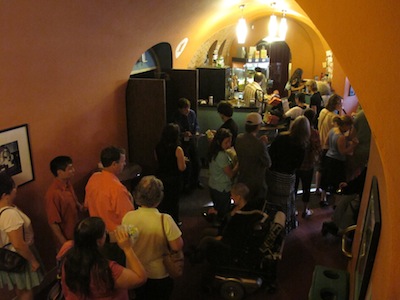
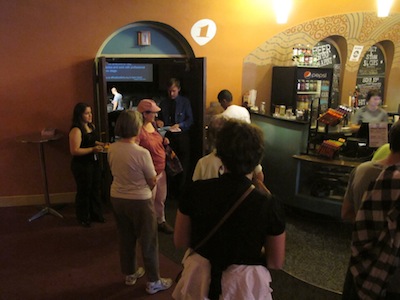
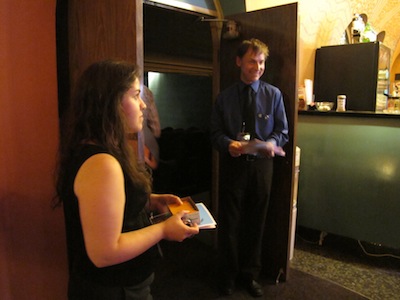
The concessions area formed a sort of airlock between the front doors and the doors to the auditorium. As attendees passed through, an OIAF volunteer kept count using a tally-clicker. It's difficult to track attendance when some people just have to wave their badge. This solves the problem elgantly.

30. ByTowne auditorium

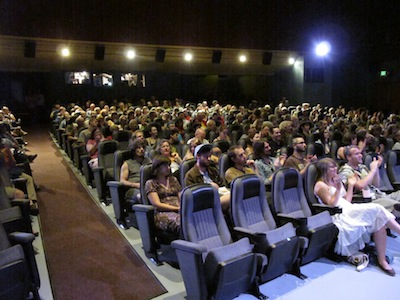
The ByTowne has a single large auditorium. It's similar in size and flavor to Portland's Cinema 21, so I'm guessing it has roughly 500-600 seats.

31. Feature Competition I audience at the ByTowne

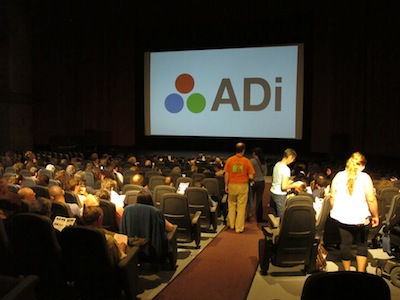
Prior to the start of the show, there was a pre-show reel. Mostly it contained stills from various shows in the festival — in effect, advertising the festival itself. There were also a few advertisements from sponsors. One of these was animated; appearing amongst still images, it was a rather jarring effect.

32. Chris Robinson's speech at the opening ceremonies

Chris Robinson took a very low-key approach to kicking off the festival. No pomp and circumstance, no statements of grand ideals. Very much one peer speaking to others. His choice of costume — a casual short sleeved shirt and jaunty hat — added to this impression.

33. merch table at the ByTowne

On the way out of the theatre, there was a merch table where you could purchase odds and ends. Tables like this were present at all of OIAF's venues.

34. line for re-entry

The auditorium gets cleared between shows. Given the length of the line to get back in for the next show, there's a strong incentive not to lollygag. If you don't get yourself out of the room quickly, you're going to find yourself halfway down the block.

VII. NATIONAL GALLERY

The National Gallery is large, beautiful art museum. I didn't have time to go see any of the exhibits — but I did see several films in its big, modern auditorium.

35. National Gallery

The National Gallery is maybe a 10-minute walk from the Arts Court, or 15 minutes from the ByTowne. I'd be a little winded from speed-walking to get from one place to the other — but I never had any trouble getting into a show and finding a decent seat.

36. Maman sculpture

There's a remarkable sculpture of a giant spider just outside the National Gallery titled "Maman." A nearby plaque says this about it: "Maman, the giant egg-carrying spider, is a nurturing and protective symbol of fertility and motherhood, shelter and the home. With its monumental and terrifying scale, however, Maman also betrays this maternal trust to incite a mixture of fear and curiosity." It seems to me a very daring piece, which in itself says something about the cultural life of Ottawa as a city.

37. ticket/merch table at the National Gallery

The OIAF's "Festival Reader" includes names and photos of event staff. Using it as a reference, I could tell that the blonde woman at the merch table was Technical Coordinator Keltie Duncan. I would like to have had a chance to query her about details of running the festival, but the opportunity never seemed right.

38. National Gallery auditorium

The National Gallery's auditorium is huge, and has a fairly steep rake. The upholstery of the seats and the carpeting all seem quite new. I'm guessing there may be 1000 seat in the room.

39. National Gallery audience for "The Making of Le Tableau"

The same pre-show reel screens at every venue. When the show starts up, there's a clip that lasts maybe 60 seconds acknowledging the festival's sponsors. I was surprised by how quickly the names appear and disappear — no more than 2 seconds given to each. I suppose that when the clip is repeated so many times throughout the week, no one's going to complain too much about brevity. Plus, with so many sponsors to mention, you really do have to rush — or else people will quickly get antsy for the show to start.

40. director Jean-Francois Laguionie and translator

The first show I saw at the National Gallery was "The Making of Le Tableau," in which the director of this feature film showed concept art and clips from its development. Director Jean-Francois Laguionie is French and needed some assistance from a translator. During the course of the week, it became very apparent that there is a wide range of skill levels amongst translators. One or two switched between languages with fluency — but I'd say the majority struggled from time to time, trying to find the right words. (One poor soul was truly flummoxed by the task, which raised audible audience ire.)

41. Christie projector

Again I poked my head into the projection booth. Christie is a very high profile brand of digital projector. The National Gallery's projectionist told me that the company provided several projectors this year. They gave essentially flawless performance, so far as I could tell.

VIII. EMPIRE RIDEAU

The Empire Rideau theatre is housed within the Rideau Centre, a large maze-like shopping mall in the heart of downtown Ottawa. Being a typical cineplex, it's easily the least interesting of the festival's venues.

42. Rideau Center

The Rideau Center seems to take up several city blocks. Finding the movie theater inside there took a little doing the first time.

43. escalators up to the Empire Rideau

Did I mention that this mall is also four stories tall?

44. Empire Rideau theatre

The Empire Rideau has several auditoriums — but OIAF was only using one of them. Some patrons were showing up to see Hollywood fare, completely unrelated to the fest.

(I have to say, it felt a little odd to be watching indie films in such a mainstream venue.)

45. OIAF table at the Empire Rideau

Again, there was an OIAF table up front.

46. concessions/lobby at the Empire Rideau

I'd estimate that this auditorium has about 250-300 seats.

47. Empire Rideau auditorium

I noticed that the edges of the image in the pre-show reel were cut off. I think I recall hearing that only 3 out of 5 venues were using Christie projectors... If that memory is accurate, perhaps this auditorium was using a pre-existing projector arrangement?

48. pre-made sandwiches

One excellent discovery I made at the mall: pre-made sandwiches. There was a sort of grab-and-go deli on the ground floor selling various flavors of sandwiches in plastic wrap. When you're running across town, trying to get to the next show on time, having a few of these in your shoulder bag can be a real life-saver!

IX. NATIONAL ARTS CENTRE

The National Arts Centre is the grandest of OIAF's venues. I hear that the building was closed for renovations for a few years, and that OIAF is just now getting back into the space. It has smaller auditorium and a larger auditorium. The big one is where the closing "Best of the Festival" show took place.

49. National Arts Centre

Situated on the edge of a canal, the National Arts Centre building is a gorgeous sight.

50. NAC entrance

To get to NAC's entrance, you go down a story from where you were when crossing the nearby bridge. Despite being in the middle of downtown, the entrance feels tucked away.

51. NAC lobby area

The lobby is long and has low ceilings. When people would queue up for a big event in the main theatre, the line would snake far down this passage and loop back around.

52. NAC sculpture / water feature

At one end of this lobby space is a sculpture and water feature. The "AniMarket" clusters around this area. From what I'd read, I expected the AniMarket to have dozens of vendors — like one might see at a comics convention. Instead, there was a motley gathering of perhaps eight tables: a few animation schools, Wacom tablets, Disney reviewing artist portfolios, an animation software company...

53. Aniboutique at the NAC

With the AniMarket opening Friday night, OIAF's own Aniboutique switched spaces. It seemed like there were a lot more items over at the Arts Court Studio; here, OIAF staff somehow managed to fit all the DVDs into a single glass case, and the books onto one table. I think the DVDs for sale were primarily items carried by Animation World Network — I didn't notice individual animators bringing in DVDs, trying to sell their own films.

54. animation school representatives

It's increasingly clear to me that there are just a handful of animation schools with an international reputation. Supinfocom (France), National Film and Television School (UK), and Tokyo University of the Arts (Japan) were all featured in a special "School Competition" block of films... But they didn't send recruiters. I spoke to a representative from Vancouver; she says that the students there are putting out top-notch work, but word hasn't reached festivals yet. I'm interested to find out more.

55. Ralph Bakshi's table

Ralph Bakshi (of "Fritz the Cat" fame) was a featured speaker at the fest. He had a table in the lobby/AniMarket area where his son was helping to sell cels and other original artwork. This table seemed most akin to comic con culture.

X. NAC STUDIO

The Studio was NAC's "small" auditorium — I'd still guess that it had 350+ seats.

56. NAC Studio audience

Programming for this space focused on panels and presentations having to do with career development. Due to scheduling conflicts, I was only able to sit in on two partial workshops. Once again, I felt that panelists are prone to making off-the-cuff pronouncements... And then the one speaker who I saw doing a solo presentation seemed to rely perhaps too heavily on video clips.

57. NAC Studio speakers

Maybe I'm being unfair. Perhaps the intellectual in me is hoping to hear academic papers? Or perhaps the opposite: practical hands-on how-to workshops? I'm not sure what I really think yet, except that I walked away with a vague sense of dissatisfaction.

XI. NAC THEATRE

The National Arts Center Theatre is big — but not as huge as I thought it might be. It's a little bigger than the Newmark Theatre at the Portland Center for the Performing Arts — but a little smaller than the Arlene Schnitzer concert hall.

58. NAC Theatre

Some of the competition screenings were identified as "galas." I gather that these were the ones where filmmakers would be in attendance. I prioritized gala screenings, so I'm not entirely certain how much the non-gala competitions differed.

At my first gala, I was surprised by how the show comes to a stop between films, a live announcer reading off the title and director for each film over loudspeakers. If the director was available, the lights would come up briefly after the film ended, the artist standing up from where they were seated to receive applause.

Having a live announcer really helped distinguish the experience from simply going to a typical movie at the cineplex. It may have also played a practical role. OIAF continues to screen some 35mm prints; having a pause in the program probably helps smooth the transition between films. (I expect this was even more important in the past, when celluloid was the norm.)

59. NAC Theatre

I said that the Christie projectors' performance was flawless... But there was one tiny technical issue that occurred during a screening at the NAC Theatre. When the screen was dark, a few little white points would appear randomly. My own guess is that the problem had to do with interference in the cables somewhere — but there's no way to know.

Hisko Hulsing, both a juror and director of "The Junkyard", commented publicly that the colors of his film had been washed out — that we hadn't seen a true reproduction of the work. I seriously wonder, though, if there's an unfair comparison being made between what can be accomplished on an LCD computer screen vs. throwing light across a room onto a giant screen.

60. One-on-One with Ralph Bakshi

I asked Chris Robinson what he considered must-see at this year's fest. He recommended the "One-on-One with Ralph Bakshi" interview, saying that sparks might fly — so I gave this featured event a whirl.

I respect Ralph Bakshi's contributions to animation; I'm neither a serious fan nor a detractor. Several of Bakshi's feature films were screened during the week — but on principle, I skipped any screening that I could either see in a mainstream theatre (e.g. Hotel Transylvania) or rent at home (Fritz the Cat). So Bakshi's work was not especially fresh in my mind during the interview. I got the impression that this is someone who has spent a lifetime being scrappy and managing to make passable art without waiting for big budgets to fall in his lap... Someone who feels they're making important social commentary about class disparities in the USA. Perhaps this interview was an apt centerpiece for the festival; but because I didn't prioritize Bakshi's films, much of the meaning was probably lost on me.

61. Shorts Competition jurors announce winners

One thing I'll say for the NAC Theatre: it really added a sense of grandeur to the final "Best of the Festival program." Environment matters!

62. emcees Joel Frenzer and Alan Foreman

Yet, this awards show was a curious animal. With many awards to hand out, there was a bit of a rush to keep the program moving. It was unrehearsed, so the jurors seemed a little uncertain at times about which one of them should be at the microphone to speak — or for that matter, what needed saying. As emcees, Joel Frenzer and Alan Foreman (who host an animation podcast) did some light comedy between segments. Having met them, I think they're both very nice people... Yet, there's something about these segments that didn't seem to quite fit. I'm having trouble putting my finger on exactly why. Clearly every film award ceremony follows in the shadow of the Oscars... Perhaps I'm just picking up on the dissonance between animators pantomiming glamor and the reality of just how socially awkward most of us are.

63. Kids Jury

Films for kids were judged by kids. Neat idea. Unfortunately, a horrifying gender dynamic played out. Upon reaching the stage, the young boys immediately made a grab for the two cushy interview chairs, and put on appalling airs of superiority towards the girls. I have some interest in trying a youth jury in Portland — but the way the boys reacted to being in the spotlight now sounds a note of caution in my mind.

64. award winners projected on screen

I don't recall any film clips being shown during the awards ceremony — but there were slides that displayed the names of the winners. When I was planning out my schedule for the week, I wondered why there weren't any re-screenings of the competition programs on Sunday. Now I realize that all the competitions had to be juried by the end of Saturday in order to leave time for preparing Sunday's show. I hate to imagine being the person who had to put all the slides together the night before!

65. Rob Shaw accepting award for Zero Rats

It was a proud moment to see Portland's own Rob Shaw accept an award for his "Portlandia 'Zero Rats'" segment. Rob hired me for my first professional animation gig at Bent Image Lab some years ago. He does very clever work, and I'm glad to see him receive recognition.

66. OIAF Award

Each of the OIAF awards is a unique sculpture created by a local artisan. I have mixed feelings about this. On the one hand, the creativity inherent in making unique awards is laudable. On the other hand, when the awards all have a single design, I think it helps an animator feel like they are joining a long line of winners, joining a heritage. Formality enhances tradition, whereas the whimsy of one-of-a-kind awards undermines that sense of venerable membership.

XII. OIAF PICNIC

Now that I've covered all five screening auditoriums, I'd like to review some peripheral locations... Beginning with OIAF's famous Animator's Picnic.

67. bus to picnic

Free busses cycled back and forth between the Arts Court and the picnic area.

68. picnic tent

The picnic tent, set up in a nearby park, was huge. It was a sort that I've seen used by colleges at outdoors graduation ceremonies.

69. Cartoon Network sponsorship sign

Cartoon Network sponsored this event. As usual, there was a sponsorship sign on a tripod at the entrance.

70. picnic tent interior

The combination of rain outside and free lunch inside made for a very crowded tent.

71. free lunch

The buffet tables were arranged in a long line down the middle of the tent. There were vegetarian options — but they weren't clearly labeled, so I was left to guess. Ample garbage and recycling bins were provided.

72. pumpkin carving

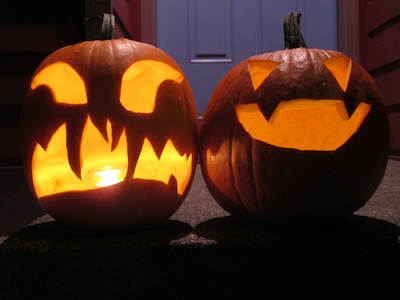
The highlight of the picnic is the pumpkin carving contest. It was mostly college students doing the carving — I'm not sure I saw anyone else make a submission. I can't be sure, but I think most of the participants were part of a group that bussed up from the Rhode Island School of Design.

73. pumpkin carving contest lineup

The buffet was cleared and pumpkins were arranged for judging. I'm including photos of several below. With regret, I don't recall which one was the winner.

74. ferris wheel pumkin

75. pumpkin matrix

76. smoking pumpkin

77. pumpkin birds

78. "Monster of Nix" pumpkin

79. pumpkin mask

80. pumpkin carving contest winners

Brooke Keesling from Cartoon Network gave out DVDs as prizes to the contest winners.

XIII. HARD ROCK CAFE

The Opening Night Party was held at the Hard Rock Cafe.

81. Hard Rock Cafe

Passholders received coupons for free drinks, which were slipped into our festival badges at registration. Limitations were set on which types of alcohol you could order — just the basics. Still, free drinks are a great way to get the party moving.

82. view from Hard Rock Cafe staircase

I bumped into Shu Zhang again, and she introduced me to a few people — taking an active role in helping folks mix. (Thanks Shu!)

83. karaoke: "I like big butts..."

The RISD students were really getting into karaoke upstairs. One woman sang an energetic a version of the "I like big butts" song that blew the crowd away.

84. shirt over the head — this is a thing?

And then there was this guy. Jumping around with your shirt over your head is a thing now? The segments of the portable stage began to come apart, and the karaoke TV monitor wobbled dangerously. Our moderator, a drag queen in a purple rubber wig, had to gently bring this behavior to a halt.

XIV. RITUAL NIGHTCLUB

Reviewing the schedule, I realize there was an alcoholic opportunity at the close of every night during the festival.

85. Ritual Nightclub

Hard Rock cafe had karaoke, a bar, and booths where you could get some food. In contrast, Ritual Nightclub was much more of a dance club.

86. dancing at Ritual

The dance floor was quite crowded. I made the mistake of setting my coat down for a while. When I came back, someone had stolen my business card holder. Most likely they thought they were getting my wallet — so I got off lucky. I saw a young woman in tears, talking to the fest organizers, who may have had a more significant loss. (If I ever try to host something like this, I'm going to need to think seriously about what security should look like.)

XV. SALON DE REFUSES AT CLUB SAW

Club Saw is physically connected to the Arts Court — though I don't know of any indoors passageway between the two buildings.

87. Club Saw

This was the site for "Salon de refuses" — a screening of some of the better films that didn't get into the fest. How were they chosen and who compiled them? I wish I knew — it's a rich concept. All I do know is that Laika sponsored the event.

88. Laika sponsorship sign at "Salon des refuses"

From what I gather, "Salon de refuses" has been going on for at least a few years. Chris Robinson introduced the event, and commented that it was his first time attending... Kind of a strange experience for him, being the the very person who does the refusing.

89. "Salon des refuses" at Club Saw

There was tiny moment of drama. Chris mentioned some topical political absurdity going on in the USA (remember, this was during the lead up to the elections)... On this cue, a group of students in the back of the room — the same ones who had sat behind me, talking through the films of the last screening — started bleating "You Ess Ae! You Ess Ae!"

90. Chris Robinson introduces the "Salon des refuses"

I despise jingoism. Quite out of character, acting on an unsuspected instinct... I flipped them off from the front of the room. Which took Chris quite off guard and made him crack up, so he couldn't finish his introductions. He came down from the stage to chat with me, still laughing. Nice moment of conection. Unorthodox international diplomacy — but hey, if it works...

XVI. EPHEMERA

To wrap up, I wanted to document some ephemera associated with the fest.

91. Festival Guide and Reader

Ottawa produces a "Festival Guide" and a "Festival Reader." Both contain the schedule and event descriptions. The Guide is newsprint — which is presumably inexpensive, being left out as a freebie at various venues. (I'm curious to know how many copies were printed, and where all they were distributed.) The Reader is glossy and has a spine like a paperback book. It comes along with a festival pass. Purchased on its own, it's $20. Unlike the Guide, the Reader feels like a keepsake. It also contains contact information for every filmmaker in the festival — which is a very valuable resource to a another fest director, such as myself.

92. signal film painting by En Masse and See Creature

In addition to the pre-show ads and the animated sponsors clip, there was also a "signal film" that acts as a sort of "station identification" for the festival. This year's signal film evolved from a group painting created by the groups En Masse and See Creature.

93. painting detail

The original painting hung in a small gallery space in the Arts Court.

94. poster on a light post

There were four different posters for the festival. I saw a few around town on lamp poles and in shop windows. Nice bright colors really make a difference.

95. OIAF flags

I also saw some OIAF flags in one or two spots around town. I'm not sure whose property they were on, or what the arrangement is that allowed this display. It seems similar to how Portland sometimes hangs banners on its lightpoles for marathons and the like. (I have no idea how those permissions work, either.)

96. flyers on tables at the Arts Court Studio

OIAF organizers weren't the only ones creating ephemera. Filmmakers, schools and vendors also brought flyers along to scatter across flat surfaces.

97. Smoke's Poutinerie

A form of ephemera that has almost nothing to do with OIAF... Poutine! I definitely wanted to try some of this Canadian favorite while in Ottawa. I'm glad I did so on my first day there, while there was some free time to explore. It couldn't have happened at any other time. I overheard some people talking about going to restaurants for meals. There were no meal breaks in the schedule — I can't imagine how you could go eat somewhere special without missing big chunks of the fest.

98. Poutine!

The trip to Ottawa served the function I'd hoped for. I feel like I've returned home with a much broader literacy about animation festivals in general. I'm charged up with ideas for how do better event organizing — with a particular interest in expanding and continuing to develop the Northwest Animation Festival.

Thanks again goes to the Regional Arts & Culture Council for its marvelous support!

posted by sven | permalink | comments (1) | categories: exhibits & events

January 14, 2013

staged reading: March

by gl. at 2:03 pm

i'm directing a staged reading for fertile ground! it's a play at the intersection of art and science, one of my favorite places. it's a complex script with a strong female protagonist created by a female playwright.

--

MARCH by Kate Belden
Sunday, January 27, 2013 • 1-3 p.m.
Hipbone Studio: 1847 E. Burnside Street #104
$10

Margery Dawson is a neuroanatomist, a PhD in how the brain works. But hers isn't. Hers is having a stroke. And though she's too busy to have one, and certainly too busy for history, family, or a relationship, all of them are happening. Right here, right now.

Described as fugue for three voices, MARCH is a play that looks at an experience as the brain does. Seemingly disjointed, but perhaps the most accurate description of what truly happened.

--

and this is the video that inspired the play!

posted by gl. | permalink | comments (5) | categories: other art

December 25, 2012

warmest winter wishes from scarlet star studios!

by sven at 6:00 am

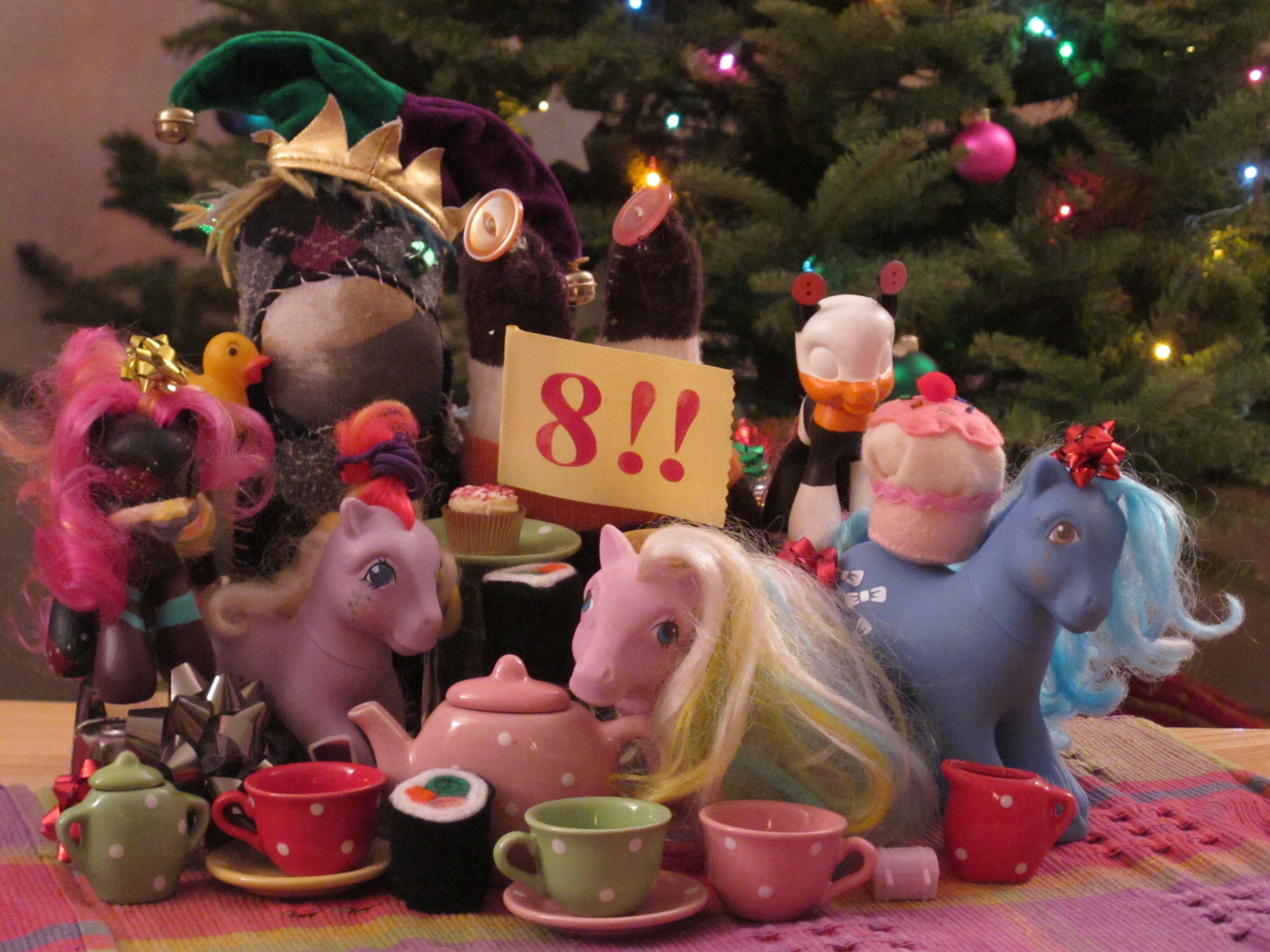
We have an unexpected addition to our tree this year...

It began with a terrible storm that downed the giant butterfly bush in our backyard.

From inside its branches, we salvaged the robins' nest that birds built this past summer.

With a big gap in the middle of our branches, we knew just where to put it.

But what's this?

An errant writing mouse from Halfland has moved into the nest!

As the world gently tips, beginning our journey back toward light, we send you our best and brightest wishes…

(Thanks Shelley!)

posted by sven | permalink | comments (2) | categories: miscellany

December 24, 2012

toby's christmas miracle!

by sven at 10:00 am

click on image to play film (3:35min - 12.4 MB)

A Scarlet Star Studios Christmas tradition…

The classic musical comedy which has delighted and enraptured children around the world...

Featuring the most beloved five-armed sock creature of all time: Toby!

...It's TOBY'S CHRISTMAS MIRACLE!


(Also available on YouTube.)

posted by sven | permalink | comments (1) | categories: toby

September 11, 2012

review: best of the nw animation festival 2012

by sven at 1:28 pm

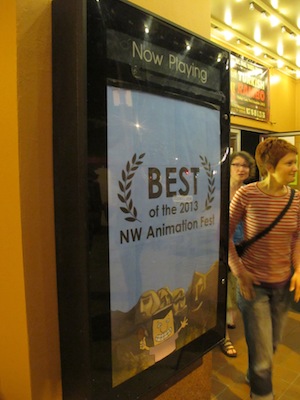
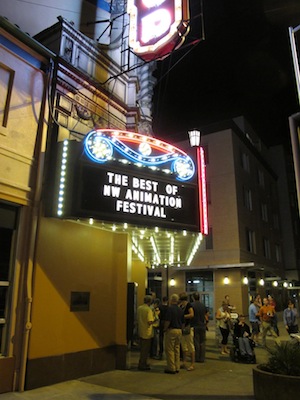
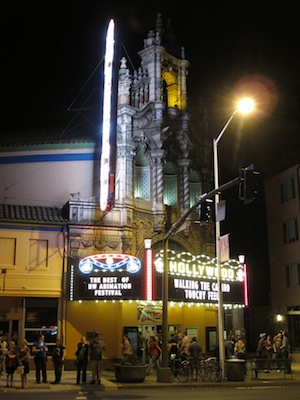
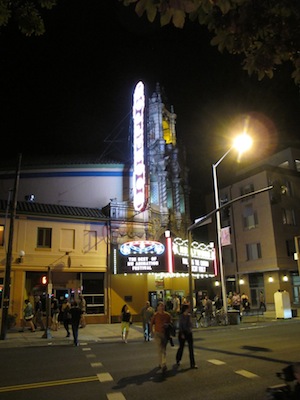
1. Hollywood Theatre

This past Sunday's "Best of the Fest" show went quite well.

I work hard to make sure every show is better than the last. Here's how we grew this time around:

  1. attendance
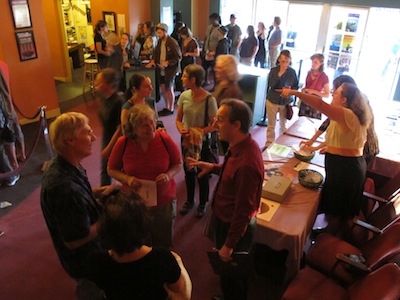
    By my count, we filled 196 seats. I believe this is the largest turn-out we've had to date. That's 171 paid tickets, 14 guests, 10 event staff, and 1 theater representative. I've estimated our NWAF12 shows in May at roughly 200 attendees each night. However, the exact numbers are uncertain. Friday and Saturday ticket sales were 129 and 140 — but we had much better guest turn-out than this past weekend. An improved guest book system means that that the head count this time around is much more accurate.

  2. blu-ray projection
    This was our first time projecting from Blu-ray. Whereas a pro-level computer-driven playlist introduced minor static between films at NWAF12, using consumer-grade discs on a lowest-common-denominator technology provided a seamless stream. The Hollywood Theatre's digital projector has a maximum resolution of 1280x1024, which means anything larger than a 1280x720 Blu-ray is overkill, anyway. After much research, I believe I've also found the best solution for converting 25fps films to a 24fps standard. From a technical standpoint, this was our most flawless presentation of films yet.

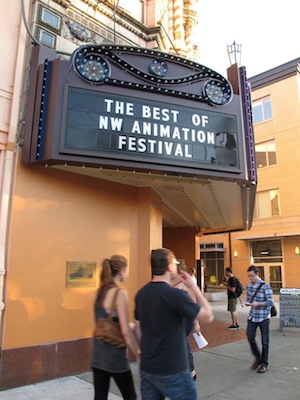
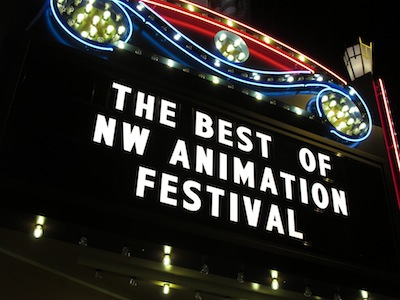
    2. Hollywood Theatre marquee


  3. community partners
    In an effort to reach new audiences, I made cross-promotional deals with 11 arts organizations and 4 film festivals. I provided screen ads in exchange for mentions in newsletters and social media. The number of attendees garnered from any one deal was in the single digits. Yet, based on the size of these mailing lists, we probably reached more than 10,000 people who hadn't previously heard of NWAF.

  4. Hollywood Theatre collaboration
    This summer Justen Harn from the Hollywood Theatre approached me with a proposal to form a closer relationship with the venue. Instead of paying 100% of rent up front, we get the space for free and split ticket sales 50/50. Given that 2hours in the main auditorium now costs $800, not having to worry about breaking even was a huge relief. (The new relationship also paves the way for a much bigger event in 2013).

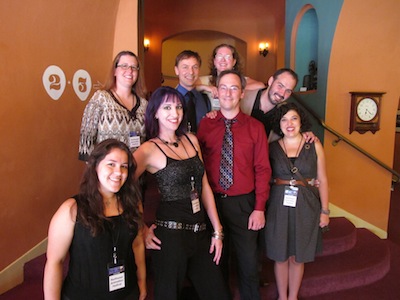
3. Event staff: (front, L to R) Carly J. Cais, Temris Ridge, Sven Bonnichsen, Gretchin Lair, Becky Steele; (back row) Danie West, Nick Doggerpuss Nall, Brad Bolchunos, Christina Beard, Bill Womack


Ten people were on the event staff: Christina Beard, Brad Bolchunos, Carly J. Cais, Gretchin Lair, Nick Nall, Temris Ridge, Becky Steele, Danie West, Bill Womack and myself. It's a large team — but I've learned that simultaneously losing three people to personal emergencies is a very real possibility — so I lean on the side of safety.

We gathered at Magnolia's Corner immediately across from the theatre at 5:30pm. I should have allowed more time. The wine bar is typically staffed by the owner, and only has one stove. We needed more time to get everyone fed and get bills paid. We wound up heading over to the theatre at 6:15, and had very little time to get oriented before the audience started arriving.

Awkwardly, I had to be watching through the window at Magnolia's to see when info table staff from other organizations arrived. I needed to leave my food and cross the street to welcome them and help set up. Next time around I either need to keep someone posted at the theatre from 5:30 on — or I need to dictate that tablers have a specific time window in which to set up.

4. event staff clipboards


At NWAF12 I started giving everyone on the event staff a clipboard of their own. Everyone needs a "reserved" sign for their seat, a schedule and a program of films. Certain roles (Lobby Leader, Guest List, Front Door) get additional handouts. The clipboards are a good way to bind all these papers together — and help make the staff feel like they've got authority.

I improved on the clipboard concept this time by also giving each volunteer a written description of their responsibilities. I think this is going to be important at NWAF 2013, when I have to find volunteers to cover three days. It's very likely that I'll accidentally neglect to give someone an orientation. The written description should help get people up to speed if I'm absent.

The one hitch was that people didn't have enough time to read the descriptions thoroughly when we got to the theatre. I should have handed them out when we were still at Magnolia's Corner, and done Q&A while people ate.

Another tweak was that I gave each volunteer a sign with their name on it for claiming their seat (rather than just a "reserved" sign). This made it much easier to give each person the appropriate clipboard. However, it would have been smart to also label the clipboard itself, since there were a number of times when one was left lying on a table and it wasn't obvious who it belonged to.

It would have been nice to provide "reserved" signs for the info table folk as well. Telling them how many seats are reserved for each organization might be a diplomatic way to clearly limit how many volunteers each brings along.

5. the line to get into the theatre


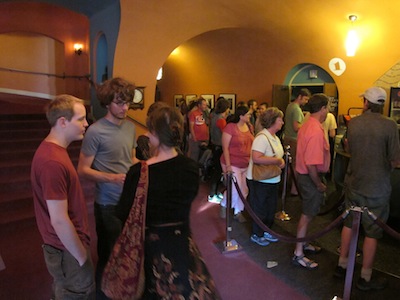
At Best of the Fest 2011, we had a long line waiting to get into the show and had to start 15 minutes late. That hasn't been a problem since. Why? Were the doors locked last year until a certain time? Were people just exceptionally tardy, arriving at the last minute? I'm not sure. Whatever the case, we had no troubles with lines this time, and started only 5 minutes past showtime, allowing for stragglers.

6. Christina Beard welcomes attendees


At NWAF 2012 we had two volunteers staffing the door... Unfortunately it felt a little like they were guarding the doors rather than welcoming people in. This time we only had one person out front, and that was plenty.

7. purchasing tickets at the box office


At NWAF 2012, spare volunteers had a tendency to clump in the lobby, talking to each other. It impeded traffic and didn't look professional. So this time I specifically asked people to avoid doing this, and to seat themselves out of the main flow if they didn't have anything to do. That problem was largely solved.

There was still more wandering than I would have liked, though. Back in January — when we were having a technical crisis at Portland Animation Now! — I physically walked volunteers to their post and told them to be "locked down" there. If we have adequate orientation time next year, it would probably be a good idea to do a similar "locking" process again.

8. lobby as people are arriving - concessions


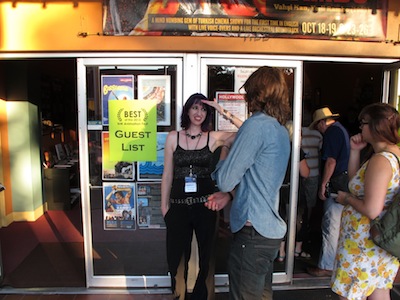
My back-up people were most likely to come out from the auditorium to check if they were needed. I should define their station better. Temris needed to abandon her post with the guest list in order to help ASIFA bring in T-shirts. That revealed a flaw in the "written responsibilities" plan: Gretchin hadn't been briefed about the Guest List position and was unclear about how to take over. Someone from the Hollywood Staff told Christina she should come inside — probably because they were trying to be kind, not because she was doing anything wrong — and I wound up sending her back outside again.

I want to be very clear that my staff are in no way at fault for moving around! My goal is simply to record these movements, so I can find ways to further minimize chaos as the event grows larger.

9. lobby as people are arriving - info table


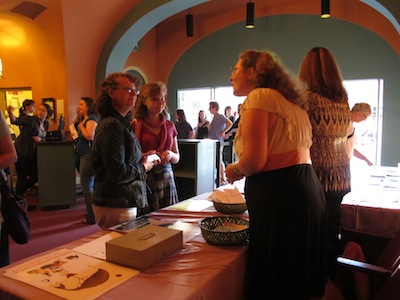
Since moving to the Hollywood Theatre, I've invited ASIFA-Portland to have an info table at each event, hoping to help independent animators connect to an organized community. Having just one organization in the hallway between the auditorium doors seemed a little... sad. This year, with so many more community organizations involved, I was able to squeeze five groups in: ASIFA-Portland, Cascade ACM SIGGRAPH, the Oregon Cartoon Institute, Portland Open Studios, and Schools and Arts Together. I haven't had a chance to debrief with the people who tabled, but it certainly presented a more lively impression.

10. Anne Richardson and Carye Bye representing Oregon Cartoon Institute


11. Wendy Robinson of Portland Open Studios


One thing I didn't foresee was that info table folk would want to be handing out flyers for their own events. One of my staff alerted me that another org's volunteer was blocking attendees' path, handing them flyers as soon as they'd purchased their tickets. I can't fault his zeal — but asked the fellow to move back to the hallway so people could move through freely. Now I know to set clearer boundaries about where tablers are allowed to interact with attendees.

12. Temris Ridge laying out programs at the guest list table


We had one door marked for people with advance tickets or buying tickets, and another door for folks on the guest list. At previous events, guests would say their name aloud and our volunteer would cross their name off a list. It was awkward, because you can't always intuit how a name is spelled — and if the line is busy, it's easy to miss crossing someone off. So this time I simply had the guest list laid out on the table and told Temris that the job was to make sure everyone coming through signed their name. I think this worked out much better. It also made it easy for me to pop over to the guest list table to see who was in the audience that I might have missed coming through.

The one problem that needs to be solved here is that a surprising number of people show up after the show starts. If my volunteers are in the auditorium watching films, there's no one to collect signatures, and I don't get an accurate head count. I don't really like the idea of keeping someone out in the lobby. I might be able to coordinate with the Hollywood Theatre staff at the box office, asking them to collect signatures. (I give them a spare copy of the list anyway.)

Previously I've only put people on the guest list if they sent a RSVP. Having discovered that many folks can't commit until the last minute, this time I said RSVPs were appreciated but not required. About a third of invitees RSVP'd "no" (due to other obligations), a third said yes, and a third didn't reply. Much to my surprise, only half of those who said yes actually showed up. We didn't see anyone showing up who hadn't RSVP'd. What I take from this is that I can afford to be pretty generous with sending out invitations; it spreads a lot of good will without necessarily eating up a lot of seats.

13. Gretchin Lair, Temris Ridge, Nick Nall — and popcorn!


Gretchin had a great idea that I'll be repeating at future events. It occurred to her that event staff never have a chance to go through the concessions line to get popcorn. Our runner, Nick, didn't have anything to do just then, so she sent him around to take orders. Brilliant! It was a lovely treat this time around... Having a "Food Runner" who can go out to grab food at the nearby fast food restaurants will be even more important in 2013, when volunteers are hunkered down for 3 days.

14. Demetra Arnett (SIGGRAPH) and Danie West (NWAF) at the doors to the auditorium


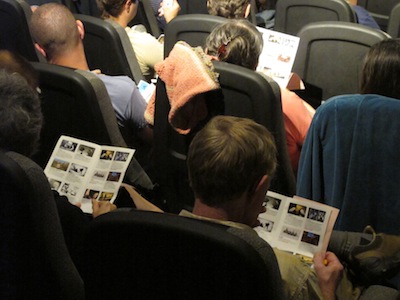
At NWAF12 we had gorgeous programs printed by Morel Ink. This time around, my timeline was too tight to work with a professional printer, so I reverted to using the color laser printer in our office. I habitually print too many programs. I intended to only print 200 this time, figuring that people tend to share. At the last minute I lost my resolve and printed 275, just to be safe. I shouldn't have second guessed myself!

After the cost of space, programs are one of the biggest expenses associated with running the show. Trying to figure out what I'm spending on ink cartridges, internet research suggests we're looking at at least 15¢ per page. So it seems that programs cost at least 60¢ apiece (probably more, given how many photos I include) — $165+ in all. At this point in NWAF's development, that's not small change.

Even so, I feel it's important to have some sort of archival document of the program... Much like a museum catalog when you go to an exhibition. Larger festivals sell book-like programs separately; I don't think we've reached that point yet.

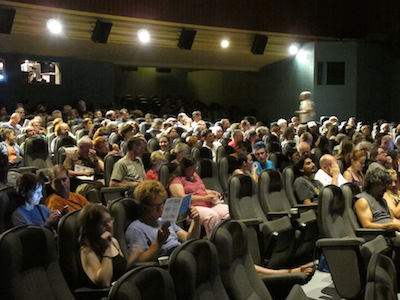
15. the audience beginning to fill the auditorium


In the auditorium, we had a pre-show reel of ads from our sponsors and community partners playing on repeat. The theatre has a separate, smaller projector that they use for just this purpose, which makes it easy to start the film program without switching settings. However, after the show I realized that it's entirely possible to have both the films and the ads formatted at 1280x720 — so next year I could perhaps offer advertisers higher resolution.

Some of the artwork I received went right up to the edges of the screen. It didn't occur to me that most people have never heard of TV-safe areas. I suspected (and had my fingers crossed) that projectors don't have the same issue as televisions. Happily I was right — none of the artwork got cut off.

To keep things interesting for the audience, for every five advertisements I included a still image from one of the films. Thinking that people would be more likely to look at the screen when a picture was up, I privileged sponsors by making sure they were the next thing to come on screen each time.

16. welcoming the audience


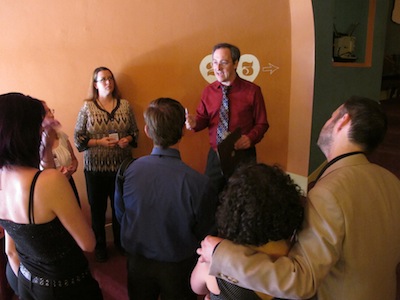
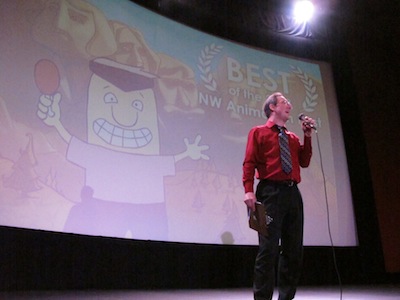
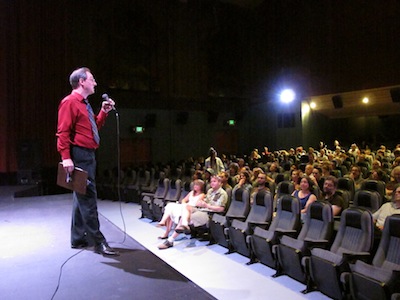
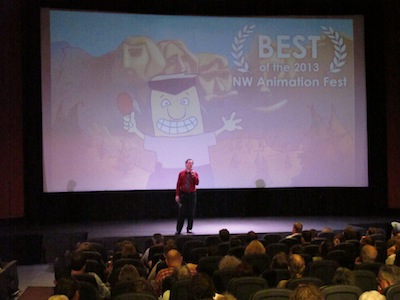
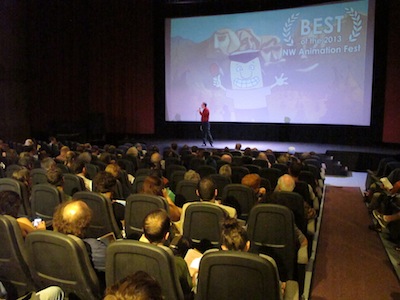
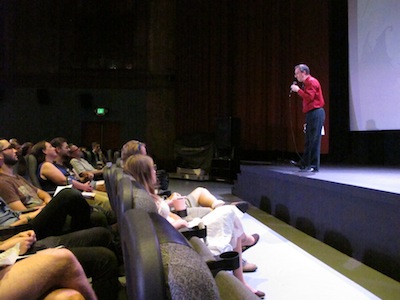
Event staff spent 50 minutes in the lobby greeting and helping audience members as they arrived. Then, at last, it was time to start the show. I warn our projectionist, Matthew Combs, then stride down to the front of the house. He brings up the lights on the stage...

At this point I'm reasonably comfortable with talking to 200 people. What works for me is to think of them as all being friends, with whom I'm having a casual conversation about something we're mutually interested in. At the same time, I also enjoy throwing in a bit of showmanship, starting with "Welcome to the Best of the Northwest Animation Festival!" in my most resonant voice.

My main agenda is to shape expectations for the evening by walking through the schedule of events. Chronology is the mneumonic for my speaking points. I try to keep it short and sweet — but inevitably someone opines in the post-show survey that the talking should be even shorter. I think no matter how tight I keep it, some would prefer that I simply not exist, and that this experience be identical to attending the cineplex.

17. introductory comments


I'll skip transcribing my utilitarian introductory remarks... Instead, here's the text I wrote for my "from the director" statement in the program.

Welcome to the Best of the 2012 Northwest Animation Festival!

Tonight you are going to see sixteen amazing films from around the world. Out of this year’s 177 submissions, we screened 57 at our big festival in May. Through filling out surveys, you the audience told us which ones were your absolute favorites.

This will be our first show projected from Blu-ray. There are significant challenges in compiling films that were created with different specifications in mind. After a great deal of research and testing, I am pleased to say that we now have the very best picture quality that can be produced using the Hollywood’s current technologies.

The Hollywood is a very special theatre, with a staff committed to preserving and restoring this historic building — while also hosting innovative and original film programs. I want to personally thank Justen Harn and the Hollywood staff for offering the NW Animation Fest special support. I encourage you to help them in return by becoming a theatre member or donating to the current marquee upgrade project.

Because of our new relationship with the theatre, I am excited to announce that the festival will enjoy a major expansion in this upcoming year. Please join us on May 17-19, 2013, for three nights and two days of animated films!

Anticipating a program of more than 125 shorts, we believe this will be the largest animation showcase west of the Mississippi, and the second largest in the nation. At the same time, we’re casting a wider net than ever before to make sure that our selections remain the very best the animation world has offer.

Much exciting stuff to come... Now, let’s watch some films!

Sven Bonnichsen
NW Animation Festival


18. Keith Daly from Schools and Arts Together!


Several of the community partners in the screen ads are groups that I've connected with through the new Portland Emerging Arts Leaders group. One of these connections is Keith Daly from the Schools and Arts Together! campaign. I like the cause, and Keith is a good public speaker, so I decided the right thing to do would be to give him 2 minutes before the show to address our audience.

19. explaining the need for Ballot Measure 26-146

In a nutshell, here's the issue: Portland is renowned as a community for creatives. However, in recent years we've lost a startling number of arts teachers. Whereas 94% of elementary schools in the US have music education, Portland is now down to 58%. Whereas 83% of US schools have visual arts education, Portland is now down to 18%. Schools and Arts Together is promoting Ballot Measure 26-146, a limited tax (~$35 per adult resident) that would help hire arts and music teachers for Portland Public Schools.

I very much think of animation as an art form. And I see all art forms as being interrelated with one another. So while this is not specifically about animation, where I should stand on Ballot Measure 26-146 is a no-brainer. Beyond the issue itself, though, giving Keith the stage is in sync with my goals for what the festival should be. I want NWAF to be understood as a community gathering. Using this opportunity to talk about an issue that's taking place outside the four walls of the theatre helps create that feeling.

20. audience as seen from the stage


By my watch, it was 8 minutes from when I first strode toward the stage to when the films were on screen at 7:13pm. Not bad, I think.

Here's the line-up of films we screened:

  1. The Maker
    by Christopher Kezelos
  2. A Morning Stroll
    by Studio AKA
  3. Bottle
    by Kirsten Lepore
  4. The Fantastic Flying Books of Mr. Morris Lessmore
    by Moonbot Studios
  5. How to eat your Apple
    by Erick Oh
  6. L'Animateur (The Animator)
    by Nick Hilligoss
  7. Luna
    by Rainmaker Entertainment
  8. The Tannery
    by Iain Gardner
  9. Pushkin
    by Trevor Hardy
  10. Orange Ô Désespoir
    by John Banana
  11. The Machine
    by Rob Shaw / Bent Image Lab
  12. Death Buy Lemonade
    by Kyu-bum Lee
  13. The Girl and the Fox
    by Tyler J. Kupferer
  14. Enrique Wrecks the World
    by David Chai
  15. LUMINARIS
    by Juan Pablo Zaramella
  16. Paths of Hate
    by Damian Nenow


21. after the films


After the first film was under way, Gretchin joined me in the auditorium and whispered that she'd seen filmmaker Rob Shaw come in. Up until I knew he was there, I wasn't certain how I wanted to end the evening. (Kind of surprising, given the level of detail with which I plan out everything else!) Knowing that a filmmaker was present, I felt an obligation to give him a moment on stage.

22. interviewing filmmaker Rob Shaw


Rob spoke onstage at NWAF 2012. By his own admission, it was a bit rough. This time around I tried to make sure I had questions he'd have ready answers for, and tried to keep our interaction taut.

I asked him to talk about using a down-shooter and paper puppets and any technical challenges involved. Knowing that he has a lot of professional work directing ads, music videos and such at Bent Image Lab, I asked him to talk about why he chose to take on this particular personal project in his copious spare time — what was its genesis? I asked him to say something about what it is that he particularly likes about stop-motion, that keeps him working in this medium.

23. everyone wants to know what's in Rob's hand ;)

It would have been nice to take questions from the audience. If there's adequate time, it's certainly my preference to have actual dialogue between the audience and filmmakers. However, I was cognizant that the auditorium needed to get cleared in time for a 9:30pm show — whose organizers had accidentally publicized a 9:00 start time — so I kept things brief.

24. audience exiting to lobby


As has become standard practice, we offered free buttons to the first 50 audience members to turn in surveys. With this incentive, we consistently get a ~50% response rate. In all, 81 people turned in surveys — which is pretty amazing!

For the buttons, I had hoped to use an image from this year's Oscar winner for Best Animated Short: "The Fantastic Flying Books of Mr. Morris Lessmore." I got permission to do so... But then was unable to find any still shots that looked really good on a little pin. Instead I went with Plan B, using a still from Iain Gardner's film "The Tannery" — easily one of the most beautifully rendered images in the show.

25. buttons in exchange for surveys


I'm still processing surveys — but here are a few initial results:

  • I asked "How did you like the show?" People were given a 5 point scale running from 1 ("hated it") to 5 ("loved it"). The stats: 55% gave the show a 5, 40% gave it a 4, and 5% gave it a 3. That's a lot of love! (Those nonplussed 3s still break my heart, though.)

  • 67% of respondents said this was their first NW Animation Fest event.

  • 54% said they went to a film festival this year other than the NW Animation Fest. This validates my hypothesis that some of the people most likely to attend a festival are people who attend other festivals. It strengthens my call for film fests to cross-promote with one another.

  • 90% said they went to an art gallery, play, or dance in the past year. This is powerful proof that my audience is part of the "Arts & Culture" set, who aren't merely looking for blockbuster cineplex fare.

  • 80% said they create art several times a year (drawing, writing, music, etc.). To me, that's a surprisingly high number of people essentially self-identifying as artists.

  • 43% said they have purchased animation-related software before. I wouldn't go so far as to say these people are necessarily animators — but the result does put me in a better position to seek software sponsorships.


26. heading over to the Moon & Sixpence


Everyone in the audience was invited to head over to the Moon & Sixpence (an English Pub) for an informal post-show gathering. The H.P.Lovecraft Film Fest has been using this venue for afterparties for years — but it took me a long time to get there myself. Even though it's just 3 blocks away, I didn't feel confident that I knew where I was going. Learning from this, I've made sure to always give my audiences walking maps in their programs.

27. afterparty at the Moon & Sixpence


By my count, 19 people came to the pub with us. We were seated in the middle of the room and couldn't all be at the same table, which was awkward. There is another area just to the right of the main entrance that worked better at NWAF 2012, but it probably wasn't available. We've yet to try the open air courtyard in back.

While most people were ordering drinks and food, Carly and Gretchin dealt with downloading photos to my laptop computer. Reusing a great idea Gretchin had at the last fest, once the photos were downloaded we set them running on loop as a screen saver. That way everyone could share the experience immediately.

28. debriefing with event staff


It's my habit after each show to ask event staff what we've learned and what we can do better. I got a few ideas back, but not as many as usual. It may be that my team has become used to running shows and are less attuned to details. Or it may be that the pub environment wasn't conducive to discussion. Or it may be that things really are going smoothly, and there just wasn't much most people could say.

The day after the show I let myself sleep in. I was feeling low — but fortunately nothing like the post-partum depression I had after the 2011 Best of Fest show. Gretchin and I spent a long afternoon debriefing at our leisure, and that made me feel better. I haven't really articulated it as such previously, but I guess that after hundreds of hours spent producing an event like this, I have a strong personal need to review and digest what just happened before moving on.

Maybe you already guessed that. ;)

29. poster on Hollywood Theatre door


When a non-profit org does a review of their last event, the first sentence usually exclaims it was "a success!" I could honestly say the same thing about Best of the Fest 2012 — but it's also true that this was probably my least favorite NWAF event.

Simply showing films is not enough. My goal is to build a community of animation lovers. In facilitating this event, I didn't feel like I did as well at creating a feeling of shared experience among audience members. A few contributing factors...

  1. few local filmmakers
    Because NWAF 2012 was much more international in nature, there were fewer local filmmakers in the program this year. That number decreased even further when the selections got boiled down for Best of the Fest. Rob Shaw was the one and only filmmaker I could call up to the stage. Without much local representation, I had a moment of panic at the end of the first film, not knowing if the audience would bother to clap. Fortunately they did. If they hadn't, then there really wouldn't be much difference between this show and anonymously attending a big budget film at the cineplex.

  2. brevity
    The Best of the Fest show is specifically designed to appeal to people who'd be intimidated attending a multi-day marathon. There's less of a time commitment — but there's also less of an emotional commitment and less bonding between the audience members. If you're a jogger in a marathon, you may be running solo — but you're running in parallel with everyone else in the race... At the end of it, you're able to make eye contact with a complete stranger and know that you've shared something, even though you don't know each other's names. I think that same experience is a subtle yet important social aspect of film festivals — and something that's lacking when the program's a mere 90 minutes.

  3. setting the tone
    My standard welcome speech is organized chronologically. I say something about the process that brought the show into being, mention if there are intermissions, ask people to turn in surveys on their way out, then join us at the after-party — and please save the date for our next big event several months in the future! I feel like I still need to do a better job at shaping people's expectations about the content, so that they're judging what they see by appropriate criteria.

    I think I've maybe come up with the magic words to put people in the right frame of mind: "If this is your first time at the NW Animation Fest, there are two important things to understand. First, this is a variety show. You might not like every film you see tonight — but it is my hope that you will find at least a few you truly love. Second, this is a celebration of creativity. Some of our selections rough around the edges; they've been included because in each case there's something remarkable about them that transcends the flaws."

    Without these caveats, there are personalities who feel compelled to point out which films "sucked" or were "too bleak" and didn't deserve to get screened... Even if those very films were Academy Award nominees or winners! Part of my job has to be putting people into a generous, positive state of mind, where they're able to see in good in things as well as the imperfections.


30. Hollywood Theatre coming attractions poster


Some people's feedback is misdirected, frivolous, or mean-spirited:

"The seats are so uncomfortable." (survey. )
Note: not only do we have no control over the seats — the Hollywood also just installed plush new seats in January.

[Q: What could be improved?] "Free Booze." (survey)

"Some of the stories were lame!" (worst survey comment)


Most people's feedback has been marvelously positive:

"Fantastic and so inspiring to see the snowballing of your event into something bigger and better. After the show I enjoyed reliving favorite scenes with hubby and daughter. Thanks!!" (Shawn D., Facebook)

"Love indie films, love film fests! So glad there's an animation festival in Portland." (survey)

"Great selection — good pacing. Loved nearly all — but all good quality choices." (survey)

"This is a great festival and animated shorts a great medium. I'm a convert." (Miriam F., Facebook)

"The show was great! I'm going to see them all now!" (Keith D., in conversation)


All told, I know that Best of the NW Animation Fest 2012 was an excellent showcase. ...Still, with love and attention I know it can be done even better.

31. coming attractions - closeup

posted by sven | permalink | comments (8) | categories: nw animation festival

September 5, 2012

best of the fest 2012 - teaser

by sven at 1:14 am

I've put together a new teaser video for the Sept 8 Best of the Fest show... Enjoy!

posted by sven | permalink | comments (0) | categories: nw animation festival

adobe premiere & animation frame rates

by sven at 1:12 am

Adobe Creative Suite 5.5 - Production Bundle

Earlier this year I finally broke down and purchased Adobe Creative Suite 5.5 - Production Bundle. ...Only a week or so before CS6 was released — sigh. Happily, though, I did a lot of shopping around and managed to get a very good deal from SoftwareMedia.com.

The critical application for me was Adobe Encore, which seems to be the only good option for authoring Blu-ray discs from a Mac. Going into this, I didn't know that Adobe Premiere is the hub of the production experience in CS5.5. It's been interesting getting familiar with the software.

The only film editing software I'd worked with previously was iMovie — and I kind of hated it. Premiere, on the other hand, is a pleasure. I particularly enjoy editing to music: looking for the best moments in my library of film clips, and finding ways for the visual beats to coincide with audio dynamics.

I've spent a lot of time watching instructional videos in order to get up to speed. (Google "Adobe TV" for the best starting place.) But now that I've begun to get my legs under me, I really appreciate some of the professional magic tricks I can work. The most crucial of these is converting frame rates.

Converting framerates for the NW Animation Festival

I'm going to oversimplify: video in Europe is 25fps, film in the USA is 24fps, and TV/DVD video in the USA is 30fps. If you tell a computer to convert one frame rate to another, it's just going to insert or delete frames — which creates a very noticeable stutter. (Unless you interlace — which is a whole 'nother nightmare.) ...What to do?

Well, first off, I've got a big advantage because I'm dealing with animation. Live action filmmakers often shoot footage in 30fps. Only a very tiny minority of animators originate films in 30fps. We work and think in 24fps. When our films get transferred to 30fps for TV/DVD use, they get degraded in the process. In the world of animation, we want to avoid 30fps if at possible.

Happily, we've finally entered an age where we can avoid 30fps. Blu-rays and broadcast HDTV can accommodate 24fps. 30fps is still in usage — but there's real movement toward 24fps becoming a universal standard for film and TV.

So, based on what's native to animators, and in hopes of a universal standard, I've settled on 24fps as the master frame rate for the NW Animation Festival. In the upcoming year, I'll be encouraging animators to send me their original source files — which are most likely 24fps — and strongly discouraging them from burning playable DVDs.

This still leaves the issue of how to work with 25fps. (Q: Where did that number 25 come from? A: It's an artifact of European electrical current being 50hz, whereas ours is 60hz.) After a lot of research and a good tip from the Steve Herring at Proludio, I've settled on this strategy: slow the films down by approx. 4%, and pitch shift the audio up by +.75dB. The change in speed is imperceptible, and no frames are lost.

In the context of Adobe Premiere, one uses the "interpret footage" menu to play back individual frames at a different rate. Audio needs to be adjusted in Adobe Audition. Once you find the settings and grasp the underpinnings, the conversion is fast and easy. Getting to the point of understanding why this is the right solution, and how to accomplish it — that was decidedly not easy.

posted by sven | permalink | comments (4) | categories: nw animation festival, stopmo