you are here [x]: Scarlet Star Studios > the Scarlet Letters > the drill press mistake
<< before
creative world
after >>
if i buy a milling machine...
May 23, 2006
the drill press mistake
by sven at 8:00 am
It seems like there's a progression of complexity for puppet armature designs:
- Mike Brent: aluminum armature wire, epoxy putty bones, nuts for tie-downs
- Nick Hilligoss: aluminum armature wire, wooden body block, T-style tie-downs
- Susannah Shaw: aluminum armature wire, K&S plug-in limbs
- Lionel Ivan Orozco ("LIO"): "open-hole double-ball" joints made from steel strips, bearings, and rods.
- Tom Brierton: multiple types of joints, milled from aircraft aluminum stock
I've gotten to the point where I can make a Susannah Shaw design pretty comfortably. For a while, I thought it was reasonable to just take the next step up -- getting only what I would need in order to make a LIO armature... That meant: a drill press, and some special-order metal stock.
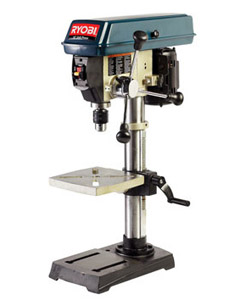
About two months ago, I actually went ahead and bought a drill press. I was reading and re-reading LIO's tutorial on how to drill type 302 stainless steel balls. In the photos, he uses a 10" Ryobi drill press. I could see in Nick Hilligoss' tie-down tutorial video that he uses a Ryobi bandsaw. Ryobi seemed like a trustworthy brand. Affordable, too: the 10" drill press only costs $99 at Home Depot. After coveting it for weeks, I finally decided that my ultimate purchase was a foregone conclusion, and that I might as well quit putting it off.
However, I wound up taking the drill press back just a few days later -- never even having taken it out of the back of the Svan.
Reason #1
At the point of purchasing a drill press, you enter into the world of tabletop machines -- which take up quite a bit of space. If a milling machine were able to both mill and drill, then perhaps for the sake of space I ought to just save up and get the more versatile machine.
LIO ranted a little at me that a drill-press is an essential tool in any shop. That helped goad me into purchasing the drill press. He's an authority that I respect... But did I feel like I truly understood why I need both tools? No. So I decided I should take the drill press back. I can always re-purchase it later, if I finally understand why both are necessary.
Reason #2
I realized that I just didn't know enough about machining metal yet. I was depending entirely upon other people's tutorials and advice. When I'd ask a question on SMA, I could see my own ignorance reflected back in what I wrote, and it just seemed ridiculous.
My new resolve: I'm a smart boy -- I can own the knowledge of metalworking for myself -- no more dumb questions -- go forth and read up on the subject! So, I drove to Powell's Technical Books and purchased The Home Machinist's Handbook by Doug Briney and Tabletop Machining by Joe Martin (owner of Sherline).
Research research research....
posted by sven | May 23, 2006 8:00 AM | comments (9) | categories: sculpture, stopmo
Comments
Good for you Svensters, I like that take no prisoners attitude. If my friend didn't have the press downstairs, I would fore go the sparks and not machine an armature. But now that I've tasted the sweet nectar of the Ambassature, I am bound to pursue its honeyed call.
I don't think we should pigeon hole Mike into wire though, when he sent those photos of his open-hole ball-joint with long pressure plated Ahab I was surprised that he had full on machine shop prowess. He doesn't talk about it much.
Posted by: shelley Noble at May 23, 2006 10:33 AM
You are right of course. Mike has way more in him than just wire armatures, and I'm doing him a bit of a disservice here.
And that's actually true for all of the folks who I named. Nick, Susannah, and LIO, at least, all make a variety of armature types.
...It's just that each of these folks has a tutorial on the particular puppet design that I mention, one that really stands out. Mike's "Simple puppet fabrication" tutorial is the best -- or at least simplest -- on the net.
Nick put together a tutorial on making really simple puppets just in the past two or so months; it's very similar to Mike's, but Mike's is still the simplest.
(I just don't think I can convey how much I've studied Mike's tut... I'm pretty sure that for my first month of "stopmo fever" I looked at it at least once a day. And sometimes four or five times a day.)
Posted by: sven at May 23, 2006 11:45 AM
So Sven... it was YOU who killed my bandwidth usage!!
Yes, I got a deep cut a while back and inside my arm I could see the gleam of silver metal... not sure if it was a thick almalloy wire or steel pressure plates.....
Posted by: Darkstrider at May 23, 2006 5:45 PM
Sven, the two books you mentioned are a couple of the best for getting the hang of metal working. Especially if you have never done anything like that before. I really liked Joe Martins book, a good introduction to a lot of metal topics.
Tom Brierton's book on armature machining is a pretty good one too, for an introduction to the subject.
I started learning this machining stuff about 4 years ago. It's been a fun journey for me. I had some metal shop experience in high school, but that was years ago.
Let me know if you have any questions, I will do my best to answer, I have not made as many armatures as LIO and some others have but I think I have a pretty good grasp of the essentials.
If you have limited space, you might want a mill/drill instead of a drill and mill and a... LIO is right though a drill press is pretty handy to have around and even if you have a mill you may want to keep the drill press.
best of luck and watch out for the machine tool addiction, it can be nasty.
Mark
Posted by: mark fullerton at May 23, 2006 9:07 PM
Mark, I hope we get to see some of those 'tures.
And Sven, listen carefully (as in between the lines) to what mark just said... he started 4 years ago. There are a bunch of guys from the board who all got started in armature smithing around that time, and they all dropped off the board into obscurity. Even Lionel has warned others not to fall into the same trap he did... to get caught up in the endless minutia of learning something as complicated as making actual ball and socket armatures. It will consume you and you'll do nothing else. Am I right Mark? Back me up here buddy.
Trickfx has been quoted as saying open hole ball joints are the way to go. They're quick and easy to make, give great movement, and don't have the finicky superprecise tolerance requirements as ball and socket joints. I can certainly see good reasons to machine certain parts, a mill and lathe can be really handy, but personally I wouldn't go into the B&S arena. Nobody ever emerges from there alive.
Posted by: Darkstrider at May 23, 2006 10:45 PM
Mark! A pleasure to see you over here at Scarlet Letters. Welcome!
I really appreciate your offering up your expertise -- thank you. :-)
An initial question... I've been wondering what kind of milling machine you use? I've been taking notes on what everyone over at SMA has -- I see that LIO has a Grizzly; Eric Scott and Yuji have the MicroLux; Tom Brierton & Jeremy Spake (flux) use Sherlines. What you and Patrick Zung and trikfx use -- still a mystery to me.
Posted by: sven at May 24, 2006 12:11 AM
Mike -- I'm listening to you, I really am. And your warning to steer clear of B&S armatures -- I believe that you are right. I'm convinced that it truly is a way to lose sight of ever doing actual animation.
That said, you gotta give me permission to peek into this world. I need to understand machining well enough to know what it is that I'm missing. That's not the same thing as saying that I must make B&S armatures myself -- I just want to wrap my head around what they're all about.
Tomorrow there's going to be a big, long post about milling machines -- don't freak out. I talk about the selection process as if I'm on the very verge of buying one for myself -- but the money is still in my pocket, and I'm holding onto it. There's a way in which knowing what milling machine I'd get if I were going to get one lets me put that issue aside and move on to other things.
From what I've read, I don't see anything about true Ball & Socket armatures that makes them superior to "open-hole double-ball" joints. The way I envision it, with a B&S there's a great deal more surface area for contact -- so you have to be crazy-precise in your machining. But with the open-hole, there's just this ring of contact -- much easier to produce.
One of the arguments against my buying a milling machine is that it seems like a pretty big investment for a small number of joint types that I'm actually interested in constructing.
Reading through Brierton's book, I know that I really want to be able to make hinge joints and step-block joints. The others -- like the universal joint and the collet joint -- it seems like I could find work-arounds pretty easily. ...Those are kinda just for showing off, ya think?
I'm working toward using steel (if not also aluminum). Any additional suggestions about how to make hinge and step-block joints are very welcome. (Oh -- and before someone asks -- yes, I've seen the Stop Motion Poor Man's Rex Armature tutorial over at StopMotionWorks.)
Posted by: sven at May 24, 2006 12:44 AM
Ok, I completely understand. I went into pretty deep research on DSLR cameras even though I never really intended to get one. I just wanted to be sure you knew the danger going in.... whatever you choose to do I'll totally support (even if you spend the next 15 years doing nothing but machining armatures! ;) ). It's like over at Halfland... sometimes I freak out on some of the things Shelley plans to do, and I'll let her know what I think, but then I always sit back and let her make her own choices and try to be as supportive as I can. I know not everybody wants to do exactly what I do (even though of course my way is the best!).
And Mark, I hope you don't take any offense at anything I said.... each of us has our own focus in this vast world of stopmo. Some want to be Nick Hilligoss (that's my path... the one-man production studio based on the KISS principle) while some want to be LIO or Jeff Taylor, and some are more like Anthony... focusing strictly on the animation without having to deal with making everything or writing the script etc.
Posted by: Darkstrider at May 24, 2006 3:51 AM
Mike, no offense taken ever. I know where you are coming from. We are all on our own journey, to each his (or her) own, live and let live. That's my take.
Sven, thanks for the welcome. Don't let Mike and LIO talk you out of something you WANT to do, they both make a good case, but you just have to ask yourself what you want.
As far as equipment, I think Patrick Z has a Bridgeport mill, which is a full size industrial machine. It might be a CNC retrofit, I can't remember. Ted (trikfx) has a Rockwell mill as I recall which is a smaller industrial size machine, it's not made anymore but is available used if you look for a while. I am a bit embarrassed about my machine tool collection, my girlfriend would say addiction. The latest is a Burke powermatic mill, which is also a smaller industrial machine. I would recommend starting with a sherline if you are interested in testing the waters. They have loads of accessories and are relatively inexpensive and don't take up much room. Oh and good resale value on ebay if you change your mind.
Yes Mike makes a good point, you can get lost in things that distract you from getting frames on film or captured or whatever.
It just depends on what your end goal is. If you really want to JUST make films, then save your money and go buy an armature from someone and get to animating. Or make a wire armature yourself, or go with the open hole method.
My path has been a bit different and it's a long story so I won't spill it all now. Don't let my 4 years scare you off. I have had long periods where I didn't do anything for months. And then I get back into it and stop again. Stop motion requires so many different disciplines and each can have their own long learning curve. Armatures, sculpting, mold making, set construction, puppet fashion design, photography, lighting, animating, sound design, don't forget story development, and the list goes on. But to make a long rant short, I think you can get pretty proficient with some basic machining in under 6 months with a few good books, some message board help and some trial and error. Maybe sooner, just depends on your aptitude for that type of work. Judging from your site you seem to be pretty well versed with a lot of different artistic media so it may come easy for you.
Posted by: Mark F. at May 24, 2006 8:00 AM