you are here [x]: Scarlet Star Studios > the Scarlet Letters > stainless steel balls
<< before artist's way guided intent (july)
after >> a stopmo play day

July 9, 2006

stainless steel balls

by sven at 2:00 pm
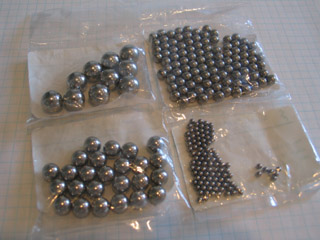
type 302 stainless steel balls

Having done a pretty successful brass armature, the next step up is to try making a steel armature. Following the advice of Lionel Orozco and Tom Brierton, I'm going to use type 302 stainless steel balls for the joints. I ordered a selection of ball sizes from smallparts.com.
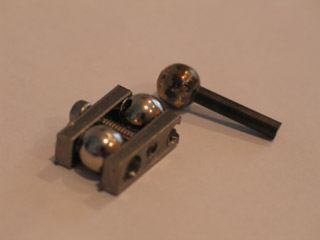
steel beads scratched by 1018 steel plates

On my brass armature, I had a nifty trick: I used hollow beads instead of solid balls -- which really cut down on drilling time. Before moving on to the professional standard (type 302 balls) I had to see if my bead trick could also be used with steel. The answer: no.

Stainless steel beads, it turns out, are harder to acquire than brass beads. I had to get my supplier, "A Bead Source," to make a special order for me. The steel beads soldered onto my 1/8" dia. K&S music wire with no problems. However, when I put the beads between my 1018 cold finish steel plates from Metal Supermarkets, the beads got all scratched up. I shouldn't be surprised -- the beads must be made of a far softer metal.

I've looked in the K&S stainless steel center for something analagous to the 12" x 1/4" x .093" brass strips I used on the brass armature -- but found nothing. Conclusion: I could make an armature that uses steel beads and brass sandwich plates, but there's not going to be an all-steel armature that uses beads for balls.
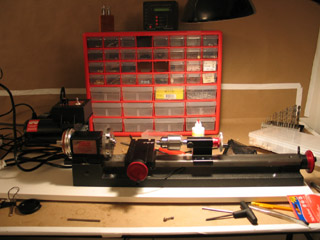
Sherline 4400 Lathe

My Sherline 4400 lathe and 5400 mill arrived June 20... I was so busy writing the brass armature tutorial, however, it took me a while to get around to setting them up. Much of this past week was spent assembling the machines, attaching them to wooden bases, and getting acquainted with their basic operations.
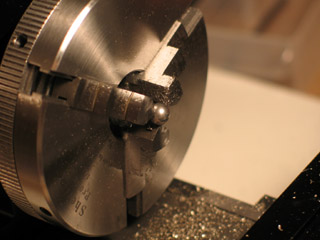
ball in lathe

Friday night (7/7) I successfully drilled my first ball using the lathe method. Basic idea: the chuck of the lathe spins the ball while the drill stays still, which allows you to make a perfectly centered hole.

I've read quite a bit by this point -- in Stop-Motion Armature Machining, Tabletop Machining, and The Home Machinist's Handbook -- and yet, the tactile quality of machining steel was not at all what I expected. I knew that you need to be patient; but I couldn't imagine the extent to which progress is measured in fractions of a millimeter. I knew that you use a lot of oil; but I didn't comprehend that the tiny metal chips would form a sort of oily paste.

...Metal-working at this level is going to be challenging. But I still think I have what it takes.
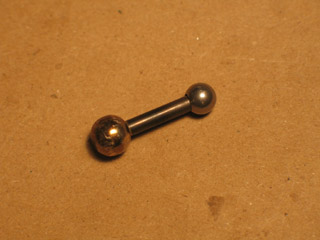
bead (left) and ball (right)

Here's a photo of my first drilled stainless steel ball. For comparison's sake, I simply fit it onto the other end of a rod that was already soldered to a bead. I have the Safety-Silv 56 solder I need in order to attach it permanently, but that's the next step...

Celebrate one small victory at a time. This stuff ain't easy.

posted by sven | July 9, 2006 2:00 PM | comments (7) | categories: stopmo

Comments

Nice progress. That ball looks perfectly centered, unlike Ahab's balls!

Hey, one thing I'm curious about, and I've heard before that drilling balls on a lathe takes a long time (I guess that's the time-consuming part you're talking about?). What is it that takes so long exactly? On a drill press it goes pretty quick, and the metal comes out in a continuous spiral piece like a long skinny corkscrew. I get little chips from some metal, but it seems like with the 302 balls I get the corkscrews.

Or were you referring to metalworking in general, stuff we haven't seen in your pics?

Posted by: Darkstrider at July 9, 2006 10:00 PM

Drilling balls on the lathe took a long time... Maybe 15 minutes to get one done? I'm hoping that gets faster as I get more comfortable with the process.

Working with brass has been relatively easy. Aluminum, being pretty soft too, doesn't scare me. Steel, though -- I'm wondering if all steel work is going to take so long?

I'm not really sure why drilling the ball on the lathe took so much time. I've experienced those nice continuous spirals while drilling brass... It feels like the reason I'm not getting spirals here has something to do with the drill bit being held still -- but I haven't wrapped my mind around why that should make a difference.

Part of the process that I didn't write about was using a centering drill bit for the first time. It has that tiny little tip... I followed the advice I've read, and repeatedly oiled it, and repeatedly backed the tip out so I could clear away chips. ...It was like a very fine oil-steel ooze was coming out of the hole.

When I moved on to using a 1/8" drill bit, it threw little chips out of the hole. They seemed smaller than the chips I'd make when cutting brass. Due to the chemical structure of steel?

It's possible that I'm not feeding the drill into the hole quickly enough. More practice is called for. ...It was getting late, and I wanted to share pics of the very first ball I managed to drill. I've got such a backlog of blogposts -- didn't want to add one more noteworthy event to the list.

Posted by: sven at July 9, 2006 11:30 PM

Metalist.

Congratulations, Sven! Your gear and skills have taken a monumetal (sorry) leap.

I bet your beauifully crafted puppets will dance smoothly with these babies underneath it all!

Posted by: shelley Noble at July 9, 2006 11:34 PM

What kind of bit are you using? High Speed Steel will work, but you'd be better off with Cobalt or Tian coated steel. Not sure if that would affect drilling speed?

You might also want to try (and I'll bet Mark can correct or corroborate this, I'm just guesstimating on this... works on a drill press though) rather than the centering drill, just use a big bastard file to make a flat spot on the ball, keeping it perpendicular to the axis you want to drill into. Then just go righ t to your finishing size drill bit. Actually, when I got things perfectly centered on the drill press, I didn't even have to file a flat spot... I could just drill right in with one bit. Might not be as dead accurate as a centering bit though.

Could also be the speed you're running the lathe at... it should be pretty slow (don't know exactly).

Posted by: Darkstrider at July 10, 2006 4:25 AM

Yes you should get corkscrew like chips in an ideal situation. It doesn't always happen. It's a speed and feed thing. It should be no different than a drill press really. If you are getting smallish chips you probably need to feed faster.

I was going to suggest a file to make a small flat on the ball before drilling, I do it even with a center drill. A lot of balls are case hardened and that helps to remover the hardened surface to make the drilling easier.

Once you get the hang of it it should go a lot faster. Some stainless steel can "work harden" which means as you drill the hole if you don't use enough pressure you are actually hardening the surface of the metal making it harder to drill. This will of course dull your drill bit which make it harder to drill and so on.

I really like the Hi-Roc drills for drilling balls. It's a spade type drill that can drill very hard balls. It should cut through 302 stainless like butter- well almost. Still any good drill should work with the 302

It's a bit of a learning curve - have fun with it. By no means do I consider myself an expert machinist but I will give you whatever help I can. Good luck.

Posted by: Mark F. at July 10, 2006 4:53 PM

You probably already checked this but just in case...is the direction the lathe is spinning in keeping with the drill bit's need to turn clockwise for drilling forward and not reverse? Not sure how to word what I'm saying...is the lathe rotation reversible so you can check which way to turn it for drilling? I bring it up because some time ago I had a real problem drilling some dowel holes until about 15 frustrating minutes into it I realized my drill was set on reverse...doh!

Posted by: Grant at July 10, 2006 6:50 PM

Way cool. As they say, "Any day you cut metal is a good day!"

Posted by: Suzanne at July 11, 2006 1:08 PM

Post a comment


Remember Me?


You may use HTML tags or Markdown syntax in your comments:
*emphasized*, **strong**, & [link](http://www.foo.com).

No need for <p> or <br> tags.