you are here [x]: Scarlet Star Studios > the Scarlet Letters > book review: the anatomy of story
<< before
greetings from tucson
after >>
clown classes
March 30, 2008
book review: the anatomy of story
by sven at 1:15 am
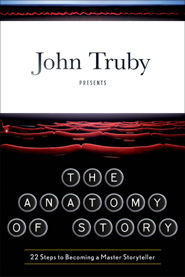
The Anatomy of Story: 22 Steps to Becoming a Master Storyteller by John Truby (2007) is just about 420 pages long. I recommend the first 100... And then to skim the rest.
The core idea of the book is, in my opinion, a good one: In order to create a compelling story, don't simply sit down and start writing... Instead, construct a well-reasoned architecture of story structure -- and then progressively flesh it out.
Frustratingly, though, the book's title is deceptive. The "22 steps" are not steps in your own personal progress toward becoming a storyteller, as one might infer. Rather, the "22 steps" are moments that occur in an archetypal story -- steps that Truby believes your protagonist must go through during the course of their adventure.
And, frankly, these steps are no huge revelation. Here is the grand list:
- Self-revelation, need, and desire
- Ghost and story world
- Weakness and need
- Inciting event
- Desire
- Ally or allies
- Opponent and/or mystery
- Fake-ally opponent
- First revelation and decision: Changed desire and motive
- Plan
- Opponent's plan and main counterattack
- Drive
- Attack by ally
- Apparent defeat
- Second revelation and decision: Obsessive drive, changed desire and motive
- Audience revelation
- Third revelation and decision
- Gate, gauntlet, visit to death
- Battle
- Self-revelation
- Moral decision
- New equilibrium
If you understand what each of these steps in the protagonist's journey represents, how is that going to help you? Well, you can use them to inspire you -- the list might suggest scenes that you hadn't thought to write yet... Or it could be used as a check-list, so you can check to see if there's anything important that you might have left out of your outline...
But in general, I feel this list is too formulaic to be of much real use while actually generating a story. It's an editing tool -- and not a particularly sophisticated one, at that.
As I said at the beginning, the first hundred pages of the book are quite worthwhile, though. Here are a few of the insights that I thought were useful:
- The premise of your story will structure everything else you do. Don't skimp at this stage of the process -- spend weeks getting it right, not just days.
- To help find your premise, make a wish-list of everything you'd like to see in your ideal story. [Chris Baty offers the same advice in No Plot? No Problem! -- and additionally suggests writing a list of all the things you hate in a story, and want to make sure to avoid.]
- Don't develop your protagonist in isolation. Instead, think of your cast as a "character web"... Develop the characters by comparing and contrasting them, so that each one is clearly distinct from all others.
- Everything works toward the climax. Start the story-writing process by figuring out how things will end, then work out the path to arrive there.
- A story progresses through "reveals." Make a list of all the reveals in your story to make sure that they build in intensity -- otherwise the story will lose momentum.
These ideas all occur in the first four chapters. Chapter 9 had another useful idea, "scene weave" -- an editing method, where you reduce the main action of each scene in your story down to a single sentence and review the sequence. [Throughout the book, Truby seems to be in love with the idea of boiling your various concepts down to single-sentence "mission statements."]
I had high hopes for the rest of the book... Chapters titled "Moral Argument," "Story World," "Symbol Web," and "Scene Construction and Symphonic Dialogue" all sounded quite promising -- but instead were painfully tedious.
For wide sections of this book, it is quite obvious that Truby had a book outline that he was working from... He dutifully fleshed out each section that was in his outline... But just because you think you ought to include a topic in your book, doesn't necessarily mean that you have anything insightful to say about it! In these areas of the book, there's no sense that even Truby is excited about what he has to say -- he becomes the most boring sort of lecturer.
Mechanically fleshing out an outline is perhaps a forgivable sin. Worse, though, is that Truby analyzes the same films over and over and over again. Instead of illuminating his ideas, it ultimately feels like Truby is padding his book with synopses.
In the penultimate chapter, pretense of analyzing the films seems to disappear entirely, and the discussion degenerates into mere film appreciation... With Truby heaping praise upon:
- The Seven Samurai - "this is one of the great scripts"
- Butch Cassidy and the Sundance Kid - "...has one of the great openings in movie history, it also has one of the great endings"
- Casablanca - "The final scene...is one of the most famous in movie history"
- The Godfather - "this great film..."
...And so on.
The author spends no time discussing more modest films, or looking at how to take a particular flawed script and improve it. The book blurb claims that Truby has taught his classes to more than "twenty thousand students worldwide." In my imagination, I see this man watching the same great films year after year, developing ever greater appreciation for them... But never writing an original script himself. How could an original work ever live up to the films he seems to worship?
I'm sure my fantasy of Truby is inaccurate and unfair. But I'll say for myself that at the end of the book I was genuinely mad at the author. He abandoned his task of guiding the writer who must generate new, imperfect material, and indulged in simply praising history's "perfect films."
If I'm going to stick with you for all 420 pages, you'd better make it worth my while!
Based on the form-factor and title of the book, I strongly suspect that the publishers want to create a feeling that "The Anatomy of Story" is the unofficial sequel to Robert McKee's Story: Substance, Structure, Style and The Principles of Screenwriting (1997).
I read McKee's book recently, and while I have minor criticisms about it, I feel that it is overall a fantastically clear book -- the first place I'd send anyone who's interested in constructing stories. It's 480 pages -- but it delivered just what it promised.
From what I gather, McKee's book has become something of a bible in Hollywood... I offer a mote of evidence, by quoting a critic of McKee, Mystery Man on Film:
"When people in the biz talk about character arcs, they are talking about a change to the inner nature as defined by the Grand Poobah of gurus whose obscenely invasive influence all throughout HW spans well over a decade now. Right or wrong, love it or hate it, we have to go by Robert McKee’s definition, unfortunately."
Given McKee's standing, it shouldn't be surprising that there will be other story consultants vying to be the next guru... But, in my opinion, after reading "The Anatomy of Story," I believe McKee's book should still be the primary text for aspiring story makers.
Truby's book is an interesting supplement to McKee. Both books share the same core philosophy, which is that story should begin with constructing a solid structure...
My hopes that Truby could build upon McKee's foundation, translating solid story analysis into a trustworthy method for story generation were largely disappointed, though.
posted by sven | March 30, 2008 1:15 AM | comments (5) | categories: writing
Comments
Hey Sven, good to see your review!!! I agree in large part, though with some differences. Basically, I thought the 1st 60 pages were skippable, because it seemed like all he did there was bitch about 3-act structure (to which he presents his 22 steps as an alternative). Though there may well be loads of good stuff lixed in there as you say.... I was just put off by the hatred and the obvious misunderstanding of what 3-act structure really is (he constantly says it's "imposed arbitrarily from the outside like a formula" whereas his Steps are "Generated internally from the story structure itself".... blah blah blah!!!! Actually his steps result in a 3 act structure, he just refuses to see it!!!! And did you notice the way kept referring to his approach as a "new Poetics"? Not only does he seem to want to overthrow McKee, but Aristotle as well!!! He has no shame!!!
But (as you're well aware) I only see this book as a supplement to other books (as you said already). All the things you liked about it I liked as well, but I think I got a bit more useful stuff that you passed on. McKee (and I'm sure other authors I haven't read as well) greatly deepen and broaden what I know of Aristotle (from the Michael Tierno book), but Truby goes far deeper. Narrower though I think. I agree with you that his approach is pretty formulaic, or rather that he only seems concerned with writing a narrow range of film types. BUT - that aaid, I was astonished at the sheer volume of ideas he presents.
"If you understand what each of these steps in the protagonist's journey represents, how is that going to help you? Well, you can use them to inspire you -- the list might suggest scenes that you hadn't thought to write yet... Or it could be used as a check-list, so you can check to see if there's anything important that you might have left out of your outline...
But in general, I feel this list is too formulaic to be of much real use while actually generating a story. It's an editing tool -- and not a particularly sophisticated one, at that."
Here's where I disagree largely. I've heard you say similar things about other books, that the advice doesn't help in generation but only afterwards in analysis. But it seems to me that, once these ideas are in your head, they do help guide you during generation, at least to the extent that when you think "Ok, now I need to work on the inciting incident" (or whatever) you have a lot of ideas on how to do that. They serve as a guiding principle I think.... no, they can't create the ideas, but they can steer you in the right direction, rather than floundering and thrashing. I used some of his principles in doing a little more work on my Buster film outline, and it's been helping immensely. I think the important thing though is to absorb and digest his ideas (and McKee's, and any other author you read of course) so they become part of your inner dialogue and can help guide you through the misty world of idea generation, where intuition is king.
Ok, anyway, not bashing your review at all.... I mostly agree with it. Just adding my thoughts.
Mike
Posted by: Darkstrider at March 30, 2008 5:07 AM
can you add links to "anatomy of a story" and "Story: Substance, Structure, Style and The Principles of Screenwriting," please? :)
Posted by: gl. at March 30, 2008 9:08 AM
@gl.- Thanks for pointing out that I forgot to link. I've added links in now. :-)
Posted by: sven at March 30, 2008 9:29 AM
@Mike: Even as I was publishing this post, I had the sense that I'd gone a bit too far with the negatives, and hadn't given quite enough weight to the book's virtues. Book reviews are a form I'm only just beginning to experiment with -- so, mea culpa.
Yes, on reconsideration, I believe the 22 steps are more useful than I gave them credit for. I'm still a bit perturbed at how frequently the movies that Truby himself chooses to analyze don't fit into the supposedly universal steps... But that aside, I have to confess that he does present a well-articulated LENS through which a story line can be examined.
And, without having read too deeply into the "storytelling advice" genre yet, I can guess that this is more than most authors are able to provide.
==========
I can tell that I'm going to have to explain more clearly my distinction between "generation" and "analysis," before we start butting heads over it. Here's a first attempt...
GENERATION
"Generation" activities are tasks that have you putting words down on paper. This text is raw material. You don't fix what you've written, or go back and change anything. Whatever the document is that you've created through the generation task, it is complete whenever you put the pen down. At this step, there is no right or wrong.
Examples:
Write a wish-list of everything you'd love to see included in your ideal story.
Write a list of every scene that you think you might need in order to tell the story, jotting down one or two sentences each.
"Write an interior monologue in the first person, an account of the story seen through the eyes of the antagonist." [That's the exercise that you mentioned Alexander McKendrick describing in "On Filmmaking."]
ANALYSIS
"Analysis" tasks have you taking raw text that you've previously generated, and applying some sort of process to them. Often analysis feels a bit like harvesting out the good stuff from the bulk of garbage you've created. The analysis step doesn't immediately result in a final product -- rather, it allows you to see what you've written more clearly.
Examples:
After having written a scene, go through and label each character's lines with a single verb that describes the tactic they're employing (e.g. begging, bargaining, threatening).
Go through your entire story and sum up each scene with one sentence; now examine the story as a list of one sentence synopses.
Take the stream-of-consciousness POV monologue that you've written for a character, and underline all the exciting phrases that you might like to work into your script later on.
Go through your scene list and label each scene according to which of John Truby's 22 steps it represents.
EDITING/REWRITING
I'm not certain, but perhaps I should say that there's a third crucial step in addition to Generating and Analysis: Editing/Rewriting. Mostly it seems that writing consultants say "just do it," and don't offer a lot of advice about this stage... But it seems to me that there could be tasks/exercises/processes that help a writer here, too. (I guess this is the step where you take your analyzed raw material, and actually transform it into something new.)
Examples:
Take a list of the reveals in your story, and re-order them from least-intense to most-intense.
Take your scene list and reorder it to match the order of John Truby's 22 steps.
...Advice about how to properly name all your various story-related documents, keep them organized, and work your way through an ordered process that ends up with a final product -- these ideas might also fall under this category.
I know from experience that working on story development will typically mean going back to square one over and over, as you repeatedly discover flaws in your project... But the idea of a story creation process that allows you to start at step 1 and methodically work your way through to completion without backtracking -- well, I think it's an ideal to aspire to.
Posted by: sven at March 30, 2008 10:28 AM
Yes, we're in agreement about what generation and analysis are - but I can see a benefit in the generation stage to having digested all this info. Example, let's say you've jotted down an outline of ideas you had already come up with and you find that your (for instance) progression of revelations is weak. Now you know what needs to be done.... you know what KIND of ideas to try to generate. Where as if you had never read Truby or McKee, you wouldn't even think to check the revelations.
To me many of his steps are good for this..... the character web, the scene weave.... they're all ways of looking at what you've got already and quickly seeing what you need to do to it.
Of course, I'm thinking of generation as a step you keep returning to..... do you mean it only as the initial ideation process?
Posted by: Darkstrider at March 30, 2008 9:44 PM