you are here [x]: Scarlet Star Studios > the Scarlet Letters > q&a with richard williams and some stopmo pros
<< before
death of a friend: elena raymond
after >>
happy halloween from scarlet star studios!
October 30, 2008
q&a with richard williams and some stopmo pros
by sven at 11:59 pm
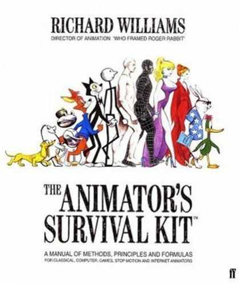
Tonight Cascade ACM SIGGRAPH and ASIFA Portland hosted an evening with celebrated animator Richard Willams. Williams is most famous for his work on "Who Framed Roger Rabbit?" and is the author of the essential book, The Animator's Survival Kit.
Williams learned from the likes of Chuck Jones and several of Disney's "Nine Old Men" -- people who literally invented the principles of animation that we use today. Knowledge that would have otherwise been lost has been passed down to the current generation of animators because of his efforts.
Williams showed clips from a new set of instructional DVDs he's peddling and mostly responded to questions. He's charming to listen to -- but I didn't feel like the questions that people asked tonight really tapped into his wisdom very deeply. Still, I was glad to go.
For me, the real thrill came afterwards: when my stopmo friend Hazel Malone introduced me to Misha Klein. Having seen clips of Klein's excellent work-in-progress, The Hallway, and various TV shows that he's worked on (Celebrity Death Match, The PJs, Robot Chicken, Moral Orel), I was kinda starstruck.
I also got to meet Anthony Scott a second time, and several other folks from Laika who've just finished working on Coraline. Having just seen Richard Williams speak, it was the perfect moment to ask some technical questions I've been hanging onto about how stopmo professionals work.
Suzanne (who's last name I didn't get!) did most of the answering. Here's my best recollection:
Q: Do you use "breaking of joints" in stopmo?
It depends on the armature mostly. But to an extent, yes, pro stopmoes are thinking in terms of breaking of joints. (Example: Bending the elbow of an arm in an unrealistic direction to increase the illusion of fluidness as the arm swings. See p.231 of Survival Kit.)
Q: Do you shoot at 24fps even when working on TV shows?
Usually yes -- but it depends on the studio. Most animation studios doing TV shows will shoot 24fps, then use 2:3 pulldown to convert to video's 29.97fps format. A few do shoot at 30fps or 15fps... "But who wants to shoot those extra frames?"
As I knew before, 24fps is standard for film work. The folks I was speaking to weren't sure about what the standard would be now that we're switching to digital TV transmissions -- but I feel confident, based on my research, that we're moving to a 24fps standard for TV too.
So, it sounds like pro stopmoes can do 15fps or 30fps if forced to... But anyone who's learning the art should learn to think in 24fps.
Q: Do you shoot on a combo of 1s and 2s, or usually just on 1s (or just 2s)?
In film work, you're generally shooting on 1s -- but yes, sometimes you'll mix in 2s where appropriate (e.g. really slow moves). Stopmo for TV is generally shot on 2s because the schedule and budget are tight.
(I know that stopmo luminary Nick Hilligoss is a big advocate of shooting on 1s... But I was astonished a year or two back when I realized that Justin Rasch shoots a mix of 1s and 2s depending on the action. From what I've seen, it looks like mostly 2s -- but with 1s for fast actions like runs. ...Hey Justin -- did I get that right?)
Q: I know that stopmo is inherently straight-ahead -- but do you use anything like pop-thrus to establish keyframes?
Yes. Apparently the folks I spoke to would do a "mock-thru" at 1 pose per 10 frames to get the timing -- and then a "rehearsal" at 1 pose per 4 frames.
Q: Are rehearsals just for the sake of the "suits" -- or are they valuable for you, too?
They're valuable for the animator, too. If you're going to spend two weeks on a shot, it's really helpful to get to go through it beforehand and find your marks.
A word about the value of good armatures.
I showed off some photos of armatures I've made, and heard some feedback about ball'n'socket armatures in general... The opinion was that they're simply crucial to doing top-notch animation, and that a puppet is basically only as good as its armature.
I pointed out that with framegrabbers nowadays, you can get by with a wire armature if the film is going to be short -- say, 2 minutes or less. Yes, I heard, but if you're going to be doing repeated motions (like mock-thrus & rehearsals) then a B&S armature is really indispensable.
No one likes fighting with wire's spring back... And everyone in the business has had to finish out shots with a broken puppet.
(A few nights ago I rewatched The Sandman on YouTube and was struck by how B&S pups have their own unique quality of movement. Even when framegrabbers are used, the motion just feels different when you've got pivot joints underneath the foam.)
I came home totally buzzed. I got some questions answered by the pros I look up to -- and may have a chance to hang out a bit more at some future date. Man, I'd love the chance to get involved in some of these folks' personal side projects!
posted by sven | October 30, 2008 11:59 PM | categories: stopmo