bestiary
featuring strange creatures and the heretofore unknown. these items are licensed under the Creative Commons Attribution-Noncommercial-ShareAlike License. If you'd like to use anything from "monster month" in your commercial project, please contact us.you are here [x]: Scarlet Star Studios > the Scarlet Letters > bestiary
July 27, 2009
ichbonnsen on muglorp
by sven at 4:30 am
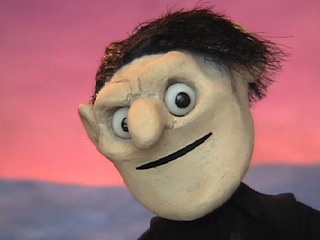
Guess who…!
posted by sven | permalink | categories: bestiary, stopmo
October 1, 2008
monster month - the nile keratos
by sven at 10:50 pm
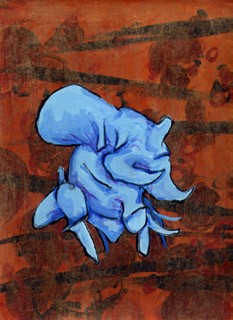
The Nile keratos is a dog-sized amphibian native to Egypt.
"Keratos" derives from the Greek for "horned face." Three large cartilaginous horns protrude from its face area. Two additional horns extend forward from its front legs. The legs themselves end in dagger-like points, rather than feet.
The keratos lives in underground passages. It has no eyes or other visual sense organs. Like a bat, it navigates using ultrasonic echolocation. The creature emits quick chirps at a pitch too high for human hearing. While audibly silent, a keen observer may still notice membranes at the top of the head vibrating as it calls out.
According to certain occult texts, the species was discovered by ancient Egyptians at about the same time the Giza pyramid complex was being built. The keratos were discovered by a construction team of slaves in flooded underground tunnels -- only one of whom survived to tell the tale.
It is said that a "powerful magician" led an expedition that managed to capture several keratos and then destroy the rest of the colony. However, keeping the "demons" was not part of magician's directive. His insistence on preserving several specimens led to a heated conflict with the Pharaoh -- and a hurried, clandestine escape from Egypt.
Reports appear 200 years later regarding a keratos breeding program to the east, in Sinai... Apparently still being overseen by the magician's heirs.
In recent decades rumors have circulated about a mysterious breeder who maintains keratos descended from the original stock. However, no definitive evidence of the species' survival has yet come to light.
Note: There is a competing theory of the Nile keratos' origins, which suggests that the animal did not evolve on Earth. Instead, it was supposedly brought here by the same alien civilization that used spaceships to help erect the pyramids.
I reject this idea. It's true that illegal trafficking in alien life between worlds has been ongoing for centuries -- but the pyramids were most certainly built by human hands.
posted by sven | permalink | categories: bestiary
monster month 2008 begins
by sven at 10:42 pm
Huzzah! Once again it's Monster Month!
For the third year in a row, I'll be using October as an opportunity to post illustrations of fantastical, whimsical, horrifying and strange creatures here on the Scarlet Letters blog.
Nothing from Professor Ichbonnsen this year, it seems. I haven't heard anything from him for several months. And actually, I'm beginning to get kind of worried about his whereabouts... Last I heard, he and Scarlet were traveling by dead of night to avoid "assassins." (Cross your fingers, everyone!)
Still, I've got a stack of his notes leftover from last year. I'm sure I'll work in a few of his "discoveries" amongst my fictional creations as time goes by. ;)
I urge you to also check out my friend Jeffrey Roche's blog, Monster Month South. He'll be picking up from where the story left off last year: Lurline Lagrasse plans to avenge her husband Raymond, who was savagely dismembered by a Tree Beast.
And so, with that all said... Let the monstering begin!
posted by sven | permalink | categories: bestiary
February 7, 2008
monster month book release party - part 2
by sven at 7:00 am

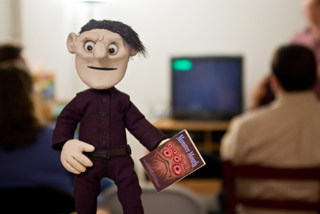
Professor Ichbonnsen couldn't make it to the Monster Month book release party -- but he was kind enough to send a letter to be read in his absence.
Watch the video to see me giving a dramatic reading -- (almost worth it for the audience participation alone!) -- or just go ahead and read the text below.
Thank you one and all for coming out tonight.
Your show of support -- not merely for this book which we have published, but for the cause of Cryptozoological Awareness -- means the world to me... And it may, ultimately, be that which saves our endangered world.
For decades, academics and politicians have scoffed at the mere suggestion that Monsters might exist on this planet with us. Narrow-mindedness, pure and simple... A comforting illusion, to believe that all things that can be known already are known.
Those of us who dare to imagine, dare to seek, and by raw courage dare to discover -- we face this tremendous prejudice every day of our lives. And so I want thank you again... For I understand quite well what the personal cost of attending this event may be for those of you here tonight. Ostracism by friends and family.... An FBI file with your name on it... Or perhaps even worse...
Yes, I say "even worse" -- because I have recently discovered that denial of the existence of Monsters is in fact being spearheaded by a well-funded yet shadowy conspiracy of unknown parties!
As those of you who have already read my book know, a serious attempt on my life -- and on that of my trustworthy assistant Scarlet -- was made while we were recently traveling though India. We still do not know who hired the one-eyed pilot, or how the hideous mutants, which we were delivered unto, figure into the conspiracy's far-ranging plot...
But, since then we have suffered, yes, another assassination attempt. And though we escaped with our lives -- I have every reason to believe that this was an act of the same shadowy forces, trying to silence our Cause.
The details of the plot are almost too tedious to relate... A rare and poisonous snake, secretly deposited in our hotel room -- a species which, I freely admit, I have always been quite eager to see in the flesh -- but not within the confines of my own bed.
You will be glad to know that with quick thinking, lightning reflexes, and the sacrifice of very tasty ham and banana sandwich, both Scarlet and I escaped unharmed.
Unfortunately, we know now that our assailants are very close behind... And so once again, we go into hiding... Traveling by night, using forged identities, staying in the homes of individuals who belong to a vast underground network of Cryptozoological Freedom Fighters.
You, too, my friends may be called to the Cause! Whatever you can do -- whatever small thing, to help spread the word -- please, take that step.
For our own safety, and for the safety of all involved in producing this event, Scarlet and I cannot risk being in Portland tonight, where we will certainly be expected. So I ask you now: Take our place -- be where we cannot be -- be that voice of reason in a world that denies the truth.
For the sake of the defenseless Monsters whose habitats are being lost --
For the sake of the defenseless Humans, who have unwittingly encroached upon the territories of carnivorous Monsters --
For the sake of Monsters and Humans alike, defending our shared world against invasive species from Mars and beyond --
Join me in making a Revolution of Cryptozoological Awareness!
Thank you. Please enjoy the rest of your evening at the Monster Month book party.
Sincerely,
Professor Ichbonnsen
January 31, 2008
posted by sven | permalink | categories: bestiary, exhibits & events
February 6, 2008
monster month book release party - part 1
by sven at 5:24 pm
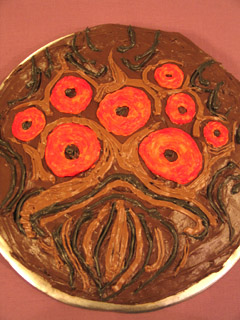
January 31, 2008, we hosted the Monster Month Book Release Party.
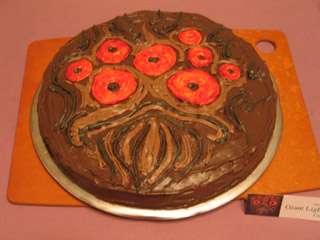
The aspect of the party that I'm most proud of: I made a huge cake and frosted it to look just like the monster on the book's cover!
Two hours to bake, two hours to decorate. Chocolate "black magic" sponge cake, 4 hand-mixed colors of homemade cream cheese frosting, 12"-wide pan. Oh yeaaaahh...
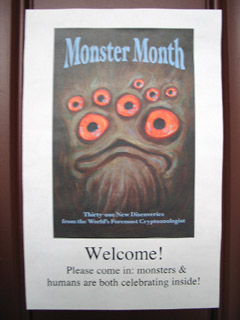
The sign on the front door: "Welcome! Please come in: monsters & humans are both celebrating inside!"
(Thanks to Gretchin for putting together the signage!)
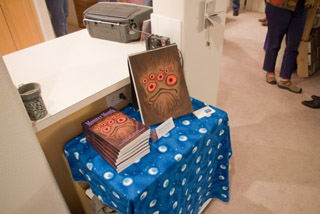
As you enter, there's a stack of books for sale, and the original painting for the book cover.
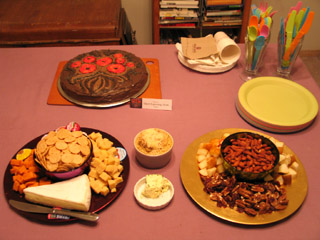
Lots of yummy snacks. Rice crackers and five kinds of cheese... (Kinda overdid it on the cheese.) Hummus... Apples, pears, almonds, and a sweet pecan-cranberry-pepper mix.

And... Grimberry Juice! Compliments of Prof. Ichbonnsen's colleage Professor Amberson.
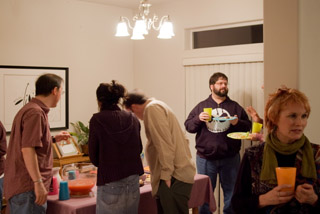
In write-ups about events, people often declare "it was a success!" ...What does that actually mean?
In this case, what I can tell you is that people were talking with each other the whole night long... You actually almost had to shout, the room was so loud... None of those pesky awkward silences ever descended on us. And although the event technically ended at 9, it wasn't til 11:30 that the last of our guest finally cleared out.
Heh. I think I've just begun to outline a Beaufort scale of party "success."

People started arriving at 7. At 8, we gathered in the living room for the reading portion of the evening. Pretty much every chair we own was set out... Which just managed to comfortably accommodate the 15 of us.
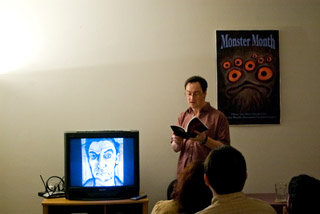
Despite best-laid-plans, the Professor himself was unable to make it to the event...
But he was kind enough to send a letter of welcome/explanation/apology, to be read in his absence.
I did the honors... Then went on to discuss how the book project came into being, and what it was like working with the World's Foremost Cryptozoologist. I concluded this bit of the evening by reading the chapter from the book titled "An Underwater Adventure - Darker Things Beckon."
The audience participation was hilarious -- gasping at all the right moments, heckling and playing along in the kindest way...
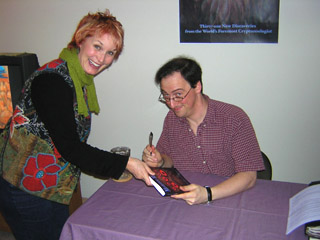
And then came cake and the signing of books. Need I say, this was the first time I've signed a book since... My high school yearbook?
Go ahead -- try to imagine what you'd write in a book, if you published one. If you come up with a clever way to deal with this pleasant-yet-awkward situation, please tell me the secret!
As it was, our friend and fellow Artist's Way teacher Dayna Collins got something to the effect of: "To Dayna -- You are the first person I've ever signed a book for! Thank you for your support and encouragement. -- Sven Bonnichsen."
It got even harder after that.

My friend and Weekly-Get-Together-To-Watch-Classic-Star-Trek buddy, Michael Hall, was kind enough to take a bunch of the photos you see here. Thank you!
Gretchin, in addition to helping with signage, managed getting the food set up, answering the phone, keeping track of time, taking money for book purchases, and and and... Oh, and she also found this website, blockposters.com, which allowed us to assemble the ultra-cool poster version of the book cover. For that and a whole bunch more... Thank you!!
Philip Flores has posted a short review of the event... As has Dayna. And now Linda and Bridget. ...Thank you!!!
And...(oh my)...How could I forget the groupies of my fledgling fan club, Bridget Benton and Linda Womack? ...Thank you!!!!
And lastly, to everyone else, who either came or who sent good wishes: THANK YOU!
posted by sven | permalink | categories: bestiary, exhibits & events
January 4, 2008
A Word From Professor Ichbonnsen
by sven at 2:52 pm
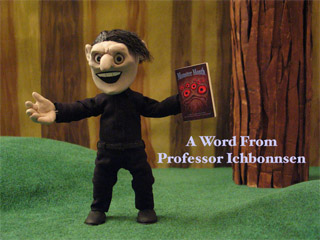
I just finished a short-short new film: "A Word From Professor Ichbonnsen."
This was a submission for the StopMoShorts.com quarterly Stopmo Haiku Challenge. The challenge is that SMS provides four keywords -- in this case realm, swap, alley, and rose -- and you have to make a short film that works in one or more of them. I chose to go with the word "realm."
The deadline was Dec. 31... And I managed to get my project uploaded a good 40 minutes before midnight. ;-) At SMS, "A Word From Professor Ichbonnsen" (AKA the Monster Month TV Ad) can be viewed here.
I feel I should explain that this project didn't start out as a commercial. Toward the end of December I had already fabricated the set and the puppet version of Ichbonnsen (no, that's not the man himself!)... I wanted to shoot a quick gag about the Professor encountering the creature from the book cover -- but ran out of time for constructing a decent monster puppet.
I was contemplating giving up on doing a short -- when it occurred to me that it would be funny to see Ichbonnsen holding a miniature copy of the book, waving it around. The book prop was much easier to make... So I went with it.
To me, the film stands on its own. The fact that there actually IS a Monster Month book for sale simply deepens the pleasure of the fantasy world.
posted by sven | permalink | categories: bestiary, stopmo
December 27, 2007
monster month book for sale!
by sven at 12:47 am
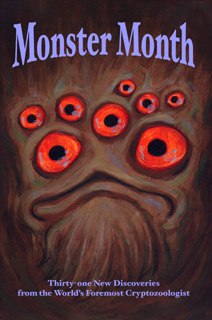
Monster Month 2007 is now available in book form, for sale at lulu.com!
I'm really proud of how it turned out. It really looks and feels like... a book. Gretchin and I put in some crazy hours during December, secretly slaving away so that we could get copies to people in time for xmas. Now that the recipients have unwrapped their surprises, we're making the book available to anyone who wants it!
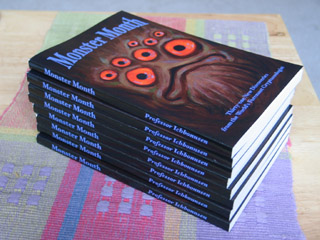
For the book version of Monster Month, I wrote up a new foreword, assembled 7 gorgeous new maps, and did a new painting for the cover. The book's a bit pricier than I'd like -- but ya gotta understand: everything's in full color!
Here's the promotional text for Scarlet Star Studio's first publication:
Monster Month
by Professor Ichbonnsen
Thirty-one days, thirty-one monsters: Monster Month!
After a lifetime of trekking jungles, climbing mountains, and spelunking caves, the world's foremost cryptozoologist at last reveals a selection of his greatest discoveries. Herein you will find the Adameve, the Dark Strider, the Opium Gore Golem, the Trick Squilligoss, the Zompire Bat... And many more fantastic beasts!
With the keen mind of a scientist and the bold heart of an explorer, Professor Ichbonnsen provides illuminating descriptions of how the creatures live -- and astonishing tales of how he found them.
Both adults and children will marvel at the Professor's adventures... And be left wondering what else remains yet undiscovered in the unexplored corners of our rich planet. Like the map-makers of old, you will understand: "Here be dragons!"
Monster Month is lavishly illustrated with 32 full-color paintings by Sven Bonnichsen, and 7 full-color maps tracing Professor Ichbonnsen's travels.
Again, where can you get it? At lulu.com. Here's the direct link: http://www.lulu.com/content/1744791
Thank you to Gretchin for the fantastic help laying out the book... And thank you to all the readers and supporters of Monster Month!
posted by sven | permalink | categories: bestiary, painting, writing
November 1, 2007
Ichbonnsen Reborn!
by sven at 2:00 pm

Wow! The good Professor has pulled a Mark Twain! ...As in: "The rumors of my death have been greatly exaggerated."
Go check it out: there's one last post on the Monster Month blog.
I am so relieved. Ichbonnsen and Scarlet have really grown on me. Maybe next year they'll even see fit to share some more stories. Whether or not I'm up to doing paintings for them... Well, we'll see.
I'm just glad that people like this still exist in the world. ;-)
posted by sven | permalink | categories: bestiary
month of 1000 monsters!
by sven at 8:00 am
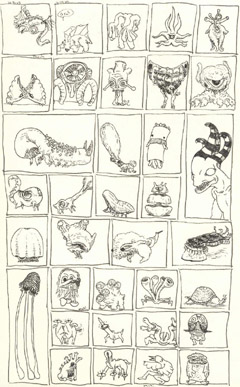
From my bro's art blog:
Monster month has ENDED! Unlike my brother who posted an illustration every day with description (and a plot!), I decided to post a page of monsters each day so the month total would be 1000. MISSION ACHIEVED!!! Enjoy!
I've been aching to post about this all month! (Boy has time been in short supply, though.) Shield really took the Monster Month concept to a new extreme...
Blows. My. Mind.
Be forewarned, Shield does his html coding by hand -- so I don't know how long the links to his monster pages will stay sitting at the top of his blog. If you want to see them all at once, he's put together a free-standing page that gathers them all together, which ought to be a bit more permanent.
He called yesterday and we congratulated each other on meeting our respective goals. Even so, I think this definitely bears repeating:
posted by sven | permalink | categories: bestiary, links
October 31, 2007
R.I.P. Professor Ichbonnsen
by sven at 11:29 am
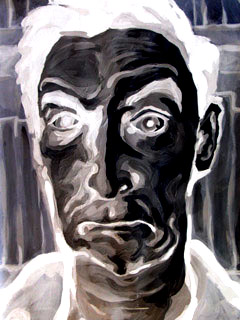
I'm stunned... Professor Ichbonnsen, my eccentric employer -- is dead!
Apparently he died from being bitten by the venomous "Amazon Dragon." His intern Scarlet (no relation to this blog) posted the announcement earlier this morning.
When Ichbonnsen first contacted me, I was incredulous.
When my friend Mike declared that Ichbonnsen was a fraud -- and the Professor started getting argumentative -- I was dismayed.
However, as time passed and I began checking out some of the Prof's stories, I became increasingly impressed with the science behind Monster Month. If everything that he said was false, then this is one of the most elaborate and well-researched hoaxes I've ever encountered.
When I agreed to illustrate monsters for him, I thought that he was just going to send me descriptions to work from... But no! He would send me photographs (admittedly blurry), his own sketches, accounts from other witnesses -- and even the occasional sound recording.
The way in which he delivered this evidence was also compelling...
Folks who only read the Scarlet Letters blog may not even be aware of what all was going on this month. All through October, Ichbonnsen and Scarlet were traveling around the world... So in addition to posting my paintings on the Monster Month blog, they were writing up stories about the exotic locales they visited, and the adventures wherein several new monsters were discovered.
Often this meant that I had very little turn-around time between when they gave me an assignment and when it was due. I can't really complain, though -- I feel like my skills in working with acrylics really bloomed. And that, after all, was one of my main goals when I signed-on.
I don't what I should do. I never met Ichbonnsen face-to-face. Yet, via email, we worked really intensely together. How to I measure that loss? What's an appropriate memorial?
Regardless of where the line between truth and fiction lies, I've developed a strong respect for the man. Here was someone who could hold onto his convictions tenaciously -- even in the face of near universal opposition.
Call it crazy if you will -- but still, that's a rare form of bravery.
Rest in peace, Ichbonnsen.
posted by sven | permalink | categories: bestiary
From Brazil: The Amazon Dragon
by sven at 8:00 am
These are the Professor's words -- but they were posted by Scarlet?
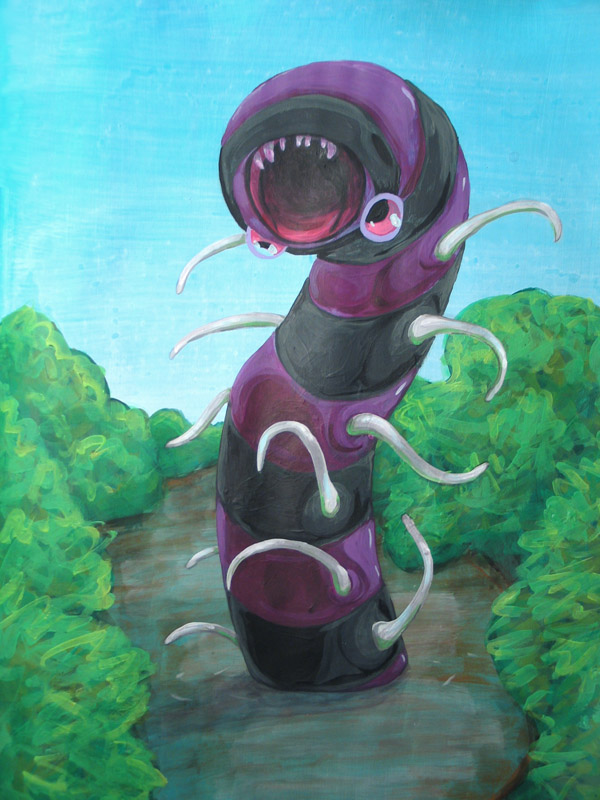
We are all familiar with the image of dragons as giant fire-breathing lizards with wings. The Amazon Dragon, however, is closer to the Medieval image of dragons as wyrms. That is to say, this creature is actually a monumental worm.
The "Dragon" was discovered by a Portuguese soldier circa 1600, deep in the Amazon jungle. From what I've been able to piece together, the animal was approximately 100 yards long. Its body is banded with alternating purple and black rings. It has rows of gray snake-like legs on either side -- rather like a millipede. Its face has been likened to that of a fish.
The creature seems to be amphibious. According to the soldier, it rises out of a river and breathes air -- then dives back beneath the surface.
I am in possession of a map -- drawn by the soldier himself -- that purportedly leads to the Amazon Dragon's lair. Comparing it with recent geological surveys, I think there is good reason to believe that there will be underwater caves in this area... Which would help explain how the great beast has remained hidden for so long.
Over the past four centuries there have been several further sightings of the Dragon. Each time, the size is reported as being significantly smaller than it was previously. The last sighting, in 1910, put the creature at a length of only 30 yards.
Is it shrinking?
posted by sven | permalink | categories: bestiary
October 30, 2007
Z - The Zompire Bat
by sven at 8:00 am
Reprinted with permission from Professor Ichbonnsen's Monster Month blog.
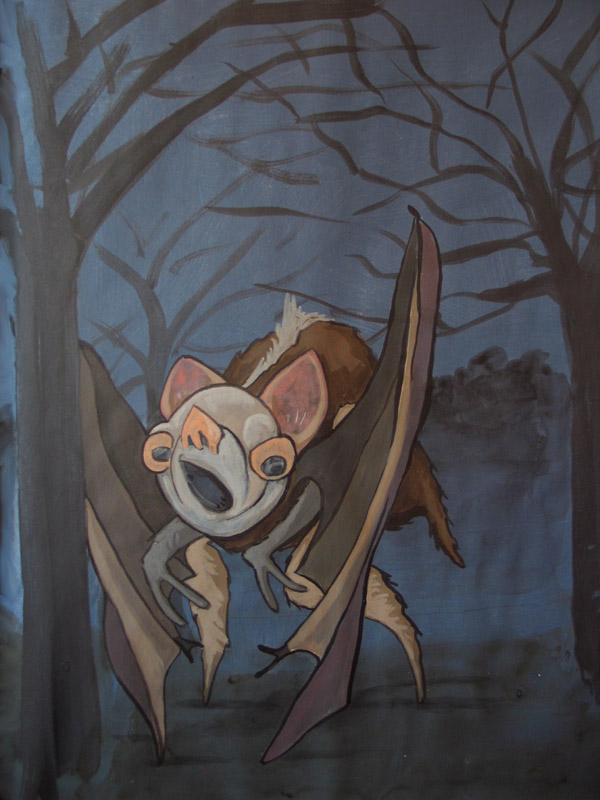
The Zompire Bat is a large South American carnivore related to the Vampire Bat. It stands about five feet tall and is found primarily in Argentina.
The bat's wingspan is approximately 20 feet -- however, it is too heavy to actually fly. It uses its wings instead to corral and capture prey, wrapping them in a deadly embrace.
The creature kills and eats large game: cattle, wild pigs -- and humans who are unwary. It is extremely messy, rending flesh, mangling the bodies of its victims... It actually only drinks their blood; the purpose of this behavior seems to be simply to create a good flow.
Zompire bats have very poor eyesight and are uncoordinated moving on the ground -- stumbling and dragging themselves about. When they hunt, they depend upon the element of surprise.
The bat digs a shallow hole and covers itself with dirt. When it senses that prey is near, it bursts from the ground -- imparting a sort of "dead rising from the grave" appearance. The wings trap its food, its powerful jaws clamp down, and the bat thrashes its head until blood is gushing everywhere.
Like other bats, Zompires use echolocation. However, whereas most species use high or even ultrasonic pitches, this creature uses subsonics (much as crocodiles do). The system only works effectively underground -- where perception extends in a 2 mile radius. Above ground, the portion of the call that is audible to humans sounds like hideous groaning and moaning.
Newborn bats are birthed directly into holes, where they are left to mature for several months. The bats seem most comfortable underground, and spend most of their lives hidden there. Wrapped in its own wings, a Zompire Bat looks quite like a large black seed pod or coffin.
It should be noted that the safest time to study the Zompire Bat is when it is hibernating during the winter months. It can be exhumed and examined for a brief period -- but under no circumstances should it be allowed to warm up. Dire consequences follow.
posted by sven | permalink | categories: bestiary
October 29, 2007
Y - The Yellow Riders
by sven at 8:00 am
Reprinted with permission from Professor Ichbonnsen's Monster Month blog.
Traveling in Australia, I met an old Gunwinggu man in the Northern Territory who told a strange tale. He reported seeing "little yellow people riding a dead man" some years ago. After weeks of fruitless searching, I finally did get a brief glimpse of the thing he described.
I was camped in the Simpson desert. Just after dawn, I woke to the sound of something rummaging through my provisions -- and there it was.
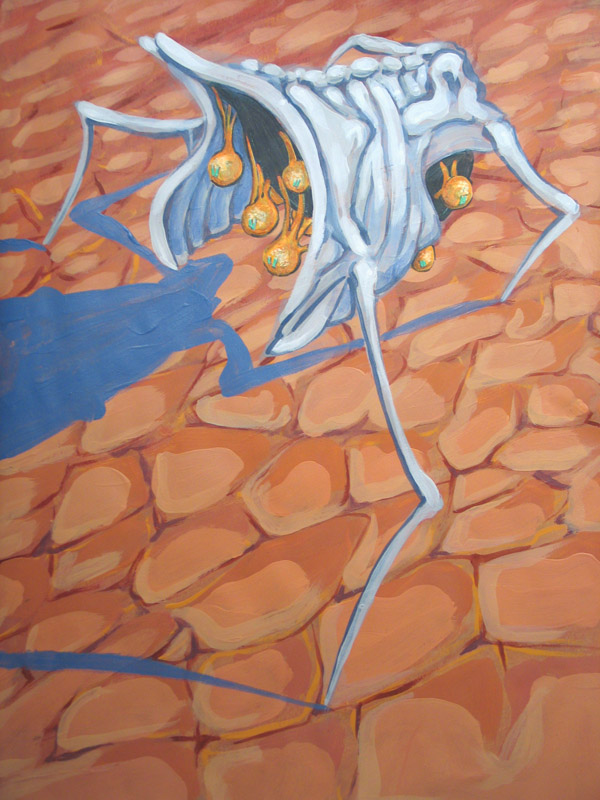
The creature looks much like a bleached human skeleton. One could easily believe that the emaciated thing is nothing but bones -- but it is covered by skin. It is headless, and moves on all fours. It doesn't have hands or feet, but rather insect-like points at the ends of its limbs. I was unable to see any sensory organs.
The ribcage is not closed; it hangs wide open, and is perhaps three feet wide. A large green-black sack hangs from the interior. I presume this is where the vital organs reside. It is also where the Yellow Riders dangle.
The Yellow Riders are small almost-spherical creatures with bright green eyes. There were perhaps fifteen attached to the skeletal being's ventral sack by sinewy roots.
As I came out of my pup tent, the Riders seemed to take notice -- making squeaky sounds and bobbing up and down. Their white mount took off at a gallop.
I leapt into my jeep and chased them across a field of cracking dried red mud... But the creatures quickly outpaced me -- meaning that the white thing can run at speeds in excess of 80 miles per hour.
I have no explanation for what this thing that I encountered might be. It seems likely that the Yellow Riders have a symbiotic relationship with the galloping creature... All I can say for certain, though, is that it likes peanut butter.
posted by sven | permalink | categories: bestiary
October 28, 2007
X - The Xem
by sven at 9:00 pm
Reprinted with permission from Professor Ichbonnsen's Monster Month blog.

The Xem is a small subterranean creature, about the size of a hat. It feeds on rotting tree roots between 4 and 20 feet underground.
It has a coat of short fur and a small mane around its head -- all of which is dingy black-brown. However, under black light the creature fluoresces a brilliant blue. This makes it much easier to spot, if one is using a sub-surface periscope.
The Xem has four two-fingered limbs and no tail. It is slow-moving, but sure-footed. The round head has two enormous eyes, but no nose or mouth for breathing. Its metabolism is almost entirely anaerobic.
The Xem's jaws are located in its midsection. The creature's ribcage is hinged at the spine; it has rows of tiny teeth where most animals would have a sternum. As the body swells and contracts, chewing is easily mistaken for breathing.
Xems live in small colonies of a dozen or so creatures, which move through underground tunnels between the trees that they depend upon for food. The adult Xem's fingers are not suited for digging; all of the tunnel systems are created by the young.
Infants are born in litters of 30 or more. At birth, the creatures have tough webbing between their fingers, ideal for excavation. Unlike their slow-moving elders, the young move about at a rapid pace, carving out living spaces for the next generation.
For unknown reasons, Xems have extremely high infant mortality rates: almost 90% of the young die within a month of birth. The bodies are transported to the lowest room in a tunnel system and left in piles to decay.
The sacrifice of the young does seem to serve an evolutionary purpose: many workers are needed to create living spaces -- but there are not enough tree roots to support such a large population. It has been speculated that a minority of Xems are born with a slower metabolism -- and that these ones are the few who survive into adulthood, while the rest simply burn out.
posted by sven | permalink | categories: bestiary
October 27, 2007
From Desolation Island: The Kerguelen Zorn
by sven at 9:45 pm
Reprinted with permission from Professor Ichbonnsen's Monster Month blog.
Little is known for certain about the Kerguelen Zorn. My belief is that it is a human mutation induced by viral infection.
The creature in question was clearly human to begin with. Evidence suggests that the transformation from man to zorn can take up to two weeks. In some cases, however, it occurs in a single day.
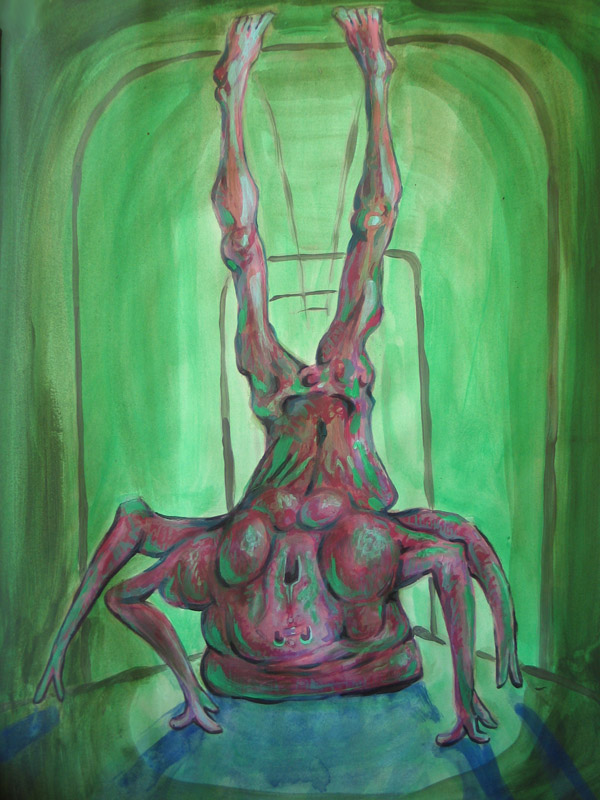
The infected person's skin becomes dark magenta -- as if it has been boiled. The head and torso become filled with fluid. The face and neck become so distended, they practically disappear.
Having become massively top-heavy, the organism inverts --- it drags its former head on the ground, and its legs stick straight up in the air. It appears that rigor mortis takes over in the legs... They become stiff, and much of their color drains away. The arms each split into two new limbs. Separation begins between the ulna and radius; one of the new limbs will have two fingers -- the other will have two fingers and a thumb.
The creature, now with four lower limbs, walks somewhat like a spider -- but dragging its slippery, sagging mass along on the floor. It is apparently blind, and finds its way by frantic, groping touch. In a low hallway, the dead legs may bump and drag above it -- almost giving the impression that the thing is walking on the ceiling.
The zorn-producing virus is highly contagious -- likely being transmitted by physical contact. My suspicion is that the virus originates from the submerged microcontinent beneath the Kerguelen Archipelago (AKA "Desolation Island"), which sunk into the ocean some 20 million years ago. I believe that an illegal oil-drilling operation recently unearthed the disease.
I have attempted to "quarantine" the virus. I hope and pray that no Kerguelen Zorns have survived.
posted by sven | permalink | categories: bestiary
October 25, 2007
V - The Vivecta
by sven at 12:00 pm
Reprinted with permission from Professor Ichbonnsen's Monster Month blog.
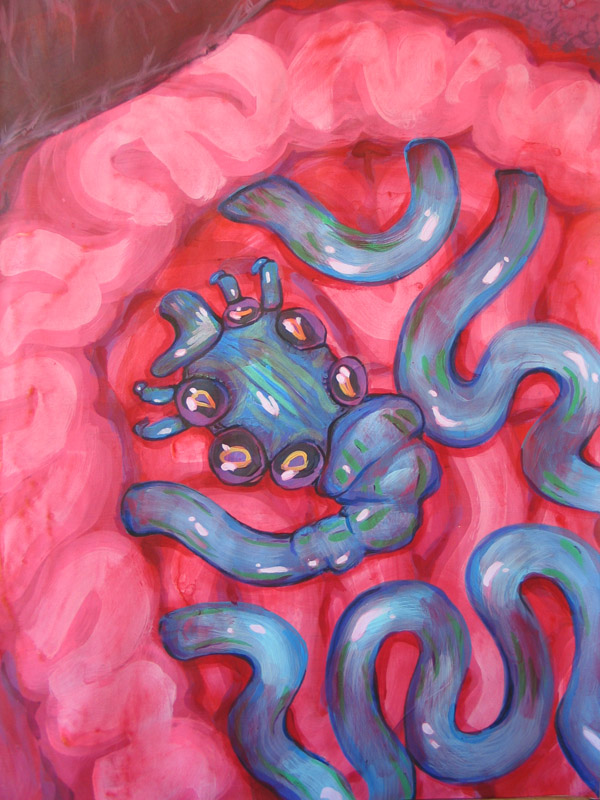
The Vivecta is a hideous intestinal parasite. It is found in The Congos, and is associated with swampy areas.
Parasitic worms typically enter the host organism orally, and then attach to the interior walls of the gastro-intestinal tract. The Vivecta is unusual in this respect; it enters its host by burrowing through the skin, and then attaches itself to the outer wall of the intestines.
At this point in its life, the Vivecta looks like a twelve-eyed, blue-green iridescent beetle. Cutting pincers at either end of the body make incisions into the intestine. Partially digested food passes from the first incision, through the Vivecta's body, and back out through the second incision into the host again.
As the parasite ages, the carapace splits in two, and a long, ropey body develops between the two "heads". Each head progressively clamps down on the intestine with four strong legs -- until the Vivecta's body completely bypasses normal digestive flow. In essence, the parasite simply becomes an extra length of intestine.
In the late stages of its development, the Vivecta can measure 20+ feet in length. In cattle and in humans, presence of the parasite is sometimes mistaken for pregnancy. Hosts are typically somewhat malnourished -- but otherwise in good health.
Reproduction is parthenogenetic. Dozens of worm-like larva develop off the hoods of the two heads. They grow quickly while in the host's body, until after a week they are approximately nine inches long. Whereas the original Vivecta passively conforms itself to the shape of the host's existing digestive tract, the infants writhe spasmodically -- which is disturbingly visible through the skin of the the host's abdomen.
The larval Vivecta leave the host en masse, first burrowing through the intestine's wall, then passing out all at once through the nether orifice. The many perforations that they make in the intestines cause severe septicaemia, which almost always results in death for the host.
There are three distinct phases in the Vivecta's life cycle. After leaving the host's body, the larvae look like black, twelve-eyed snakes. Legless, they slither outward into the environment seeking soft, wet earth in which to burrow. When they find a suitable spot, the "snakes" dig into the ground and cocoon themselves in masses of sticky fiber.
Two weeks later, the Vivecta emerge -- in the form of a small winged fly. The flies seek out warm-blooded hosts... And the life cycle begins again.
posted by sven | permalink | categories: bestiary
October 24, 2007
U - The Ubertuber
by sven at 8:00 am
Reprinted with permission from Professor Ichbonnsen's Monster Month blog.
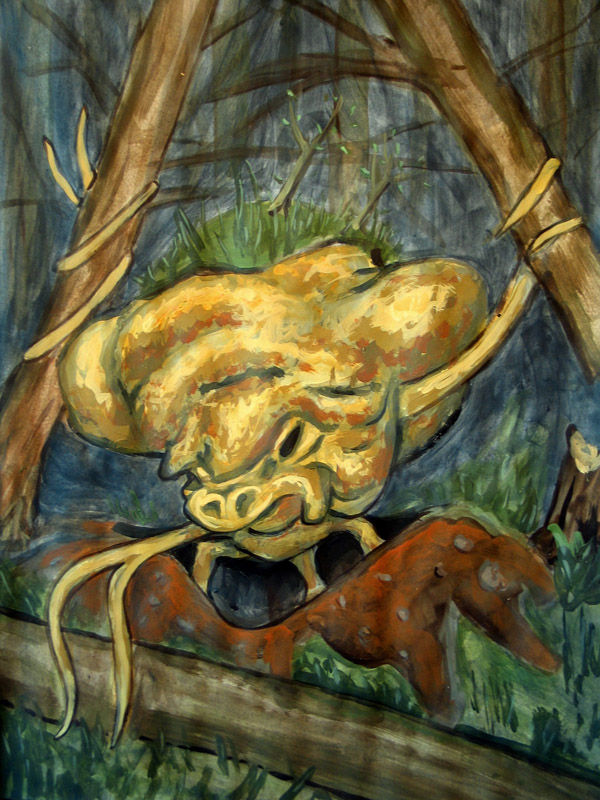
Ubertubers are currently the largest known species of sentient root. At maturity, the average plant has a mass equal to that of five elephants. Based on available data, it is believed that an Ubertuber's life-span is between 700 and 900 years.
Despite having consciousness, the tuber will spend most of its life in a vegetative state, passively absorbing nourishment from the environment. Only in times of emergency do the colossal plants become active, uprooting themselves for self-defense: e.g. when threatened by a forest fire, logging, or mining operations.
When awakened, the Ubertuber seeks immediate escape. If necessary, it is a fearsome foe -- tearing down trees and wielding them as weapons. Once it gets away from what threatens it, the plant will walk several hundred miles to find a suitable new home.
The root is semi-parasitic. It derives minerals and water from the soil -- but for certain nutrients, it taps into the trees around it. Consequently, one of the best ways to find an Ubertuber is to search a forest of great old tall trees for a patch where the trees are mysteriously shrunken and shriveled.
Ubertubers reproduce asexually by means of spores, which are released into underground streams. The reproductive cycle is usually triggered by flooding, when the water table is especially high. Given that Ubertuber populations are able to expand subterraneously, we currently have no clear idea how geographically widespread the plants are, or how many exist.
posted by sven | permalink | categories: bestiary
October 23, 2007
T - The Trick Squilligoss
by sven at 8:00 am
Reprinted with permission from Professor Ichbonnsen's Monster Month blog.
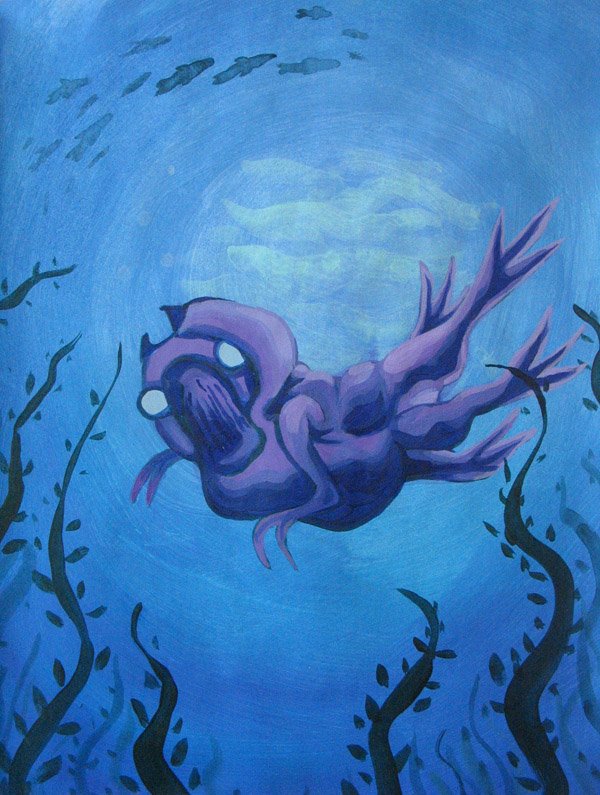
The Trick Squilligoss is a large oceanic amphibian found in the vicinity of Australia. The adult animal is between 8 and 16 feet in length. In appearance, it looks rather like a cross between a frog and a squid. It spends most of its time in deep ocean waters -- but has increasingly been sighted coming onto land.
The Squilligoss has four legs with webbed, three-toed feet. The legs have a cartilaginous skeleton that allows the creature to stand upright on land -- and also a muscular "skirt" which it can use for propelling itself underwater. There are two thin arms, which attach internally to a sort of flexible ribcage. Like squids, the creature's head has a mantle. Its beak is situated at the front of the body when swimming -- or on top of the head when it's standing. There is an air bladder on the ventral side of the head, along with two faintly bioluminescent eyes.
Normally, the Trick Squilligoss preys upon giant squid... However, due to decreasing populations of squid, the animal has increasingly been coming onto land to raid herds of cattle. Squilligosses appear in the local folklore of certain areas as a "Screaming Devil."
The Squilligoss' unearthly appearance easily "tricks" people into thinking that it is a supernatural apparition. Standing upright, the beak looks like horns. The neck bladder collapses and becomes wrinkled in a way that makes it look rather like a wide mouth with rows of long teeth. The mantle appears to be the grim cowl of a robe. Underwater, the beast emits high-pitched shrieks as a form of echolocation; on land these alien calls sound like "screaming."
The Trick Squilligoss only appears on land at night. Being most used to traveling in the murky depths of the Tasman sea, its eyes are sensitive to daytime light levels. Given the poor lighting conditions under which it has always been seen, it's not difficult to understand why terrified eye-witnesses would misinterpret what they're seeing...
A ghastly silhouette with glowing eyes, crouched over and feeding upon the mangled corpse of a cow -- a shadow twice the height of a man, which turns and lets out a blood-curdling shriek when disturbed.
posted by sven | permalink | categories: bestiary
October 22, 2007
S - The Slivener
by sven at 8:00 am
Reprinted with permission from Professor Ichbonnsen's Monster Month blog.
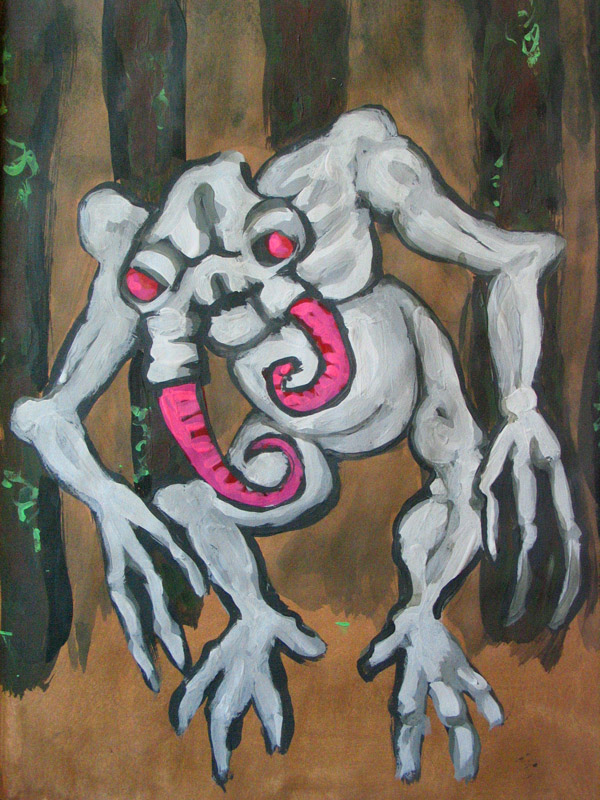
The Slivener is a twelve-foot-tall giant living deep in the forests of Kazakhstan. It is humanoid, has paper-white human-like skin, and seems to be nocturnal.
Not enough is currently known about the animal's biology to properly classify it. In some respects it is like a great ape, but in others it is more like a frog or the common housefly.
The most remarkable thing about the Slivener is its tongue. At first glance, it seems that the creature has pink, writhing tusks. However, it turns out that this is actually a single organ that protrudes from two facial orifices.
Bafflingly, the enormous snake-like tongue is unattached to the rest of the organism. It is able to slide back and forth between sides of the creature's face, always becoming longer on one side and shorter on the other.
The leading explanation for this is that the tongue is actually a separate, symbiotic animal. If so, we are looking at a truly unique evolutionary partnership.
One must ask: Can the tongue survive independently if removed from the Slivener? And if so, for how long?
Initial experiments aimed at answering these questions have proven... ill-advised. Further research -- and further researchers -- will be required.
posted by sven | permalink | categories: bestiary
October 21, 2007
R - The Rasch
by sven at 8:00 am
Reprinted with permission from Professor Ichbonnsen's Monster Month blog.
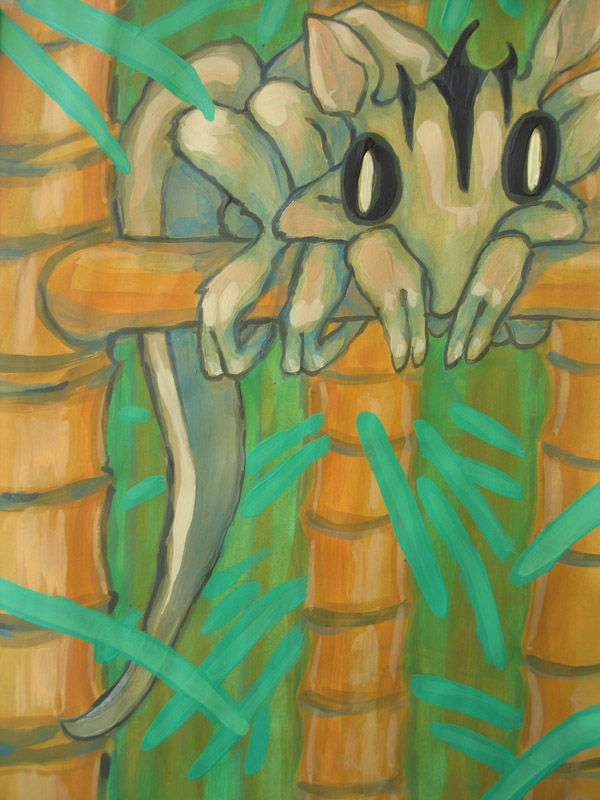
The Rasch is a six-legged marsupial that lives deep in the bamboo jungles of China. It is named after the German explorer who first brought news of it to the Western world in 2006. Strangely, Chinese cryptozoologists don't seem to have been aware of its existence before then.
The animal is primarily arboreal, and has a long tail that helps it keep balance as it leaps from tree to tree. The fur is predominantly light gray, with three distinctive black stripes on the head. Its eyes are often said to be "flashing"; they are usually so dilated that they appear entirely black -- except for when light reflects off the retinas and they seem to glow (much like a cat's eyes at night).
The Rasch is highly animated. It has a metabolism that is in over-drive. During the course of a 24-hour period it never sleeps. It is in constant motion seeking out flying insects, which are its food. Every action is fast, alert, and precise.
The price for life on fast-forward is an early grave. The Rasch is only conscious for three weeks. At the end of this period, it buries itself deep in a burrow and goes into a comatose state -- which it will remain in for the rest of its life, approximately 15 years more.
When the Rasch goes dormant, it takes its offspring with it to this "grave". The several young it has in its pouch will spend the next decade slowly developing -- before bursting to life for their own brief period of consciousness.
One must wonder: Sleeping for almost 25 years of its existence, what does a Rasch dream about?
posted by sven | permalink | categories: bestiary
October 20, 2007
the science of monster month
by sven at 12:00 pm
I've been looking into the Prof's claims -- and there's more truth to them than I would have initially thought!
Using wikipedia.com as an easy place to begin my research, I've dug up a fair amount of supporting evidence... And the info that I'm finding is pretty interesting in and of itself. I'd like to share some of the more remarkable bits that I've found here.
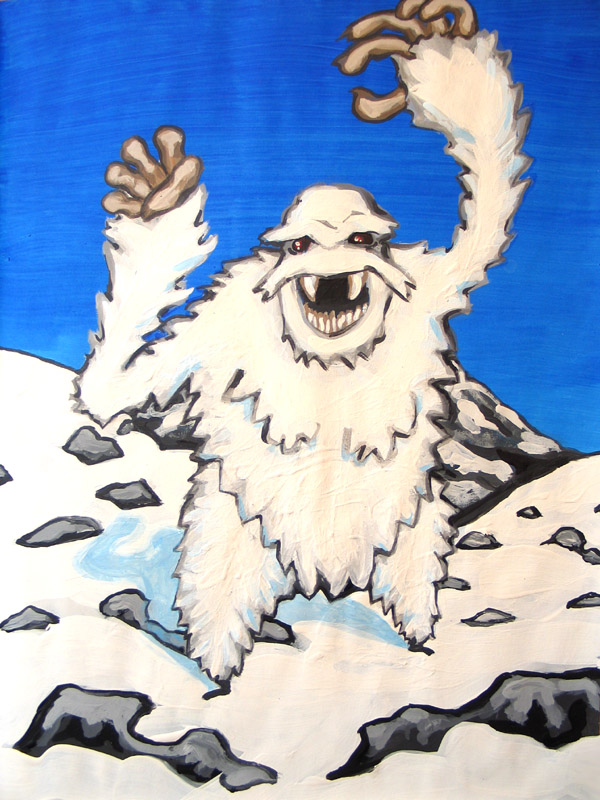
It really rubbed me the wrong way when Ichbonnsen claimed that Jane Goodall believes in Sasquatch... But it's true!
Sasquatch
In a 2002 interview on National Public Radio, Jane Goodall first publicly expressed her views on Bigfoot, by remarking, "Well now, you'll be amazed when I tell you that I'm sure that they exist... I've talked to so many Native Americans who all describe the same sounds, two who have seen them. I've probably got about, oh, thirty books that have come from different parts of the world, from China from, from all over the place...."

The Prof mentioned that Littlefoot is related to "Gigantopithecus." Check this out:
Gigantopithecus
Gigantopithecus was a genus of ape that existed from as long ago as five million years to as recently as 100 thousand years ago in what today are China, India, and Vietnam, placing Gigantopithecus in the same time frame and geographical location as early hominids such as Homo erectus. The fossil record suggests that the Gigantopithecus species were the largest apes that ever lived. [...]
Based on the slim fossil evidence--primarily huge molars nearly one inch square recovered from Chinese traditional medicine shops, but clearly genuine - Gigantopithecus likely stood about 3 metres (9 feet) tall and weighed from 300 to 500 kg (660 to 1100 lbs.). This is two to three times larger than modern gorillas, although its closest living relatives are the orangutans.

Ichbonnsen says that Littlefoot lives on Mount Shishapangma...
Shishapangma
Shishapangma (officially: Xixiabangma) is the fourteenth highest mountain in the world and the lowest of the eight-thousanders. It was the last 8,000 metre peak to be climbed, due to its location entirely within China and the restrictions on outside visitation to the region imposed by the Chinese during the 1950s and later.

It makes sense to me that a "cryptid" could stay hidden there for a long time. Mountain climbers aren't going to pay as much attention to the fourteenth highest mountain, I imagine. And given China's control of the area, it's going to be more difficult to get access to the place. The Prof did mention that the initial evidence for the creature had to get smuggled past Chinese officials...
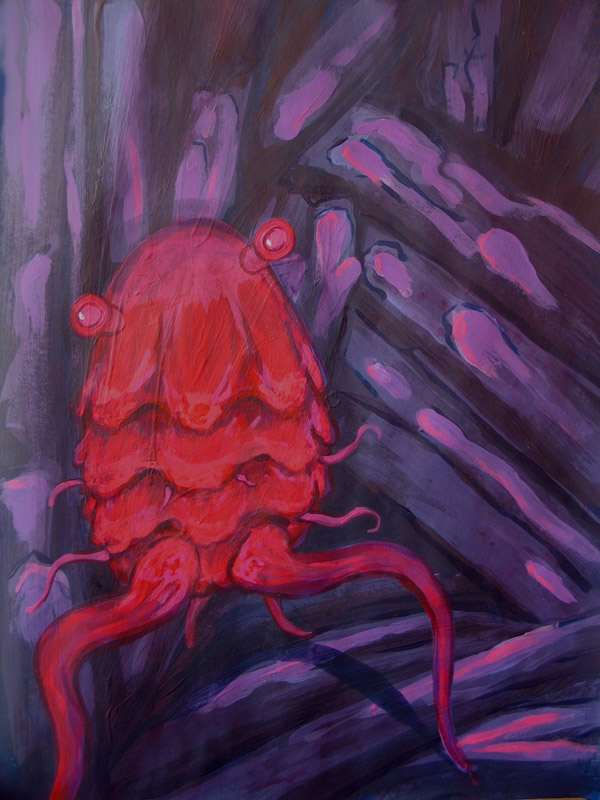
The Prof says that the Grrrheart lives in a deep cave, which was accidentally opened up by coal miners. I'm thinking to myself, not everywhere in the world has caves -- let's check the geological accuracy of this claim.
Cave Research in India
In India, biospeleological research is still in its infancy. Although there are thousands of caves in this country, research work that is being carried out currently is restricted to very few cavernicolous taxa. The state Meghalaya of India is famous for existence of maximum caves.
OK, so I guess Meghalaya really is a plausible location for a cave to be found. But what about coal mining? It's not like you can find coal mines just anywhere...
Meghalaya
Meghalaya is considered to have a rich base of natural resources. These include minerals such coal, limestone, silimanite, Kaolin and granite among others.

Oh. Guess that part of the story checks out OK...
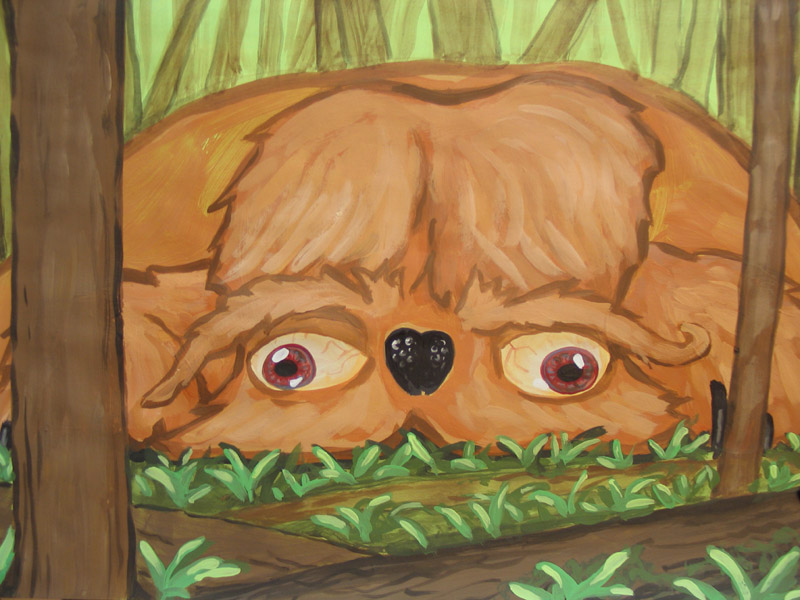
Ichbonnsen made this outrageous claim about North Korea digging tunnels underneath the Demilitarized Zone into South Korea. You've got to be kidding!
Third Tunnel of Aggression
The Third Tunnel of Aggression is a tunnel under the border between North Korea and South Korea.
Only 44 km (27 mi) from Seoul, the Third Tunnel of Aggression was discovered in October of 1978. It is 1.7 km (1.1 mi) long, 2 m (6.5 ft) high and 2 m (6.5 ft) wide. It runs through bedrock at a depth of about 73 m (239.5 ft) below ground. It is apparently designed for a surprise attack on Seoul from North Korea, and can easily accommodate a full division per hour along with their weaponry. A total of four tunnels have been discovered so far, but there are believed to be up to ten more. South Korean and U.S. soldiers regularly drill in the DMZ in hopes of finding more. Its description as a tunnel of aggression was given by the south, who considered it an act of aggression on the part of the north. North Korea tried to downplay the shaft, officially declaring it part of a coal mine. Black "coal" was painted on the walls to help confirm this statement. Additionally, observed drill marks for dynamite in the walls point towards South Korea. Photos are forbidden within the tunnel, which is now well guarded. The South Koreans have blocked the actual Military Demarcation Line in the tunnel with three concrete barricades.
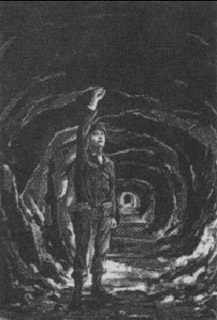
Whoa. OK, that blows my mind.
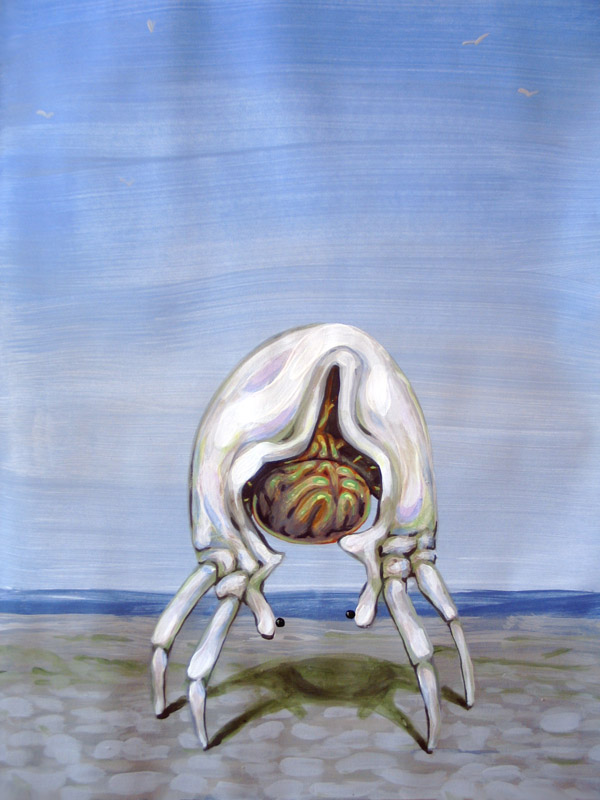
Yesterday's monster supposedly lives on a big Russian island that used to be used for nuclear testing. That ought to be easy enough to check out...
Novaya Zemlya
Over its entire history as a nuclear test site, Novaya Zemlya hosted 224 nuclear detonations with a total explosive energy equivalent to 265 megatons of TNT. For comparison, all explosives used in World War II, including the detonations of two U.S. nuclear bombs, amounted to only two megatons.

Sure enough -- it's real!
Obviously none of this proves that the Prof isn't making up the creatures he describes. But if they are fictional beasts, then he certainly seems to be going out of his way to make sure their back stories hold together.
I still have my doubts... But I'll confess, Ichbonnsen is opening up my horizons a bit.
I live a cozy little existence in an American city, spending my days making art in our studio. It's easy to feel like this is all there is. But the more I look into the world of "Monster Month", the more I realize that the world is really a very big -- and often genuinely strange -- place!
posted by sven | permalink | categories: bestiary
Q - The Quillaupus
by sven at 8:00 am
Reprinted with permission from Professor Ichbonnsen's Monster Month blog.

The Quillaupus is native to New England, where it is usually found amongst woods of birch trees. It is furry, with blue and purple stripes. This makes for terrible camouflage -- which is presumably why it evolved to arboreal existence.
The animal has many sharp quills -- and many sharp eyes for sighting its prey. Its method of attack: the prehensile tail loosens its grip on the tree branch where the creature hangs, and the Quillaupus simply drops down upon its victim from above.
The typical Quillaupus is approximately the size of a raccoon; it preys primarily upon squirrels and birds. However, there is record of one Quillaupus that grew large enough to swallow a grown man in one fell swoop. Luckily for this man, the beast's teeth became lodged in the soil, and he was able to dig his way out to safety.
posted by sven | permalink | categories: bestiary
October 19, 2007
professor ichbonnsen validated?
by sven at 2:28 pm
OK, I'm a little freaked out.
Jeffrey's cousin, Raymond J. Legrasse, has reported seeing these creatures in the bayou that he calls "Ocean Folk"... And they look exactly like what Professor Ichbonnsen calls "Polycephalic Forg-men!"
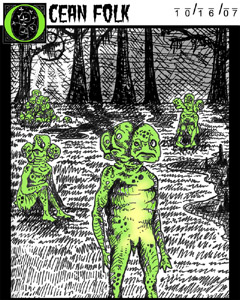
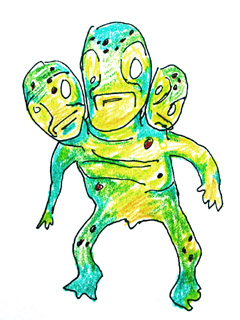
In my initial post about Professor Ichbonnsen I was, shall we say, skeptical.
I mean...Monsters? Really?
But this report about "Ocean Folk" -- it constitutes independent validation! ...Could Ichbonnsen actually be telling the truth?
posted by sven | permalink | categories: bestiary
P - The Pak Mozg
by sven at 8:00 am
Reprinted with permission from Professor Ichbonnsen's Monster Month blog.
"Pak Mozg" roughly translates from Russian to English as "brain crab." It is a species that has recently been found on the southwestern coast of Novaya Zemlya -- an archipelago to the north of Russia, relatively close to Scandinavia.
What makes this crab interesting is that it has an exceptionally large brain, which dangles exposed beneath its dorsal shell. The ventral shell is entirely missing. This makes the crab quite vulnerable to attacks from seagulls -- but it is also, presumably, what makes the prodigious brain development physically possible.
The typical adult Pak Mozg is approximately 10" wide and 14" tall. Its dorsal shell is high and crested, which makes it look somewhat like a helmet. To an extent, this unusual shape helps deflect gulls' attacks.
If the crab is turned over, you can see the web of its nervous system adhered to the shell -- as well as a vestigial stomach lining. The creature seems to subsist solely upon zooplankton, which are captured by a swath of microscopic flagella. Two beady black eyes dangle from protuberances at the front of the shell. The only significant musculature occurs within the creature's four legs.
From 1954 to 1990, Novaya Zemlya was used as a nuclear test site; in the end, it hosted a grand total of 224 detonations. While there is no definite link between the tests and the appearance of the Pak Mozg, the concurrence of these events merits further investigation.
At this point in time, it seems that only a handful of fishermen have taken note of the new species. The ones I've spoken to jokingly refer to it as "the intellectual." When they see gulls flip the crabs over and peck out the brains inside, wry comments are made about the appetites of these "government agents."
Whether or not Pak Mosgs survive into the future is uncertain. On the one hand, they are astonishingly vulnerable to predators -- which seem to enjoy the crabs as a sort of delicacy. On the other hand, the animal displays a high degree of intelligence and adaptability.
It is known, for instance, that the first recorded generation of crabs attempted to lay its eggs on land in the daytime -- and was consequently slaughtered en masse by hungry birds. In the following generation -- several years later -- the crabs appear to have avoided the threat by laying their eggs at night. The most recent generation is reported to have stolen nets from nearby fishing boats -- and actually laid rudimentary traps for the predators.
It will be very interesting indeed to see how this trend develops over time.
posted by sven | permalink | categories: bestiary
October 18, 2007
O - The Opium Gore Golem
by sven at 8:00 am
Reprinted with permission from Professor Ichbonnsen's Monster Month blog.
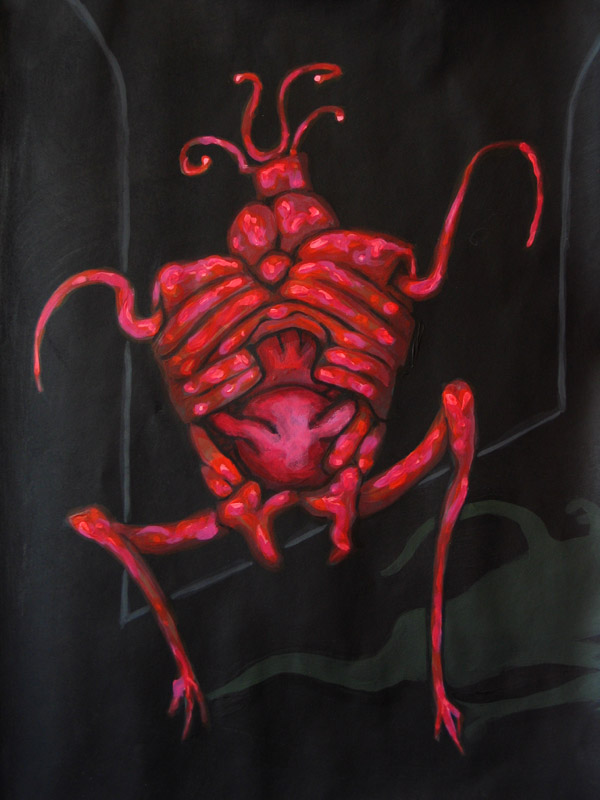
The story as it's told is this: The most powerful and vicious drug lord in Afghanistan captured and enslaved a wizard. After suffering hideous torture, his body and will broken, the wizard finally consented to do his captor's bidding -- to summon up a commando of demon soldiers. The Gore Golems' bodies were constructed from the entrails of a hundred slaughtered enemies, and then animated by each being fed a portion of the wizard's own soul. The grizzly monsters now serve as the drug lord's personal body guard. They are unstoppable in battle; even the bravest man is paralyzed with fear when confronted by their demonic visage.
The truth of the matter is more mundane -- yet no less strange.
The "Gore Golem" is a semi-intelligent, quasi-insect species imported from the deep caverns of Mars. It is believed that six are currently on Earth, and it is true that they are in the possession of an Afghan Opium cartel.
The creature -- whose proper name is unknown -- is a horrid sight to behold. It stands between eight and nine feet tall. The barrel chest has two overlapping ribcages, and an exposed double-stomach digestive system. The thing is covered in grizzly, glistening shell armor -- which sweats blood, so that it's constantly coated with a wet red sheen. It is bipedal, walking on skeletal legs that somewhat resemble those of a grasshopper. The arms are dangerous whipping tentacles. The mouth is concealed in a thick, stump-like neck -- which is guarded by four miniscule eyes at the ends of long, prehensile stalks, that look quite like writhing worms.
"Gore Golems" are not intelligent enough to act as independent mercenaries; their mental capacity is similar to that of a trained horse. However, the animals are deeply susceptible to hypnotic suggestion. By entering a drug-enhanced meditational state, human handlers are able to command the "Golems" almost as if they were extensions of their own mind.
Indeed, over time as the telepathic bond between handler and animals increases, the human becomes able to control them from great distances -- even when they are miles away and out of sight. Given the tactical advantages this presents, drug lords are prone to choose their best and brightest soldiers to manage the Martian beasts. But, the power that the "Golems" grant is not without a price. Human beings who attempt to control these terrifying instruments of death are quickly drained of their mental and physical strength; no master has ever lasted more than six months.
When the handler dies -- eyes wide open, mad and staring -- the "Golems" go into a wild frenzy, killing and destroying everything in their path. Recapturing them and putting them under human control again is a difficult feat, always accompanied by loss of life.
Among certain opium-trafficking drug lords, possession of the "Golems" has become something of a status symbol. More than once, one of these men has ruthlessly executed a rival and tried to steal the beasts for himself. It is rumored that during a botched attempt at theft, one of the six animals escaped, and has since been running amok somewhere in the Hindu Kush mountains.
Cartel use of these creatures violates both international and interplanetary law (United Nations special code). My "foreign contact" has hinted that a mission may be afoot on his end of things to deal with the problem -- but details beyond this are not forthcoming.
A last detail, which I am reluctant to mention. Beyond the sheer physical power of the "Opium Gore Golems", and the undeniable psychological impact that they have on their foes, the creatures are also valued for their detachable shadows. When commanded to, the animal goes into an inscrutable dormant state, and its shadow rushes off from battle to report to its human master. I have witnessed this with my own eyes... And while I have no explanation as yet for how such a thing is possible, I continue to insist that it cannot be "magic."
posted by sven | permalink | categories: bestiary
October 17, 2007
From India: The Grrrheart
by sven at 8:00 am
Reprinted with permission from Professor Ichbonnsen's Monster Month blog.
The Grrrheart looks like a red jellyfish with four strong tentacle legs. The average specimen is approximately 2 feet tall, and has two eyes on stalks at the top of its body. The body appears to be composed of three overlapping "caps," from which lesser tentacles protrude. The entire animal is somewhat translucent.
The only known examples of this species were discovered in 2007 in a deep cavern in the Indian state of Meghalaya. They are apparently amphibious, being equally at home on land and in the water. It is hypothesized that they subsist on cave crickets and fish -- although evidence to support this idea has yet to be gathered.
Grrrhearts are profoundly malleable. They are able to travel quickly through cracks in the stone that are no more than an inch in width. It is unknown whether this is a prehistoric species that became trapped underground far in the past, or if it is more closely related to modern day jellyfish -- possibly even going back and forth between the caves and outside bodies of water. The fact that the animal is not blind lends some support to this second possibility.
The Grrrheart lives in large communities. When one animal is threatened, it lets out a warning cry -- which sounds much like the furious growling of a small dog. Dozens of Grrrhearts will rush to its aid.
Despite this fearsome first impression, however, the Grrrheart seems to have a generally non-aggressive, even playful nature. When gathered all together, great numbers of Grrrheart have been observed apparently "dancing" with each other, simply for the pleasure of it.
posted by sven | permalink | categories: bestiary
October 16, 2007
N - The Noble Shelkay
by sven at 8:00 am
Reprinted with permission from Professor Ichbonnsen's Monster Month blog.

The Noble Shelkay is sort of a half-onion, half-periwinkle, half-rose creature. It lives in the most ancient of forests, building nests inside of enormous, mossy old trees.
Noble Shelkays live in small colonies with their own kind, eating flowers. They appear to co-exist quite harmoniously with the birds, mice, and moths that also share their tree-homes. The creatures seem utterly content; only on the rarest of occasions will Shelkays venture away from the nest.
The Noble Shelkay has a pretty chirping voice. The sing-song sounds it makes may in fact be a language -- but as of yet it has proven incomprehensible.
posted by sven | permalink | categories: bestiary
October 15, 2007
M - The Mountain Howler
by sven at 8:00 am
Reprinted with permission from Professor Ichbonnsen's Monster Month blog.

The Mountain Howler is native to Canada's Yukon Territory. It looks rather like an enormous yellow slug with two legs and a cavernous mouth.
The Mountain Howler is typically 2-3 feet in length. It consumes moss and lichen as it climbs sheer mountain cliffs. The Howler is distantly related to gastropods; however, unlike snails, its segmented shell grows internally -- providing it with a pseudo-skeleton. The rigid "legs" act much like pitons, assisting the animal during its climb.
The creature has no eyes to see with. However, it does have an excellent sense of hearing. When it comes time to mate, Howlers announce their presence to one another with an echoing breathy call, which sounds quite similar to a howling wind.
Like slugs, Mountain Howlers are hermaphroditic but need to come in contact with another of their species to accomplish fertilization. Also similar to slugs, concluding mating often requires apophallation.
posted by sven | permalink | categories: bestiary
October 14, 2007
L - The Littlefoot
by sven at 8:00 am
Reprinted with permission from Professor Ichbonnsen's Monster Month blog.
The Littlefoot is a white-haired carnivorous mountain ape indigenous to the Himalayas. Like the North American Sasquatch, this animal is an evolutionary descendant of Gigantopithecus -- a 9-foot-tall ape that lived as recently as 100 thousand years ago in China, India, and Viet Nam. At 12 feet tall, the Littlefoot now claims the title for largest ape ever to have walked the Earth.
Despite living in the same region, the Littlefoot bears no relationship to the mythical Yeti. Whereas notable primatologists such Jane Goodall have been convinced that Sasquatch exists, there is a consensus among serious scientists that the Yeti is a product of folklore and hoaxers.
However, that said, there are some important distinctions that must be made. "Yeti" is a catch-all moniker for several supposed animals, which include the Meh-Teh (the "classic" Yeti), the Teh-Lma (a three-foot-tall frog-eating Yeti), and the Dzu-Teh (a giant half-bear, half-ape creature, which walks on all fours). When people discuss the Yeti, it is almost exclusively the Meh-Teh that receives their attention.
My own research confirms that the Meh-Teh is most likely a product of the imagination... But the Dzu-Teh is quite real. It is what the Littlefoot eats.
The Littlefoot has several interesting adaptations that have preserved its anonymity for so long -- leading some to say that the beast is actually unfilmable.
First of all, there are its feet. In stark contrast with the Littlefoot's huge body, it has tiny little flat feet -- which make footprints easily mistaken for those made by a human wearing shoes.
Secondly, the animal lives in deep ice caverns, and only comes out to hunt during severe, near-blinding blizzards. Thus, eye-witness sightings are profoundly unlikely -- and the winds quickly obliterate the already misleading tracks that it leaves behind.
Thirdly, the Littlefoot is an extremely fastidious creature. When it kills its prey, nothing is left behind. It is careful to bring every bit of the Dzu-Teh carcass back to its lair. I have been lucky enough to get a glimpse of the ancestral caverns -- which after so many years, are now like bone cathedrals, meticulously decorated with thousands of old skeletons.
My having finally been able to track down a Littlefoot tribe's cave is almost entirely thanks to another man's misfortune. Three years ago, a fellow cryptozoologist became lost during a blizzard on Mount Shishapangma. He was tracking a Dzu-Teh -- but little did he know that a Littlefoot was just behind him, following the same trail. Camera in hand, he was about to photograph his "Yeti" -- when the Littlefoot struck...
But, just at that moment, an avalanche came tumbling down the mountain and took the lives of all three! Neither the researcher, the Dzu-Teh, nor the Littlefoot were ever found -- but miraculously the camera survived intact.
The story of how the camera came into the hands of the Chinese authorities, got smuggled out of the country, and then found its way to me -- is too involved to tell here. However, I would be remiss not to mention that there is a small movement afoot to rename the Littlefoot after the researcher who died discovering it: "Mullins' Yeti."
Despite my protests that the Littlefoot is an unrelated species, I expect sentimentality will win out and the name will stick.
posted by sven | permalink | categories: bestiary
October 13, 2007
K - The King Shielyana
by sven at 8:00 am
Reprinted with permission from Professor Ichbonnsen's Monster Month blog.
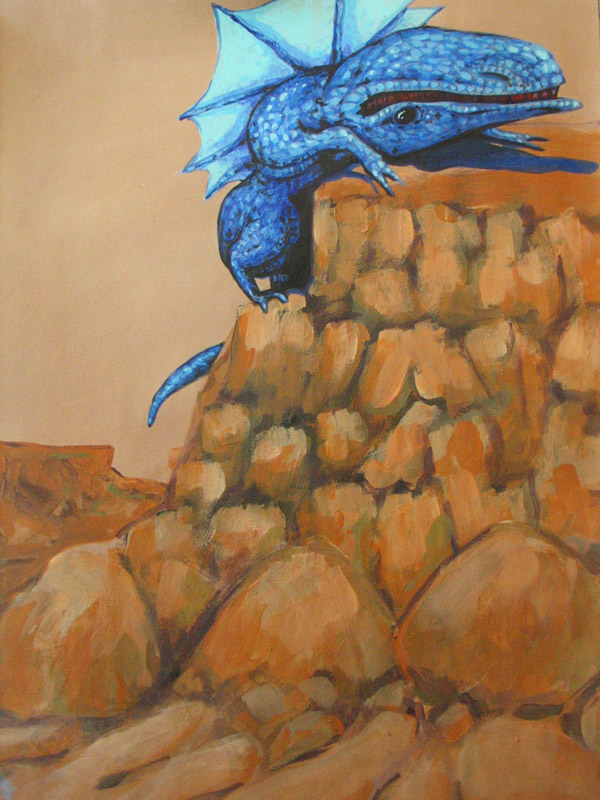
There are several varieties of Shielyana, including: the Dwarf Shielyana, Zompire Shielyana, Emerald Shielyana, and King Shielyana. Of these, the King Shielyana is the largest and most majestic -- being approximately 50 feet long and covered with shining sapphire-blue scales.
Shielyanas are essentially a form of land whale. All cetaceans (whales, dolphins, and porpoises) are descendants of land-living mammals; Shielyana aside, their closest living relative is the Hippopotamus. In a moment of evolutionary indecision, after having returned to the oceans where all life began, Shielyanas decided that life on land really was better after all. Going from one extreme to the other, the Shielyana's aquatic forebears moved as far inland as possible and became desert dwellers.
The King Shielyana is native to the Sonoran Desert, with the majority of specimens being found within Arizona's state borders. Whereas most desert animals find shade during the hottest part of the day, the Shielyana thrives in the heat, and seeks out all-bright locations. The animal regulates internal temperature by raising or lowering its webbed dorsal fan.
Instead of teeth, the King Shielyana has baleen plates growing from its upper jaw, which allow filter-feeding. The animal's diet consists primarily of pollen and air-borne desert krill.
Shielyanas lead a solitary existence until it comes time to mate. Once they have a found a suitable partner, they spend the rest of their life traveling as a pair. The animal typically bear two young per litter.
posted by sven | permalink | categories: bestiary
October 12, 2007
J - The Jrumiglior
by sven at 8:00 am
Reprinted with permission from Professor Ichbonnsen's Monster Month blog.
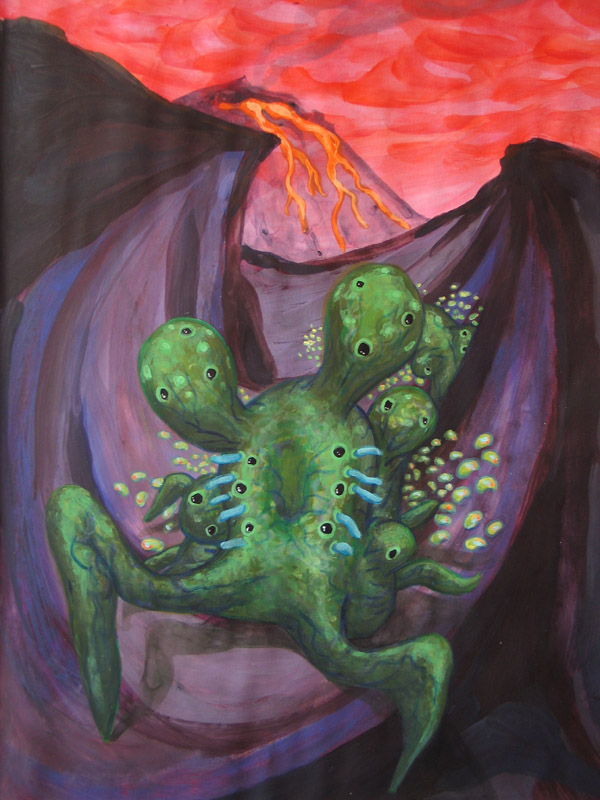
The Jrumiglior is unique in the literal sense: only one such animal currently exists on Earth.
It is non-terrestrial in origin, having come to our planet in a meteor approximately 400 million years ago. It is not, however, independently space-faring. Evidence suggests that it was sent here by a second species, as part of a colonization effort.
The Jrumiglior exists in two distinct states: dormancy and activation.
In its dormant state, the animal becomes utterly rigid and its color turns to a slate gray. It is easily mistaken for a surreal stone statue.
Activation is triggered by extreme heat (in excess of 300°F). When the Jrumiglior's environment reaches this temperature, its blood / internal fluids re-liquify, and normal metabolic functions resume.
When dormant, the animal is frozen in a curled up position -- much like a pill bug -- and it is approximately the size of a small car. When activated, it unfurls itself, revealing a form 30 feet in length that is simultaneously reminiscent of a centipede and a prickly pear cactus.
The Jrumiglior has a segmented body. There are ten segments, each with two pointed legs. Internal partitions allow any one segment to be severed from the whole and still continue functioning independently.
Like yeast, the Jrumiglior reproduces by budding. At any particular time, each of the body's segments is likely to have between one and three new "bulbs" growing off of it. The animal is so long-lived, it is essentially immortal. Bulbs develop slowly; there is no record of one breaking off from the main body during its time thus far on Earth. (Given how infrequently the animal has been activated, however, this does not really tell us very much.)
In its activated state, the skin is green, wrinkled, and warty -- rather like a pickled gherkin. Blue vein-like structures are visible beneath the skin. Some of these break through the surface and develop into prehensile tongue-like organs. The creature's dorsal surface is punctuated with beady, jet-black eyes. These begin as cysts, which over time move outward, ultimately erupting through the derma in a largely random pattern.
Much of what we know about this animal's existence -- both on Earth and before coming to Earth -- has been pieced together from archaeology and occult tomes.
The earliest known images of it come from ancient texts that were discovered in Australia. The Jrumiglior appears several times in fragmentary writings attributed to a great race of conical beings, which voluntarily departed from our planet prior to the emergence of dinosaurs.
Images of the Jrumiglior appear again in hieroglyphics that date back to the Triassic Era, which were recovered in the 1930s from a deep, hidden cave in Antarctica. It appears that the creature was kept there in suspended animation for nearly 250 million years. The broken doors of its vault warn of dire consequences for those who would awake the beast. What sort of beings served as guardians, watching over the Jrumiglior for so long? As of yet, science has no satisfactory answer.
It is unclear how the Jrumiglior came into human hands. However, it has been nothing but a curse to those who have tried to possess it. My colleague, Professor Albert A. Zeef, has made an in-depth study of this history -- which I shall only briefly synopsize here...
For at least a thousand years, the dormant beast seems to have been kept in a hidden underground city in England -- whose strange inhabitants ultimately degenerated into cannibalism. From there, the beast was forcibly taken by a certain pre-Christian religious sect, which transported it to the USA -- carrying it underwater through the Atlantic with the aide of a peculiar, blob-like aquatic creature which I am personally unfamiliar with. The Jrumiglior came to reside in a small fishing town in Massachussets, where -- over generations -- the townsfolk have lost their humanity, due to interbreeding with a species distantly related to the Forg.
The last definite location of the Jrumiglior was in New England. A renowned "wizard" stole the beast from the misceginated forg/humans, and concealed it beneath his farmhouse dwelling. Due to an unrelated tragedy, the estate burned down -- and during the fire the animal was temporarily reawakened. This is where the historical record ends.
The Jrumiglior's current location is uncertain -- but humankind has reason to be fearful. Recent re-interpretations of the Australian texts have shed new light on the creature's distant origins -- and its possible future.
References are made to an unknown species living outside of our solar system. Their name, roughly translated: "The Contributors." Apparently Contributors use the Jrumiglior as a midwife to their own young. The beast is mechanically split open and thousands of fertilized eggs are implanted in its central body cavity. The Contributors telepathically imprint programming into the Jrumiglior's nervous system, and then send it out through space to colonize other planets. When the programming is triggered, the animal deposits the Contributors' eggs in their new habitat. Certain secretions from its body jump-start the maturation process, and soon the eggs begin to hatch. Thus, the Jrumiglior serves first as a protective vessel for Contributor eggs -- and then later, when the eggs are exposed and vulnerable, as a ferocious guardian.
From what we can decipher, the trigger which causes the Jrumiglior to deposit the eggs is some sort of alignment of the stars.
During the past year there have been rumors of the Jrumiglior being sighted awake and active near Mt. Etna -- an Italian volcano which is currently erupting. My contacts report that a large centipede-like creature has been spotted emerging from freshly hewn lava tubes... And that it has been seen on the horizon against a sky of fire, looking up -- as if waiting expectantly for some sign.
I for one am profoundly disturbed by the implications. If this creature is indeed the Jrumiglior and it finally enacts its intended purpose, then the extinction of native life on Earth may very soon come to pass.
Yet, there is hope. I have alerted a secret society whose very purpose is to find and contain the "Apocalypse Wurm." Let us pray for their success.
posted by sven | permalink | categories: bestiary
October 11, 2007
I - The Ichabod
by sven at 8:00 am
Reprinted with permission from Professor Ichbonnsen's Monster Month blog.
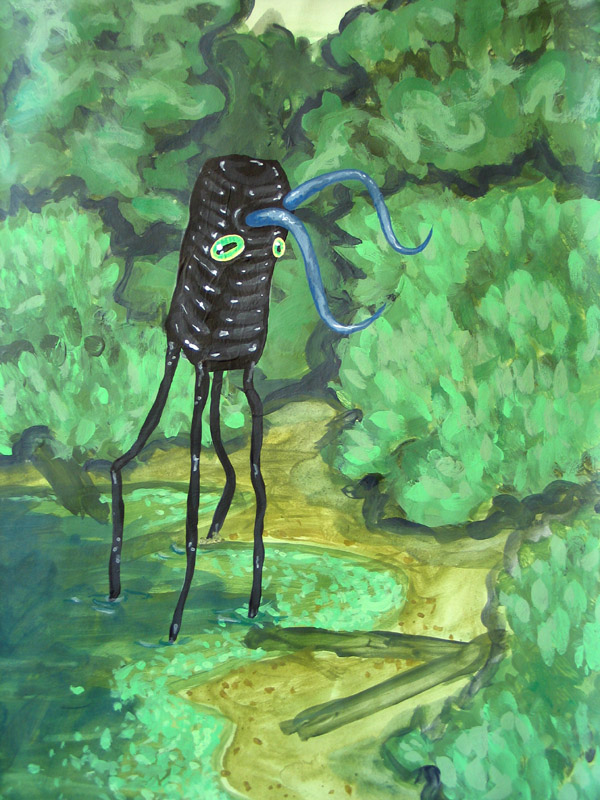
The Ichabod is found only in the deep swamps of Louisiana. Its diet consists solely of Polycephalic Forg-men. Once on the very brink of extinction, there is currently a resurgence in the Ichabod population. Hurricane Katrina helped re-sediment the Forg-men's habitat -- leading to larger than usual clutches of heads. With more prey available, there is hope that Ichabods may yet be able to reestablish themselves.
The adult Ichabod stands approximately seven feet tall. It has long, spindly legs that help it travel more easily through algae-clogged ponds. The legs have neither a skeleton nor exoskeleton; rather, they function purely through vascular tension. The body is boxish, and has roughly the proportions of a milk carton. Two long, prehensile tongues are used for capturing Forg-men. Its pie-plate sized green eyes have slit-like irises. The animal's skin is shiny-black with horizontal ridging, and exudes a thin, clear slime at all times.
The evolutionary origins of the Ichabod species remain somewhat mysterious. Our current best guess is that the creature is a zorn created long ago by a virus that no longer exists. [For an explanation of the term "zorn," please refer to my previous post about the Elysian Zorn.]
The "Insect-Amphibian Transmission" theory proposed by Professor Julian Roche suggests that the Ichabod might even be the result of two successive zorn transformations. The basic idea is that the first virus was associated with a variety of Black Slime Mold. It corrupted the genetic code of an insect related to the Walking Stick. Some time after this, the virus mutated again and was passed on to salamanders -- which ultimately became the Ichabod of today. DNA sequencing for zorns is notoriously difficult -- but Roche's preliminary results do lend some support to this explanation.
The Ichabod takes its name from the fictional character "Ichabod Crane" in Washington Irving's short story, "The Legend of Sleepy Hollow." To understand this, however, first a few words must be said about the life cycle of Polycephalic Forg-men.
The Polycephalic Forg-man is continuously growing and shedding new heads during the course of its lifetime. Heads that have been shed are often left in clutches like eggs, where they develop into new, full-bodied animals. The Ichabod survives by eating these heads.
Previously, while working on an unrelated project, Mr. Bonnichsen created a reasonably accurate illustration of the Polycephalic Forg-man. I have reproduced that drawing here with his permission.
When attacked by a predator, Forg-men are able to shed their current head as a defensive measure. With luck, the predator will be distracted -- chasing after the headless body, which scrambles off wildly. The severed head will ultimately grow a new body; but without a head, the decoy body dies in convulsions several hours later.
This defense is particularly effective against the Ichabod, which by all appearances is horrified by the headless body. Invariably, it runs away, trying to escape the thing... Much like Ichabod Crane fleeing in terror from the Headless Horseman in Irving's famous tale.
posted by sven | permalink | categories: bestiary
October 10, 2007
From Sumatra: The Porpische
by sven at 8:00 am
Reprinted with permission from Professor Ichbonnsen's Monster Month blog.
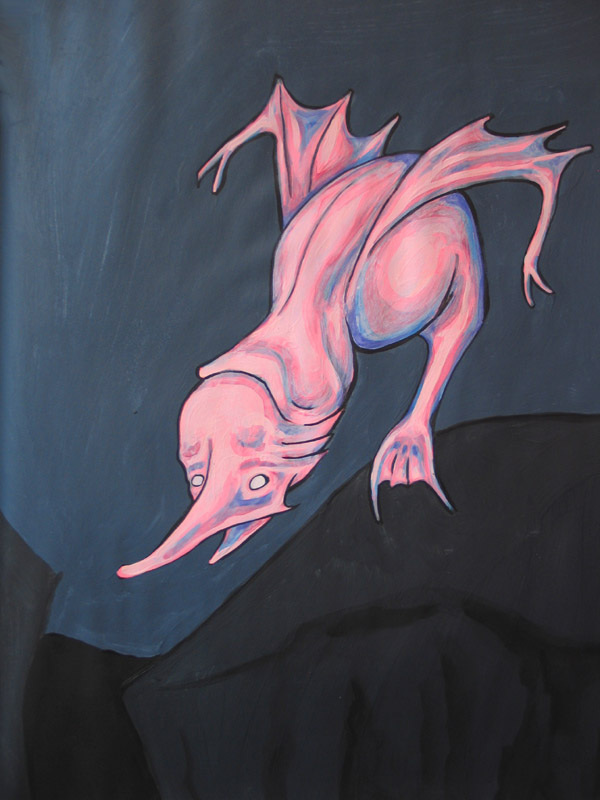
The Porpische is an extremeophile: it lives in deep ocean crevasses, where immense pressures and volcanic heat vents make human exploration extremely difficult. Populations have been discovered off the eastern coast of Sumatra. Whether the species exists in other areas is not yet known.
The Porpische is large -- nearly twelve feet in length. With a long "bottle-nose," the animal looks somewhat like a dolphin. However, it is actually a form of fish -- with gills and a cartilaginous skeleton -- distantly related to sharks.
Porpische have a beautiful full-body bioluminescence. The entire animal glows with a ghostly pink light. When the animal is startled, the light suddenly winks out -- presumably to help hide it from predators. (What sort of deep-water leviathan hunts Porpische is currently a mystery.)
Rather than fins, the Porpische has two bat-like wings at its sides. The impression that the animal is actually "flying" through the water is astonishing. Like a bird that rides updrafts of warm air, it can use these wings to catch an updraft of hot water coming from a volcanic vent and soar swiftly upward. One can imagine that this ability occasionally provides the animal with a means of quick escape when it finds itself in danger.
Porpische seldom come up farther than the mouth of the chasms in which they live. Watching the glowing beasts gently circling back down into blackness, like a spiral of Christmas lights disappearing into the night, one's mind cannot help but be tattooed with a haunting sense of wonder. Myself, I count this experience as one of the most awe-inspiring moments of my life to date.
posted by sven | permalink | categories: bestiary
October 9, 2007
H - The Heartbreak Spider
by sven at 8:00 am
Reprinted with permission from Professor Ichbonnsen's Monster Month blog.
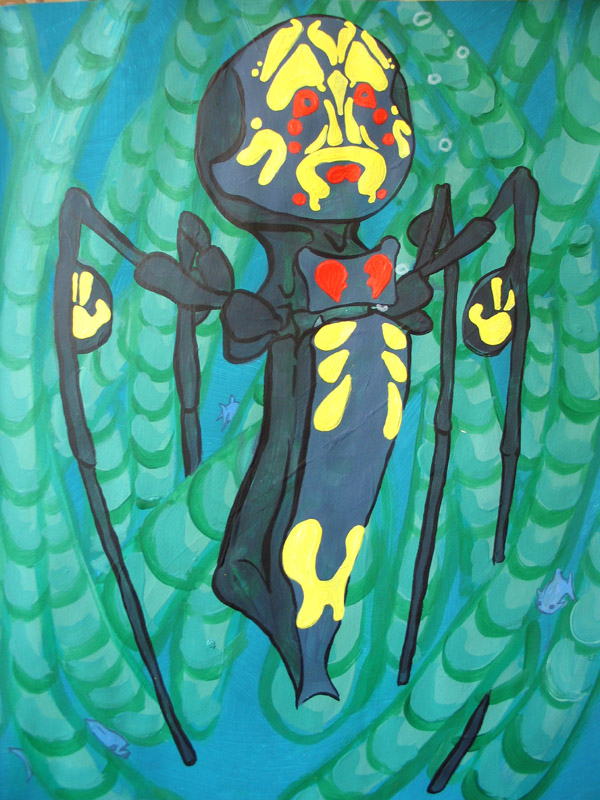
Bright markings on a creature are often nature's way of saying "danger!" Nowhere is this more true than with Indonesia's Heartbreak Spider.
This four-foot-tall aquatic spider is adorned with brilliant yellow and red markings, which bear an uncanny resemblance to a scared human child:
- The spider's proportionally-small and raised abdomen simulates the child's head. Many see weeping eyes and a face in the pattern of the abdomen's markings.
- The cephalothorax lacks pedipalps; instead, there is an exceptionally long and toothy jaw. Markings on the jaw are often interpreted as a human ribcage and pelvis.
- Also unlike most spiders, this specimen has only four legs -- each of which sports a flexible air bladder, with markings on the front two that look quite like hands.
- Adorning the creature's "nose" are two more red markings, which look just like a broken heart.
Heartbreak Spiders consume fish and waterfowl -- but they are particularly suited to snaring human prey. Around twilight, when visibility is poor, the creature comes up from its underwater nest, and lurks half-submerged in the shallows of a slow-moving river...
When a human passes by, the spider goes into spasms, splashing about -- which in the half-dark causes it to look very much like a drowning child. When the passerby attempts rescue, it grabs onto their leg with its powerful jaw and pulls them down to a watery death. The spider is able to stay there underwater for up to two weeks at a time.
Tangentially, it should be mentioned that there is another species involved with the Heartbreak Spider, which enjoys a symbiotic relationship: the Bone Fish. Bone Fish, as one might guess, eat bones. They take no interest in meat from the spider's prey -- but after the bare skeleton has been discarded, they use their sharp little teeth to break it down into digestible chips. No evidence of the victim is left to be found. This deadly partnership has contributed to the spider having remained anonymous for so long.
In the past, a few remote communities have become aware that something is living in the rivers, dragging people to their deaths. An additional "heartbreak" caused by the spider is that in several cases children have simply been allowed to drown, because adults suspected that the child was really a magical "monster" trying to lure them into the water.
The catastrophic tsunami of December 26th 2004 not only devastated the human population -- it also wiped out more than 80% of this spider species. However, three years after the wave, the species is beginning to reemerge -- and in places where it had not been seen before. It appears that the flood waters swept the spiders' eggs up into areas where they have not existed previously... Bringing them into contact with entirely new potential victims.
posted by sven | permalink | categories: bestiary
October 8, 2007
G - The Grimberry Tree
by sven at 8:00 am
Reprinted with permission from Professor Ichbonnsen's Monster Month blog.
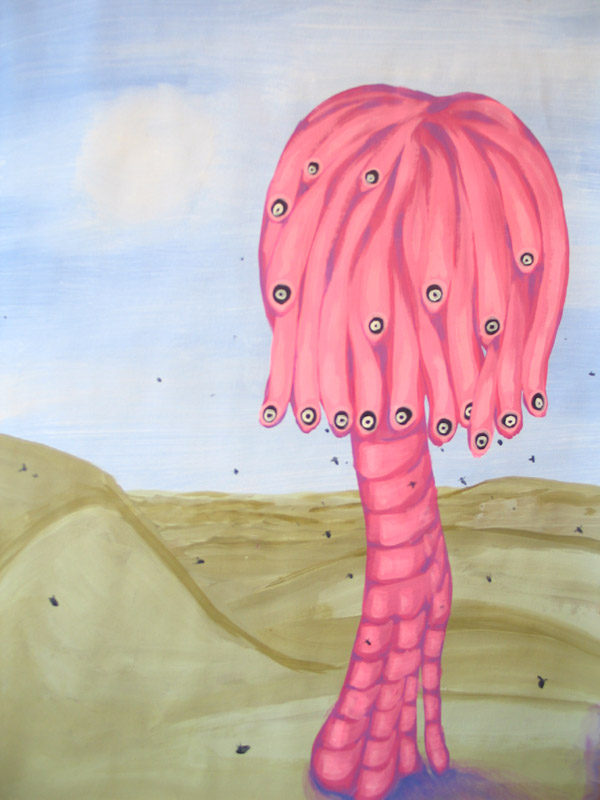
My acquaintance Professor Amberson was traveling recently in the deep Saharan desert along with his family -- when he happened across a Grimberry Tree. This is his how he recounts the experience:
"We're traversing great rolling dunes -- swells like ocean waves in a storm, but made of blistering, dusty sand. We ran out of water a day ago. Our lips are cracked and bleeding. My tongue is a dry, alien thing in my mouth. Death cannot be far away...
But wait! Up ahead there seems to be some sort of tree, bursting from the sand. Surely this must be a mirage, I tell myself -- because the tree is flamboyantly hot pink. But so what if it is a mirage? With nothing to lose, we might as well check it out.
The sweetest smell of honey floats on the air, and the gentle hum of bees fills our ears. It's comical, it's cartoonish: this tree is straight out of a Dr. Seuss story.
And then: the 'happy little tree' lets out a ferocious roar -- like a belching lion.
A pink, slimy frond whips out fast as lightning and grabs my son by the ankle. With demon speed, the tree dashes the boy against the ground repeatedly, swinging him from the ground on the right all the way over its 'head' to the ground on the left and back again. Again and again and again!
The tree sucks Wes -- poor Wes! -- into its canopy, and chews him up with loud crunching sounds. Then: silence. My daughter Polly and I look to each other, stunned.
Just as suddenly, the tree spits out the boy's skeleton like a watermelon seed. Which lands at our feet. Thud."
The Grimberry Tree is a muscular carnivorous plant with slimy pink tentacles in place of leaves. The tree is unable to "walk" per se -- but its root-legs do enable it to stay atop shifting sands and (to an extent) to steer its course as sandstorms reconfigure the landscape around it.
The tree is not sentient -- nor does it even have a "brain," as we understand such things. However, it does have photoreceptors on the ends of many of its tentacles -- which both look and act very much like eyes. These "eyes" interact with its pseudo-nervous system in a way that enables effective attacks on large prey.
For the most part, the Grimberry tree subsists on insects, which are attracted to its distinctly honey-like scent. It also consumes birds when possible -- and as we have seen, equally enjoys human flesh. Typically animal corpses will be dropped from the tree's branches half-digested. The stink of rotting flesh helps to attract more insects. The "bait" doesn't last for long, however. Such debris is soon "washed away" and buried with the shifting sands.
[In case you're curious: Professor Amberson, Polly, and Wes all miraculously survived their encounter unharmed. I may meet up with them "on the road" in the near future. Last I heard, the family was planning an outing to Mount Etna, to take an up-close look at the ongoing volcanic eruptions.]
posted by sven | permalink | categories: bestiary
October 7, 2007
F - The Flightless Goan
by sven at 8:00 am
Reprinted with permission from Professor Ichbonnsen's Monster Month blog.
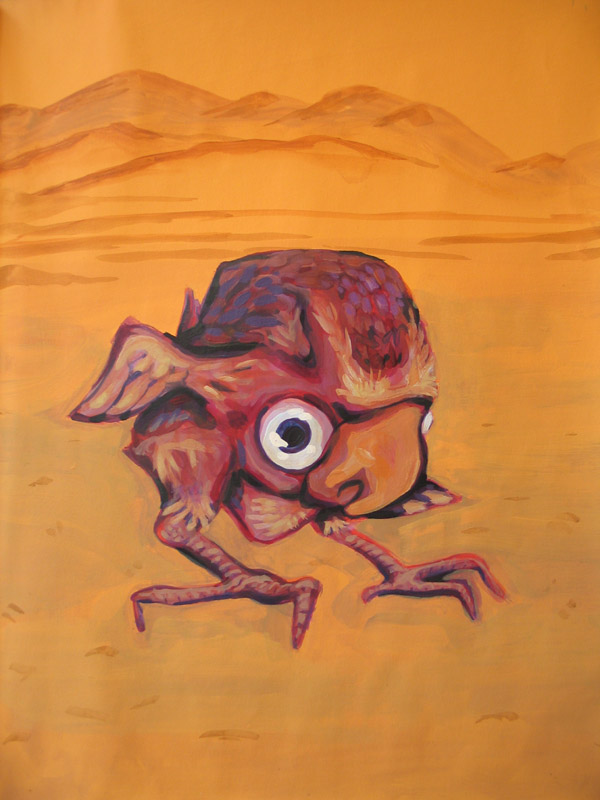
The Flightless Goan is a carnivorous, desert-dwelling bird found in the Mexican state of Coahuila. It is exceptionally fast, and has remarkably keen eyesight.
Standing at two feet tall, Goan hunt small and medium-sized game such as rabbit and coyote. Hunting is often done in groups of 2-4 animals. Their razor-sharp beaks rapidly slice prey into ribbons.
The birds have a distinctive cry -- "moh!" -- which they shriek whenever running. When they pause, the cry stops. It is a curious experience to hear the animal as it stops and starts: Moh! Stop. Moh! Stop. Moh!
Goan, it is believed, are a pygmy version of the quasi-mythical Giant Roc -- a bird allegedly capable of carrying off fully grown elephants in its claws. Recent evidence suggests that such a species genuinely did exist at one point in time, but that it went extinct long before the appearance of Homo Sapiens. The Giant Roc in European and Middle-Eastern mythology -- and the Thunder Bird in Native American folklore -- most probably emerged out of humans' attempts to explain fossil remains.
In essence, the Giant Roc seems to have been a cross between the Pterodactyl and the Archaeopteryx (the earliest known bird) -- but larger than either. It is doubtful that even the largest Giant Roc could have lifted an elephant; prey approximately the size of oxen, however, were not out of the question. Such great birds must have depended upon the existence of huge herds of prey to survive. We can guess that they were very territorial, and that due to this, successful mating was rare.
Given the immensity of their drain on the ecosystem, no one bioregion could support Giant Rocs indefinitely. As food became too sparse, mutations resulting in smaller birds were advantageous. Based on skeletal evidence, it is almost certain that today's Flightless Goan is a direct descendant of the avian megafauna. Indeed, fundamental similarities between the Goan and the Roc are so profound, some have suggested that it is only a matter of time before a random mutation in the Goan genome leads to the rebirth of Giant Rocs in the modern world.
Our collection of fossilized birds is too scanty at present to prove anything -- but perhaps over long periods of time we are seeing a cycle between the pygmy- and giant-sized version of a single bird species. If so, the phenomena would lend new credence to myths about the Phoenix that is reborn from its own ashes.
posted by sven | permalink | categories: bestiary
October 6, 2007
From North Korea: The Giant Mupp
by sven at 8:00 am
Reprinted with permission from Professor Ichbonnsen's Monster Month blog.
The Giant Mupp is a species of dog native to Korea. Early in its lifespan, the animal is indistinguishable from a common street mongrel. However, as it ages, a remarkable difference becomes apparent.
The Giant Mupp lacks the genetic coding that turns off physical growth. As each year passes, it simply gets bigger and bigger. Furthermore, it also lacks the related code that produces senescence -- meaning that there is no significant metabolic deterioration as it ages. Theoretically, the animal could live forever.
Only one factor limits the Mupp: gravity. When it reaches the size of an African Elephant, the sheer weight of its flesh cripples the dog's ability to walk; only by crawling on its belly is it able to move about. As the Mupp becomes even larger than this, it will ultimately become stranded in one spot.
The animal would starve to death at this point, were it not for a very unusual adaptation. The tongue begins to grow at a faster rate than the rest of the body. The Giant Mupp is able to press this organ down into the ground, and begins absorbing nutrients from the soil beneath it. Over time, the tongue actually splits and forks into many branches -- until it resembles nothing so much as a tree's root system.
But gravity always wins. As a Mupp's eyes get larger and larger, they become distorted by their own weight, flattened out. Eventually, the membranes are too weak to contain their vitreous humor, and the dog's eyeballs burst. The Mupp can live on, blinded, but other internal organs will inevitably meet the same fate. Life ends.
Stories have been told of Mupps sixty feet wide and thirty feet tall being mistaken for hills. Animals of this size, however, have not been seen for several centuries -- and likely won't be seen again. It is estimated that the largest Giant Mupps that ever existed lived to approximately 600 years. Few today, however, ever even become noticeably large.
For generations, the meat of Mupp was considered a delicacy in Korea. Due to its popularity, the native population was almost wiped out. Farmers who bred Giant Mupps in captivity harvested the animals at earlier and earlier ages, until little difference remained between the size of the Mupps being consumed and other dogs. The practice of breeding Mupps died out; the few remaining specimens have mostly been assimilated into the general street mongrel population.
Giant Mupps as distinct species lasted somewhat longer in China. During the early dynasties, Mupps were exported to China to serve as imposing imperial guardians. The "Foo Dog" has mistakenly been identified by some as a Chinese representation of the Lion. Not so! As "magic" protectors for homes of the rich, few were entrusted with the truth of the animal's origins -- but I have personally met with certain old families remaining in possession of scrolls that provide enlightenment on this matter.
It has been rumored that there are at least two Giant Mupps surviving within China's borders. It is also likely that there are still some genetically pure Mupps left in Korea, which have escaped into far-flung wooded areas.
posted by sven | permalink | categories: bestiary
October 5, 2007
E - The Elysian Zorn
by sven at 8:00 am
Reprinted with permission from Professor Ichbonnsen's Monster Month blog.
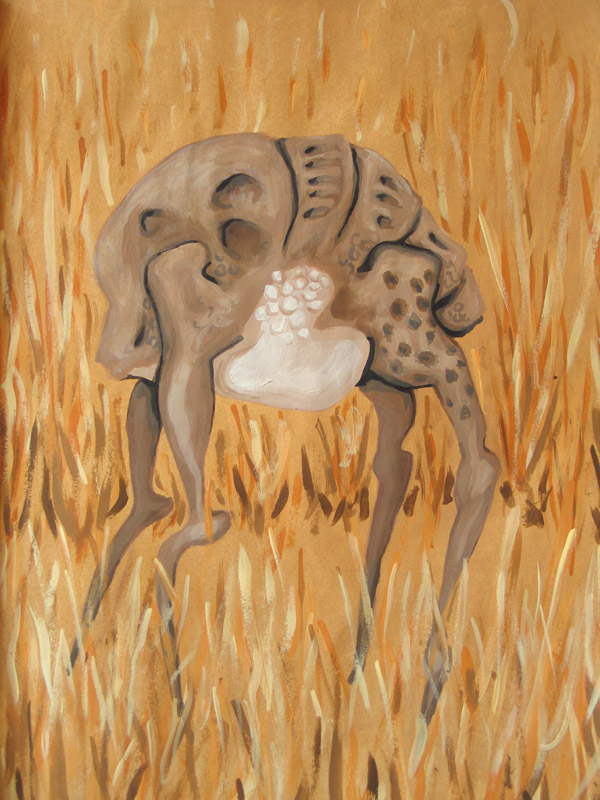
A virus is unable to self-replicate except by invading the living cells of a host animal. Certain viruses are able to significantly re-write their host's genetic code. When this genetic re-coding results in "massive" transformations of the animal's outward form, the resulting creature is referred to as a "zorn." "Zorn" is not a single species, but rather a category of species: creatures whose origin is viral DNA re-scripting.
Zorns based off of giraffe, gazelle, buffalo, elephant, and baboon stock have been sighted with increasing frequency throughout central Africa for the past five decades. It is obvious from their appearance that these zorns share a common viral origin.
The animals have become headless. Their eyes and ears have been replaced with an ultrasonic echolocation system, now located in the frontal thoracic region. The truncated throat has transformed into a loosely musculatured proboscis only capable of dealing with liquified nourishment. The ribcage has reformed into a segmented shell (typically still covered by fur). The dorsal shell is perforated with orifices that excrete a weak acid solution, which the zorns use to dissolve plant materials -- which are then slurped up through the proboscis. The legs and digestive systems of the original animals remain essentially intact.
Fortunately for humankind, this particular zorn-producing virus cannot be transmitted by casual contact. It must be injected directly into a host animal's bloodstream. However, once the animal has become a zorn, the condition is inheritable. All subsequent offspring share the parent's new form... Zorn herds are increasing.
What is the original vector of this viral strain?
With great difficulty, I have tracked the virus back to its source: Martian insect megafauna. These are colossal flea-like creatures, the height of a two-story house. They are omnivores that occasionally enjoy meat -- and they are extremely effective hunters. After capturing their prey, they trap it in a cocooning blanket of slime, and then inject it with digestive juices that slowly liquify their intended meal from the inside out. On very rare occasion, some of the prey have managed to escape. These "lucky" ones became the first zorn of their kind.
It is my belief that there are only two or three of the giant insects on Earth at present. I believe that they were brought to our planet entirely unintentionally, during the course of black market trading between Earth and Mars. Certain foreign correspondents of mine have linked this particular insect species specifically to Elysium -- a large volcanic region of Mars, stretching roughly between 15º-45º latitude and 130º-160º longitude.
Knowing this, the zorn that we are currently seeing in Africa should properly be identified as Elysian Zorn. (Zorn are typically named after the location where their viral mutagen first emerged.)
Because the Elysian Zorn virus is only transmissible via direct injection into the bloodstream -- and because we know the original vector of transmission -- we have an excellent chance of being able to contain this outbreak before it spreads farther... If authorities are willing take action.
However, proliferation of the Elysian Zorn is indicative of a even larger, more insidious problem. Given that the first record of an Elysian Zorn in Africa dates back to 1863, we can reasonably extrapolate that illegal trafficking between Earth and Mars has been going on for at least 150 years.
Contact between the two planets is hopefully still a rare occurrence -- but every instance is a new opportunity for disease and invasive species to spread into environments where they do not belong. Elsewhere I have written about illegal importation of the "Opium Gore Golem" by certain drug cartels... What other dangerous species are already here among us?
posted by sven | permalink | categories: bestiary
October 4, 2007
D - The Dark Strider
by sven at 8:00 am
Reprinted with permission from Professor Ichbonnsen's Monster Month blog.
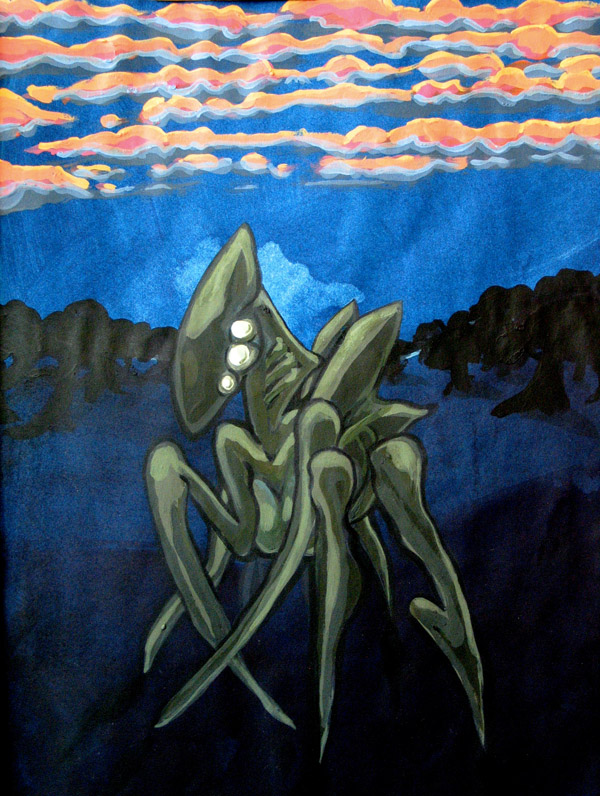
The Dark Strider is clearly insectoid in origin, having six legs and vestigial wings. However, in many respects its form and temperament are strikingly equine in nature. Indeed, seen at a distance and in dim light, the animal is easily mistaken for a wild horse. It stands approximately eight feet tall (6 ft at the shoulder) -- and when it runs, its gait is best described as a gallop.
The front two legs are sharp spears, much like those of a Praying Mantis. Contrary to appearances, however, the Dark Strider is vegetarian. These frightful weapons are used purely for self-defense and grooming purposes.
Most Dark Striders seem to suffer from parasites -- in particular, a translucent, apple-sized grub known as the "Noub." Noubs attach themselves to the Dark Strider's back, typically behind the vestigial wings, where it is difficult for the skewering front legs to reach.
Noubs are a constant source of irritation, as they emit a high-pitched chirruping whine for hours at a time during the night. This noise poses a serious threat to the Dark Strider: predators are often attracted to the sound. Yet, a strong fight-or-flight response makes the animal difficult prey to fell.
The Dark Strider is native to Romania, but is far-ranging in its travels. Following our successful efforts to tag a Dark Strider with a radio transmitter, my colleagues the Quay Sisters have reported back that the animal seems to have a particular affinity for Czechoslovakia. Perhaps this is an ancestral home, where the species returns to breed -- just as salmon instinctively return to their place of birth.
The Dark Strider is a purely nocturnal creature, only venturing out from its murky forest shelters as twilight ebbs into night. It is extremely solitary for most of the year; however, on occasion, a small group will inexplicably gather together in a moonlit glade. During this meeting -- a "forum" as it has been picturesquely termed -- the animals seem to communicate with each other. The purpose of these gatherings remains a mystery.
posted by sven | permalink | categories: bestiary
October 3, 2007
C - The Cradle Robber
by sven at 8:00 am
Reprinted with permission from Professor Ichbonnsen's Monster Month blog.
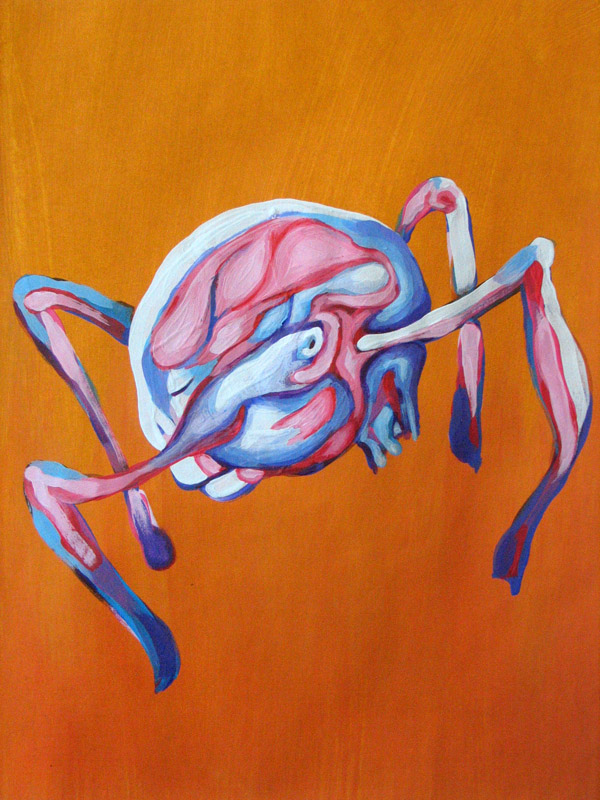
The Cradle Robber is a pale blue, four-legged, spider-like creature.
What is most remarkable, however, is that the animal's carapace is almost exactly the same shape and size as a human infant's severed head. This gruesome camouflage has been to put to good effect by the hunter in its preferred environment: mass graves.
The creature's body is covered by a bone exoskeleton, with exposed muscle groups and vein systems on the sides. Its slimy red eyes and prehensile mouth-fingers are located where the neck of the "baby head" seems to dangle. Indentations on the back of the carapace simulate the baby's mouth, nose, and closed eyes.
Cradle robber populations flourish during times of war or plague. The animals crawl into pits of dead bodies being readied for burial, and then wait patiently for their prey. Bereaved parents searching for lost children inevitably find their way to the graves... And then as the mothers and fathers kneel over piles of corpses, weeping and looking for their offspring, the predators strike.
When plagues are at their height, the animals have sometimes been emboldened to venture into the heart of human communities. Terrible tales have been told of the Cradle Robber that sneaks into a nursery, kills and consumes a child sleeping in the crib, and then waits for the parents to return -- sitting motionless there upon the bloody pillow, as if it were a wet nest.
During periods of peace and human health, the Cradle Robber population shrinks and retreats into dry underground tunnel systems. Clutches of eggs have been found secreted inside both French and Czech ossuaries.
There are large periods of history where the animal seems to be entirely absent from written record. It is possible that the Cradle Robber population collectively goes into a period of hibernation when the environmental factors that support its survival are no longer right.
If so, then we must ask: how does the species wake up again? At this point in time, the leading theory is that the Cradle Robber has a symbiotic relationship with rats -- which also prosper during times of human suffering. It is suspected that there are certain chemical markers in the urine of rats eating human flesh that serve as the wake up signal -- much like the ammonia component of smelling salts.
Evidence of Cradle Robber populations has been found throughout Europe and also the western reaches of the former Soviet Union, reaching back to Roman times. In recent years, rumors have circulated about a subspecies of black-shelled cradle robbers being sighted much farther south, in Rwanda and Darfur. Further investigation is required.
posted by sven | permalink | categories: bestiary
October 2, 2007
B - The Badogedown
by sven at 8:00 am
Reprinted with permission from Professor Ichbonnsen's Monster Month blog.
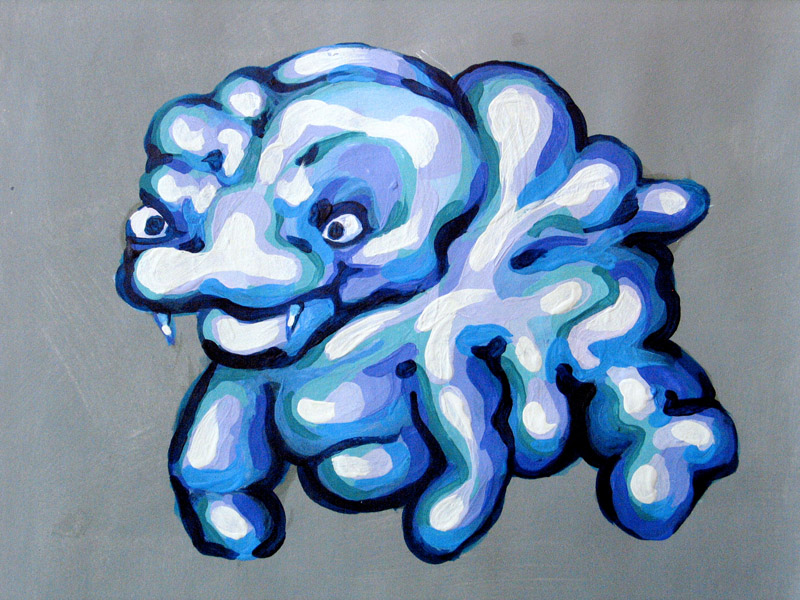
Nearing the end of 2007, the world population of badogedowns stands at approximately 30 animals. The species was believed to have gone extinct in 2005. However, under condition of anonymity, it has been revealed to me that two private collectors have managed to preserve several animals, and are quietly pursuing a breeding program.
The Badogedown is a rubbery, blubbery, gelatinous sort of puppy dog. It is not the result of natural selection, but rather a failed attempt at genetic engineering undertaken during the early 2000s by corporate interests.
Two companies, one in Japan and one in the USA, are responsible for producing the new species. Their intent, it seems, was to capitalize upon the designer toys/urban vinyl movement by producing a living pet whose flesh emulates the texture of shiny rubber toys. They hoped to appeal to the aesthetics of parents who grew up in the 1970s, who would then purchase the pups for their target market: young girls, ages 10-12.
In most respects, the companies' scientists were eminently successful. The Pekinese-sized pooch both looks and feels like a living toy. Furthermore, the Badogedown's character is ideally suited for family environments: its enthusiastic affection and loyalty toward children is truly unparalleled. When the dog is brought home, it bonds to its young new owner almost instantaneously, and the two become immediately inseparable. It follows the child around wherever they go, relentlessly leaping up and happily licking the youngster's face.
Unfortunately, there are two tragic flaws in the animal's make up, which genetic engineers were never fully able to eliminate...
The dog has no ears. As it affectionately assaults its human master, there is simply no way to call it off.
Worse yet, the Badogedown possesses two very sharp fangs. Consequently, in the several test groups of young girls that it was exposed to, the animal's paroxysms of love invariably resulted in serious injury. (Quite unintentionally, on the part of the dog.)
Even after these tragic incidents, it was several years more before the "vinyl love dog" project was finally brought to a halt and the animal population destroyed. It seems that this delay resulted from a peculiar communications breakdown during the international collaboration.
Product testing for the pups was done in the USA; the Japanese project leaders were only able to listen in via teleconferencing. The young girls' screams of terror were misinterpreted as shrieks of pleasure. In Japan, "bad dog, get down!" was believed to be an unknown English colloquialism of affection... Which resulted in the Badogedown's name: a Japanese transliteration of the exclamation that that each and every test subject was heard shouting.
Attempts to file down or mechanically remove the teeth have all been unsuccessful. Likely due to the addition of rodent DNA, the teeth regenerate and continue to grow quickly during the animal's entire life-span. Corporate interests finally were forced to admit failure.
However, ego and soft-heartedness are stubborn traits. There is reason to suspect that the two individuals who have preserved the Badogedown species were in fact scientists who worked on the original "vinyl love dog" project. Facing the prospect of their creations being exterminated and all records erased, I believe that they smuggled out a handful of pups -- and have since continued on with their "labor of love."
My contacts have not been forthcoming with details about where the dogs are currently being kept -- but they assure me that all necessary precautions have been taken to keep the animals safely contained in captivity.
posted by sven | permalink | categories: bestiary
October 1, 2007
A - The Adameve
by sven at 8:00 am
Reprinted with permission from Professor Ichbonnsen's Monster Month blog.
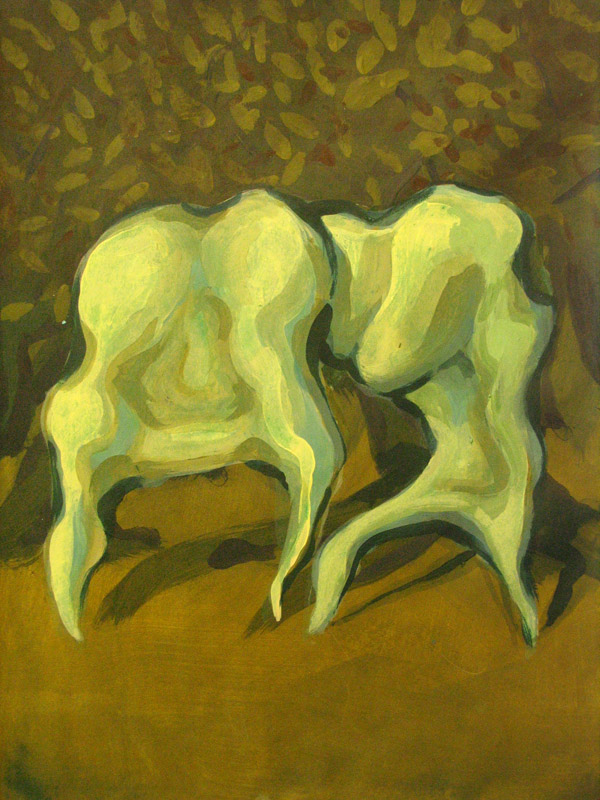
The Adameve is a large, glistening white, maggot-like beast. It has a grossly oversized, eyeless head, and two long facial feelers that are nearly identical in shape and size to the legs.
The creature is bipedal -- yet often gives the appearance of moving on four legs. Being completely blind, it uses the facial feelers to help find its way along the ground, moving them in a sort of "walking" motion.
At maturity the Adameve can stand as much as twelve feet tall. Folded in half as it travels, the dorsal crest will measure approximately six feet up from the ground.
The species is known to haunt certain old, blasphemous orchards in England and western Europe. Primarily nocturnal, for centuries its rambling gait has caused witnesses to mistake this monster for a ghostly couple: a naked man and woman silently dancing together beneath moonlit trees.
This impression, combined with the association with apples, likely explains its name: a conjunction of "Adam and Eve."
To reproduce, the hermaphroditic Adameve injects its eggs into apples growing on the trees -- thus supplying the young with a ready-made supply of food when they hatch. In their early stages, the larva are easily mistaken for maggots writhing in and out of rotting, fallen fruit.
Adameves are extremely territorial. The young (initially numbering in the hundreds) will quickly tear each other apart, competing for dominance. Near the end of the frenzy, the most aggressive children will gang up to kill and eat their own parent. Ultimately, only one animal survives in the orchard.
Based on historical records, it is believed that the species spawns approximately once every hundred years.
posted by sven | permalink | categories: bestiary
September 30, 2007
monster month begins!
by sven at 3:06 pm
Professor Ichbonnsen took a suggestion I made, and has started up his own blog. I've reprinted the initial post here with his permission.
Introduction: My Life As A Monster Hunter

I have spent my life seeking out the unknown.
In the parlance of academia, my field of study is referred to as cryptozoology. More plainly: I am a Monster Hunter.
I have made it my business to track down legends, to investigate strange rumors, to delve into the darkest, unplumbed depths of nature -- searching out species heretofore unknown to humankind.
Now, for the first time, I am ready to share a selection of my most prized discoveries with the outside world.
"Respectable" universities have willfully denied the reality of my claims for too long. Scoffed at by closed-minded individuals -- who have never even dared step foot outside the safety of their ivory towers -- I am compelled to bring my appeal directly to the general public.
What you must understand is that we are currently in a state of global emergency.
Cryptids, extremeophiles, and exobiotes ("monsters" if you will) are facing the same environmental threats as better known species -- such as the Spotted Owl, Siberian Tiger, and Blue Whale. Man's encroachment on wild habitat may soon bring extinction to these creatures that are so exceedingly rare to begin with.
In other cases, we may ourselves become the victims of Man's relentless expansion. Many of the creatures that I have studied have remained anonymous for so long only because they are exceptional hunters -- witnesses to their existence have seldom survived to tell the tale.
We must also take seriously the environmental threat posed by invasive species that have accidentally been transported into ecosystems where they have no natural predators. I am thinking in particular of the Martian insect megafauna that have taken hold in central Africa, and the viral mutations that they have provoked in native populations.
I have been the first to sound the warning cry -- and as of yet, no university or environmental NGO has even seen fit to investigate.
My sincerest hope is that if the general public is able to experience the (often terrifying) majesty of these Monsters for themselves, then the groundswell of concern will finally compel academia and the powers that be to take action.
Toward this goal, I have hand-selected 31 animals from my personal bestiary. Over the course of October, 2007, I shall reveal them here on this "website" -- one each day. To help further illustrate my research notes and bring them to life for the reader, I have employed noted nature artist Sven Bonnichsen to produce an accompanying set of lush, photo-realistic paintings. I thank him for his willingness to embrace a broader view of life on Earth.
If all goes well, I will collect these documents into book form for wider dissemination. My tentative title: "Lifeforms Heretofore Unknown by Science: New discoveries from the world's most renowned monster hunter." As further news about the book project becomes available, announcements will be posted here.
And so, with all that said: ONWARD INTO THE UNKNOWN!
Professor Ichbonnsen
writing from Brussels, Belgium
September 2007
NOTE: If you want to support the book project -- or acquire a copy for yourself when it becomes available -- please consider writing to my editor at Scarlet Star Publishing. So many before him have flat out refused to be associated with my work... We must ensure that this (rather skittish) man does not also lose his resolve!
posted by sven | permalink | categories: bestiary
September 1, 2007
monster month challenge
by sven at 8:00 am
Woo-hoo! I've just gotten my first paid illustration contract!
My employer is noted cryptozoologist, Professor Ichbonnsen (no relation). He's hired me to do illustrations for his forthcoming book, "Lifeforms Heretofore Unknown by Science: New discoveries from the world's most renowned monster hunter."
I'm actually kinda baffled as to how he found me, given that I've never really done illustration work before. It's possible that he found Scarlet Letters by googling his own name -- after all, I did mention (1, 2) his work during last year's monster month.
It's also possible, though, that he's mistaken shots from Let Sleeping Gods Lie for actual documentary footage... And thus thinks that I'm a fellow crypto-enthusiast??
Anyway, the Professor -- he's never mentioned a proper first name (hm...) -- has asked me to do illustrations of 31 creatures, to be delivered one-a-day over the course of October. Doing that many is a bit of a challenge, so I've already started work on some sketches and studies. I plan to use this as an opportunity to develop my skills in painting with acrylics; that's how I'm hoping to do all the final pieces.
Ichbonnsen, frankly, seems rather eccentric. I confess, based on the adventure stories he's told me so far, part of me's wondering if he's flat out delusional! But, money is money...
(The "Dark Strider," the "Noble Shellkaye," the "Trick Squilligoss," the "Colossal Ubertuber," the "King Shielyana"... What the heck are these things, anyway??)
an open invitation
I'd like to invite all my artist friends to join in the fun. I'd love it if you'd do up some monster sketches of your own for October and post them on your blogs. ...BUT -- and here's the trick! -- be sure to make them illustrations of purely imaginary creatures!
See, I want to play a little game and test the good Professor -- to see whether he's really the World-Class Monster-Hunter that he claims to be -- or if, rather, he's a Certifiable Loony!
When I point him to the pictures on your blogs, will he believe that the intentionally made-up creatures are also "new discoveries, heretofore unknown by science?" ...Or will he immediately see through the ruse?
Help me discover the truth!
P.S. I want to give everyone adequate time to start thinking about this. But please DON'T post any of your pictures until October 1st! That's when I'll start posting my own pictures, one-a-day -- and we don't want to tip our hand to the Prof, OK?
posted by sven | permalink | categories: bestiary, exhibits & events, painting
October 31, 2006
monster month - 22
by sven at 8:00 am
These are the final sketches for Monster Month 2006. Once again, I'd like to thank my friend Jeffrey Roche for proposing this wonderful event! I've tried to put a little extra oomf into these final critters... Happy Halloween, everyone!
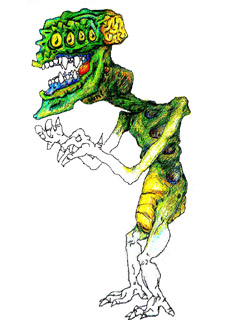
The Disappearing Drax stands nearly twelve feet tall -- bumping up against the ceiling, and smashing your dining room table out of its way.
...What is worse? To see its hideous fangs, set into blue gums, gnashing -- and to see that bioluminescent tongue obscenely thrusting in and out with bloodlust for you, the intended prey? ...Or is it worse watching as color drains from the giant's flesh, and the firefly-like abdomen extinguishes its light, and the huge predator disappears into thin air? Either sight turns blood to ice.
The ability to become invisible must be a precious asset to such a large animal in the wild... However, it's difficult to conceive of what alien dimension this thing must come from, as it invades a muggle's suburban bungalow. The killer's color and substance may drain away into nothingness -- but the impact of its terrible clawed feet rending the shag carpet, and of its wide shoulders bursting through sheetrock -- these effects betray its destructive presence.
We can only guess that the Drax's four sets of eyes must be attuned to parts of the spectrum beyond humans' abilitities of perception. Infrared, ultraviolet, sound waves and cosmic radiation -- what unfathomable realities does this king of monstrosities survey?
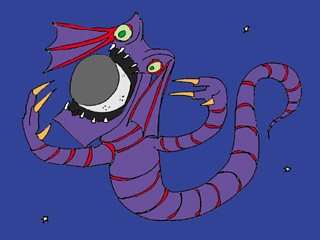
From beyond the stars, a serpentine collosus swirls and swims, cutting through the ether of space toward our unsuspecting eden. This royal, interstellar dragon fills half the horizon as we collectively watch in stunned disbelief...
No mere eclipse, the gaping maw opens wide to swallow loyal Luna. What will the nights be without our silver mirror dancing along with us through our eternal ballet of intertwining orbits? Perhaps we won't have long to grieve, the planet-killer's hunger unabated, attention now turning to the silent chorus of eyes below.
This is the end of the world: To all be wiped out in an instant, falling though the cavernous esophogus tunnel, disintegrating in the digestive apocalypse of The Dragon...
HAPPY MONSTER MONTH 2006!
posted by sven | permalink | categories: bestiary, sketchbook
October 30, 2006
monster month - 21
by sven at 8:00 am
Further sketches, contributing to Jeffrey Roche's "Monster Month" event.
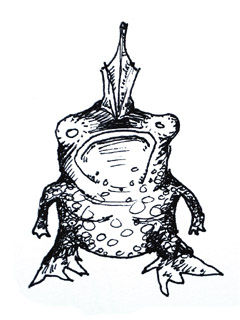
A distant relative of the polycephalic forg-man, the squat, spotted forg is native to the U.S. gulf coast, particularly in the shallows off of Louisiana. Some xenobiologists -- notably the esteemed Professor Ichbonnsen -- have postulated that forg-men may have actually evolved from the marine forgs, after they were swept up by prehistoric hurricanes and deposited inland, whole schools of the amphibians falling from the sky like a squalid rain.
Up until recently, it was thought that this species was entirely extinct. However, in 2005 several intact specimens were washed ashore during the wrath of Hurricane Katrina. While of great interest to the scientific community, news of the discovery of living forgs seems to have been largely superceded by human-interest stories in the American media. Curiously, at the same time, squat, spotted forg-fever has overtaken Japan. A plush version of the amphibian, forg-shaped backpacks, and forg-squonk cell phone ring tones are currently all the rage among the Japanese school girl set.
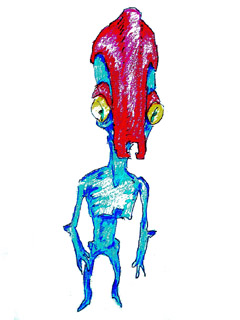
The blue martians -- unlike their green or orange cousins -- live in a profoundly stratefied society, under a complex system of castes and hereditary professions. The "war martians" (as they've come to be known) are noted for grafting helmets and other sorts of armor-plating directly onto their bodies, anchoring them within chitonous protuberances that seem strangely well-suited for this purpose.
War martians vie for ownership of drone male harems through violent head-butting rituals. Indeed, the thunderous cracking of skull against skull has been known to set off small avalanches in the polar regions, where members of the war caste are most common. While the soldiers' thick helmets do provide some amount of protection, significant brain damage is innevitable. Wreckless military offensives initiated by the elder war martian generals, often strategically dubious in the extreme, may be directly attributed to their more enthusiastic displays of cranial fortitude in earlier years.
(Were it not for this self-defeating behavior, Earth likely would have fallen to the technologically-superior martians long ago!)
posted by sven | permalink | categories: bestiary, sketchbook
October 29, 2006
monster month - 20
by sven at 8:00 am
Further sketches, contributing to Jeffrey Roche's "Monster Month" event.
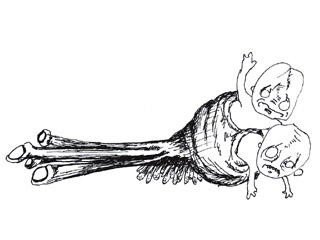
The skree buries its four long eyestalks and many anemone-like legs in the ground, leaving only its waxy posterior protruding in the air. Ugly little mutant babies come and sit on the faux sitting stone -- only to discover moments later that their own posteriors are stuck and sinking into the wax-bottomed skree's trap.
Populations of skrees in disparate locales have evolved several variations on this same tar-baby snare. Some work as a team, presenting themselves as safe stepping stones across a dangerous pit of quicksand (oh the irony!). The ugly babies become encapsulated in the wax like insects trapped in amber; the skrees deposit their baby sacs back in their subterranean nests, where they are stored like gruesome fruit preserves for later devourment. Following a capture, skrees are able to grow their earwax-yellow snares back within a matter of days.
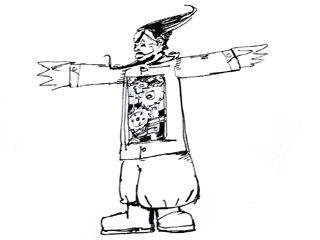
Rah! Rah! Rasputin -- lover of the Russian queen...
Rah! Rah! Rasputin -- Russia's greatest love machine...
(from the album Antler Dance, by Boiled In Lead)
Yes, it's a robotic Rasputin. Perhaps this explains why he could be stabbed, poisoned, shot -- and still live. Ah, but to throw him into the river...? Truly, 'twas a short-circuit that killed the beast.
posted by sven | permalink | categories: bestiary, sketchbook
October 28, 2006
monster month - 19
by sven at 8:00 am
Further sketches, contributing to Jeffrey Roche's "Monster Month" event.
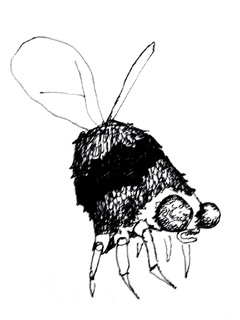
Sure, it looks like a bumbly bee... But did I mention that the buzgah is the size of a raccoon? And that a human head looks an awful lot like a flower to this guy? ("Mmmmmm... Nectar!") And that as he flies from head to head, setting down like a big furry hat, he provides running commentary about what fine, fine flowers he's found? ("Yezzz, quite a tasty treat! A brunette flower for buzzzgah to sip and sup from!")
...I didn't mention? I think you must have just not heard me, over the roar of those two vibrating wings. How does the bumblebee lift its own weight with those, anyway?
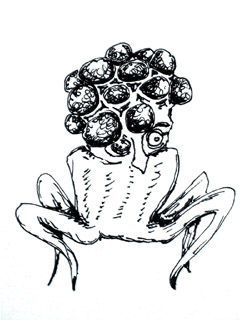
It must have started off as a severed human head. But then genetic modifications and glowing mutagenic serums produced: The Abomination. Many black, multi-faceted eyes erupting from the cranium like bubbles... Like bubbles made by some mad scientist blowing through the bendy straw in his crazy milk. But still with one human eye. (Because the contrast makes it all seem weirder.) A torso that begins from immediately beneath the vestigial nose, shaped like a squat bell pepper, ending in four skittery legs.
This is the sort of thing where you open the door to a darkened lab room and hear something scrabbling across the floor, tipping over metal trays, but you can't see it... And you think to yourself: "Oh, no... I've fallen into a sci fi/horror genre B movie! This is waaay too stereotypical to actually be happening..."
And yet, you can't help but call out (for the sake of irony, if nothing else), "Hello? Is someone there?"
posted by sven | permalink | categories: bestiary, sketchbook
October 27, 2006
monster month - 18
by sven at 8:00 am
Further sketches, contributing to Jeffrey Roche's "Monster Month" event.
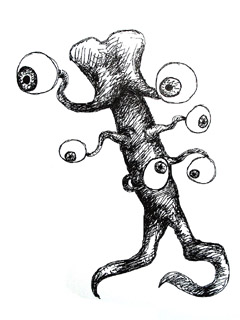
Tall trunk like a tree. Something like the skull of an elephant for a head... But with two elephantine trunks, each ending in a beach-ball-sized eye. Several more enormous eyes sway and twist on prehensile stalks down the sides of the beast. Two long snakes of muscle serve as legs.
This alien intelligence is diplomatic in character... Amenable to joint ventures, should they be in the common interest. Its appearance is tremendously unnerving to human explorers, however, as the over-sized eyes are the only (nightmarishly) familiar aspect of its body. Astronauts encountering the "eye-tree" are apt to act rashly.
(Based on an illustration I did for a short story back in junior high.)
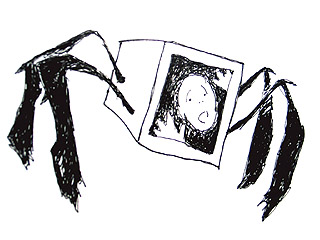
A box with legs. A prison cell... A cell block. The cramped space inside this box traps a single person at a time. The prisoner is transported hither and thither by the thing's surreal spider legs.
Where are the prisoners taken? Are the blocks stacked one upon another, in tall, forgotten aisles of the damned? Are the poor souls deposited in the presence of some higher power? Face and hands pressed against glass, the person inside anxiously calls out for help as they're transported to who-knows-where...
posted by sven | permalink | categories: bestiary, sketchbook
October 26, 2006
monster month - 17
by sven at 8:00 am
Further sketches, contributing to Jeffrey Roche's "Monster Month" event.
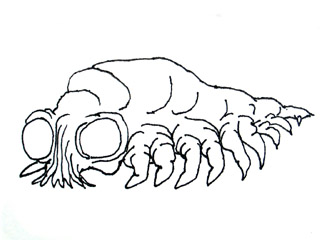
This is the larva of malice. It finds its way into the bully or the "mean girl" on the playground, and slowly wriggles its way into their heart.
At first, perhaps, the bully merely apes the sarcasm of his own parents... Or obliviously delights in the power of taunting his victims, unable to connect to the reality of their hurt... But as he works his misdeeds, an alien force progressively possesses his body. The larva feeds off of his malignant acts, and contributes back an addictive adrenalin-cocktail high. The potential for any other future for the child is inexorably erased.
Over the years, the insect hollows out the child... Growing and growing until, in the human host's maturity, you can almost see its form rippling and writhing, just beneath the surface. Waiting to tear open its false skin.
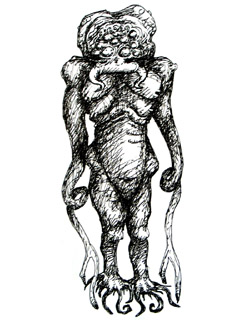
Dozens of jet black eyes. Two facial tentacles (tongues?) that lick in and out laterally from a tube-shaped proboscis (somewhat reminiscent of a gas-mask). Six breasts, each with two separate nipples, for feeding her innumerable young. Gill slits at the top of the creature's belly, indicating that the majority of the thing's life cycle must be spent underwater. Many small toe-like tentacles at the ends of the legs, providing excellent ability to grip slippery, seaweed-covered rocks. The arms drape down longer than the entire body's length, each rubbery arm ending in two prehensile tongs.
The "mother of tentacles" is ancient, having seen eons come and go. Standing more than ten feet tall, the creature moves far slower than one would expect -- giving it a statuesque bearing. Behind unreadable eyes, the thoughts of this unearthly god permute like the passage of uncaring glaciers.
After birthing a litter of its (almost exclusively male) children, the beast pays no heed to them -- rather, letting the infants suckle and crawl about her body without heed. Only once every few centuries does she venture from her midnight crypt in the Atlantic depths... Coming ashore but briefly, the heavy, quick-moving adolescent offspring are traumatized by exposure to the atmosphere, and drop to the ground, where she leaves them convulsing, to fend for themselves.
posted by sven | permalink | categories: bestiary, sketchbook
October 25, 2006
monster month - 16
by sven at 8:00 am
Further sketches, contributing to Jeffrey Roche's "Monster Month" event.
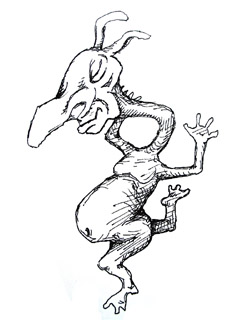
Playful Weeble pirouettes, leaps, twirls. Ever since he saw "Swan Lake," he just hasn't been the same. Not all of his bones actually connect into their sockets at any particular moment... But that's to his benefit. He's rather clumsy sometimes, and would likely hurt himself, were he not so rubbery.
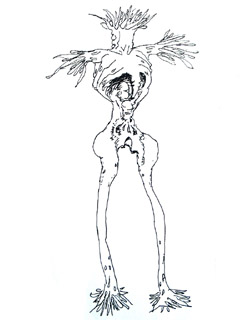
There's a forest you've walked through in your dreams, where all of the trees are you. You -- after you've died, and all your limbs have been flayed into dry, stringy tendrils of meat. These blind tree-beings shuffle about in a crowd, silhouettes in the misty light just before dawn.
Stumbling between them, just below the level of their knees, you wonder how many times you've died before... Or how many times you're going to die yet. Are these of a long series of past lives here? Or, maybe, a collection of all the moments when you've forgotten who you are, during this lifetime?
There must be some way to make them take root... To water them, and watch them turn green again. In your imagination, you can see your own face grow back, large and balloon-like, at the tops of all these giants. They would open their mouths in unison... And with a collectively sigh, inhale.
posted by sven | permalink | categories: bestiary, sketchbook
October 24, 2006
monster month - 15
by sven at 8:00 am
Further sketches, contributing to Jeffrey Roche's "Monster Month" event.
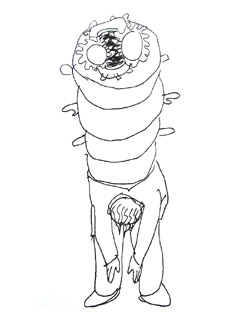
Over dinner, you wondered why you tolerate this arrogant, cruel, racist and sexist man... An uncle you only see once a year? A co-worker or superior from the cube farm? As he drinks, his tongue gets looser -- and your teeth get sorer, gritting, keeping your own tongue in place. A maggot of malice has incubated in this man's heart for so many years... It's grown huge, and writhes just beneath his skin.
No one is really surprised when he flops over -- nearly in half. The back of his spendy coat splits, and the putrid maggot rears up from inside its meat shell. Ironically, everyone in the room breathes a sigh of relief, ugliness at last revealed for what it is. Finally, we can relax and stop pretending.
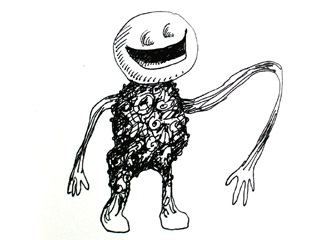
Big lollipop smile. Torso of Halloween candies all melted into a mass. Taffy arms that stretch, and stretch, out to embrace all his happy, smiling friends. With sugar-fueled enthusiasm, Candy Man is delighted to see you!
posted by sven | permalink | categories: bestiary, sketchbook
October 23, 2006
monster month - 14
by sven at 8:00 am
Further sketches, contributing to Jeffrey Roche's "Monster Month" event.
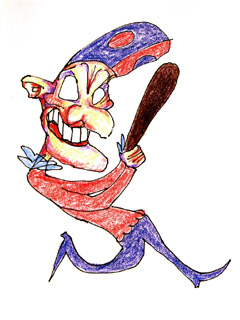
"Huzzah huzzah, I've killed the Devil!"
...Oh! It's that wicked man, Mr. Punch! Whatever has he done with his wife Judy? Where is their tender little baby gone to? And what terrible thing is he contriving to do next?
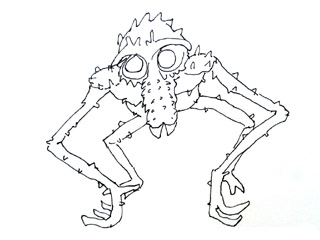
A large Old World ground-dwelling crustacean with a long doglike snout, large teeth, and naked callosities on the buttocks. The species is abundant on many shores, esp. in the tropics, where some have become fully adapted to land. Craboons are social animals and live in troops.
Bastardized from the Mac "came-with-the-computer" dictionary.
posted by sven | permalink | categories: bestiary, sketchbook
October 22, 2006
monster month - 13
by sven at 8:00 am
Further sketches, contributing to Jeffrey Roche's "Monster Month" event.
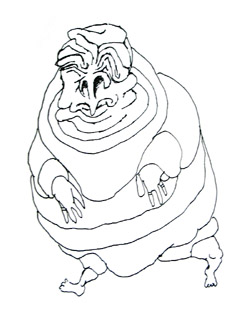
The Sluthering Vag fights vigorously against gravity to raise his eyelids and peek through the cascading folds of flab. The descendent of inbred royalty, this spherical mountain of flesh has remained in power generation after generation by swallowing whole his siblings, grandchildren, and political rivals. With a particular liking for gold rings, this blubberous man (?) has amassed an enormous fortune... Which he has used repeatedly to purchase fresh new legs -- and the transplanting services of unconscionably libertine doctors.
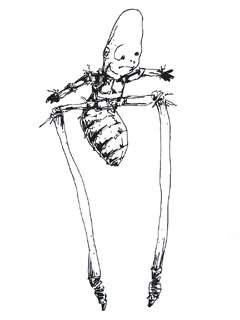
Bee-boy a lula
That horrid monstrosity's my baby
Bee-boy a lula
I don't mean maybe
Bee-boy a lula
It's my baby doll my scabied troll my rabies-infected fall
Let's rock!
My profuse apologies to Gene Vincent...
posted by sven | permalink | categories: bestiary, sketchbook
October 21, 2006
monster month - 12
by sven at 8:00 am
Further sketches, contributing to Jeffrey Roche's "Monster Month" event.
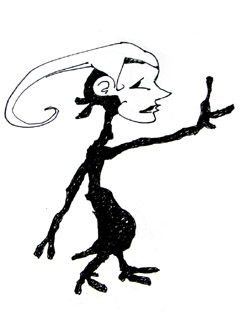
Harlequin Vinny recites Shakespeare and French poetry. He bounces and bounds along at your side during your adventures, a wannabe sidekick. A whimsical little thing, his endearing mask conceals fifteen lidless eyes, and a round maw of one thousand needle-point teeth. Be wary.
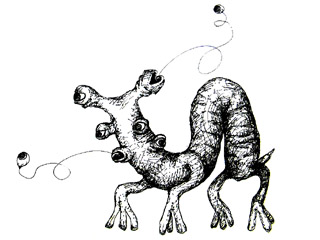
An eyeflit's most alarming feature is the ability to eject all of its six eyeballs from their sockets like projectiles -- whipping them around in several directions at once on long, elastic optic nerves. Were it not for this peculiar and disturbing ability, one might think the beast almost comic in appearance: it bends in the middle as a catepillar does, moving first its front forward, then bringing its rear legs up to the fore. Its stubby tail wags like that of an eager puppy dog.
Another odd feature of the eyeflit is its lack of a defined mouth. Nutrients, apparently, are absorbed through its semi-porous fingertips. With no vocal instruments for grunting or barking like other animals, it is notoriously quiet... It has taken many an unsuspecting zoologist -- including the author -- by surprise when it wanders into their camp. The beast is not entirely silent, however. If one listens carefully, there is a distinctive flitting sound as the eyes shoot in and out -- a sound from which the beast takes its name.
Being not much larger than the domestic cat, an eyeflit might make a fine pet -- for someone with a rather morbid sense of humor. Keeping an eyeflit would be economical; as it subsists off of decaying matter, the animal could easily be fed from a family's household compost pile. For those hoping to bring an eyeflit into their own home, however, it is sad fact that no eyeflit has yet survived long in captivity. Furthermore, recent changes in U.S. law about what may be imported from foreign nations pose a further challenge to the cause of eyeflit enthusiasts. Whether or not breeders can successfully introduce eyeflits into the American pet market, therefore, remains to be seen.
posted by sven | permalink | categories: bestiary, sketchbook
October 20, 2006
monster month - 11
by sven at 8:00 am
Further sketches, contributing to Jeffrey Roche's "Monster Month" event.
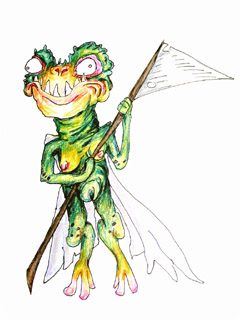
Fairy wings, but a rubbery lizard body. Bug-eyed and toothy, these nasty pixies, the "frogella", are a dangerous lot. The size of small fruit bats, a swarm of the vermin armed with their customary scythes and axes are likely to lop off a grown man's ears, pluck off his nose, and steal all his buttons -- all out of simple mean-spiritedness. While their honey is considered a delicacy by some, it is probably best for the non-expert to avoid their hives entirely.
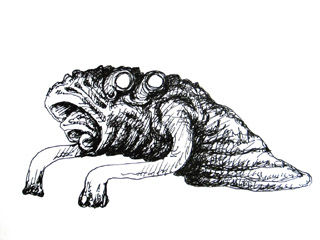
This tube-like entity drags itself forward using two sticky-ended pseudopods. Multiple, nested mouths may indicate a gill-like respiratory system, allowing the thing to inhabit oxygen-deficient environments for long periods. Indeed, it has been suggested that the four opaque white eyes indicate that the slube is most accustomed to dark, subterranean places -- although this has never been proven.
When slubes have made their way into human cities, their route of entry has generally been traced back down into the sewer systems. It is unclear whether this means that they originate from deeper in the Earth, or whether they have used the man-made tunnels to migrate inward from the Ocean bottom. A radical alternative view, advanced by one Professor Ichbonnsen, holds that this is perhaps an entirely new species, arising due to the influence of mutagenic industrial sewage. The supposed similarities between slube and human DNA have been hotly contested by the scientific mainstream... Which, for the most part, is hypothesizing that the slube is an ancient species only coming to light now due to global climate changes associated with the greenhouse effect.
posted by sven | permalink | categories: bestiary, sketchbook
October 19, 2006
monster month - 10
by sven at 8:00 am
Further sketches, contributing to Jeffrey Roche's "Monster Month" event.
The polycephalic forg-man most likely evolved from the common pond forg. Scientists initially believed there to be several subspecies of forg-man: single-headed, two-headed, three-headed, four-headed... But no. As it turns out, the creature is constantly growing new heads, which it periodically sheds. A clutch of heads has often been mistaken for a nest of eggs by the incautious birdwatcher. Once on the decline, forg populations seem to be on the rise again, following the resedimentation of their native wetland habitats by Hurricane Katrina last year.
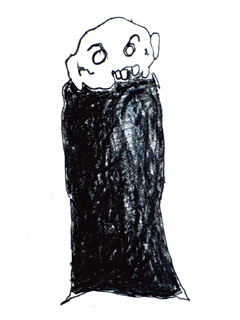
Skull-like face floating atop a cloak of black rags... It skulks, it follows, it stares. Nightmare armies of these silent killers rally in the collective unconscious. As if they were marching through small European countries, they invade our minds while we sleep. During your dreamless nights, you hide with the lights out in your childhood home, hoping not to be caught. The only hope for our waking world lies with the few small cells of guerilla dreamers -- an unconscious underground -- that struggles to resist the enemy's iron grip upon our minds.
(Another character I've been drawing for years.)
posted by sven | permalink | categories: bestiary, sketchbook
October 18, 2006
monster month - 9
by sven at 8:00 am
Further sketches, contributing to Jeffrey Roche's "Monster Month" event.
Bonus sketches today... A series of four monster-ridden heads.
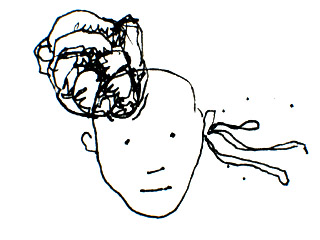
Perhaps an intelligent, parasitic tumor? As it first asserts its independence and reaches out some spaghetti tentacles from the ear?
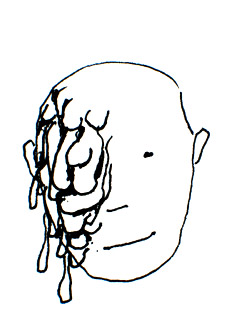
I'm melting! Oh, what a world...
The creature living inside of my head... It sorta tickles.
I've got a splitting headache...
(heh)
posted by sven | permalink | categories: bestiary, sketchbook
October 17, 2006
monster month - 8
by sven at 8:00 am
Further sketches, contributing to Jeffrey Roche's "Monster Month" event.
The grinning pig cootie has a bulbous and pink head, too large for its face. A body stolen from swine wags its stubby tail with glee. Improbably spindly legs look too thin to support its weight -- yet propel the nasty thing with speedy strength as it skitters frantically about the room. What sort of unholy union produced this mad abomination?
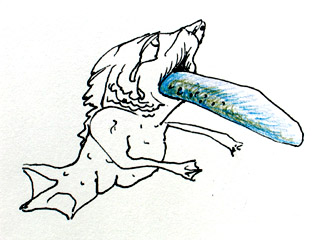
Poor little fish-girl. Her tongue is too big. It is bloated and long, like a giant sea cucumber. It makes her jaw ache, and she weeps piteous tears, in which she swims. The entire world tastes like her own briney sadness.
posted by sven | permalink | categories: bestiary, sketchbook
October 16, 2006
monster month - 7
by sven at 8:00 am
Further sketches, contributing to Jeffrey Roche's "Monster Month" event.
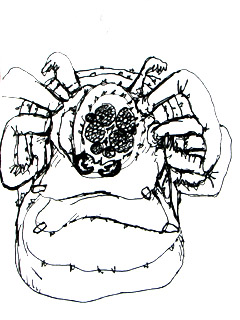
The bloated spider queen is ancient, worshipped by her thousands of progeny, the countless spiderlings that have sucked from her pendulous, poison-filled breasts. She sits at the center of a towering translucent cathedral made entirely from web. Legs having atrophied long ago, she depends upon sacrifices from her army for sustenance.
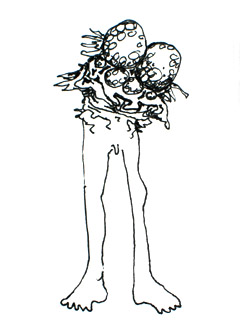
Think of Magritte's mermaid ("Collective Invention," 1934). Think of that classic horror flick with Vincent Price, "The Fly" (1958) -- and the remake with Jeff Goldblum (1986). Just cross a fly and a guy, and you get... EW!
posted by sven | permalink | categories: bestiary, sketchbook
October 15, 2006
monster month - 6
by sven at 8:00 am
Further sketches, contributing to Jeffrey Roche's "Monster Month" event.
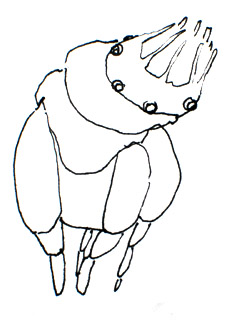
Another favorite...
Black plated armor, inky lidless eyes that encircle an anemone-like maw, elegant insectoid legs that sway like reeds in the wind. Sort of like a milipede crossed with a horse -- but with radial symetry, which allows it to whirl and dance in battle.
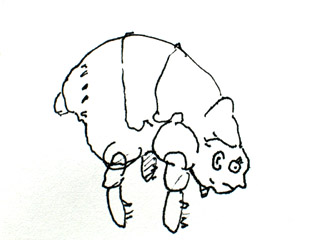
An enormous flea, with the face of a man. 'Nuff said.
posted by sven | permalink | categories: bestiary, sketchbook
October 14, 2006
monster month - 5
by sven at 8:00 am
Further sketches, contributing to Jeffrey Roche's "Monster Month" event.
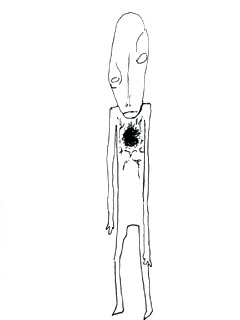
He's a thin man, lop-sided. One arm longer than the other. An eye off-kilter from its mate. An over-large head, difficult to support atop his spindly frame. And in this man's chest, the blackened and cracking hole where his heart has rotted out.
You see him walking toward you in a dream... Then look down in horror to see the front of your shirt bursting into flame, as your own heart erupts. As if pushing through the weight of water, he draws nearer.
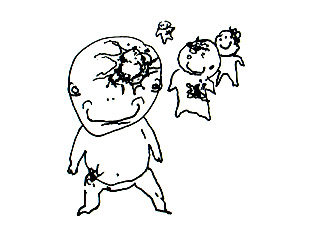
Happy goofy baby things. Oh! They wanna hug. Hug hug hug hug hug! ...How unfortunate for you that they seem to be covered with slimy diseased masses. As if they had been pelted with giant, vomitous spit-wads during some vile and unholy game of dodge ball. Not that they've seemed to notice -- the unstoppably affectionate little buggers.
posted by sven | permalink | categories: bestiary, sketchbook
October 13, 2006
monster month - 4
by sven at 8:00 am
Further sketches, contributing to Jeffrey Roche's "Monster Month" event.
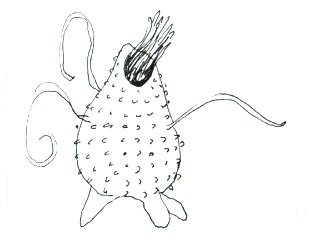
Nubbly plant-thing, wandering on wobbly stubs of legs. Delicate string-tentacles capture its prey, which are then fed -- screaming -- to the writhing maw. From within the stout carapace, muffled screams persist.
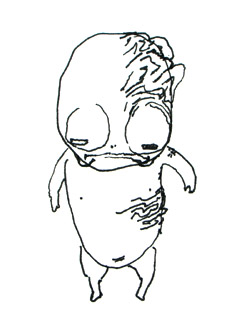
A favorite of mine...
Is it a baby? Or is it ancient? The eyes, peeking through lizard-slit lids, are unreadable. And is its skin still wrinkled from having just slipped out of an amniotic bath? Or are those burn scars from many years ago that mark its moist skin? Either way, the patches of gnarled flesh seem wrong, contrasting with the rest of its frog-soft anatomy. The infant-ancient betrays no secrets by its gait -- rather, it hovers in mid-air, still, a few feet above the ground. An enigma.
posted by sven | permalink | categories: bestiary, sketchbook
October 12, 2006
monster month - 3
by sven at 8:00 am
Further sketches, contributing to Jeffrey Roche's "Monster Month" event.
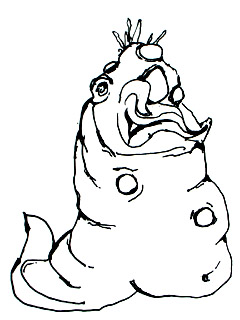
It is a putrescent slug, wallowing within its own mass. Opaque white eyes puncture the slimy surface sporadically. And yet, there are traces of the human in it... An ear, a toothy grin worthy of a Cheshire Cat... Waxy spikes protruding from its "head" in an obscene imitation of hair. My, but the arrogant, unblinking thing seems pleased with itself!
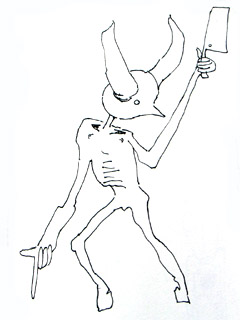
The bull-devil butcher brandishes a meat cleaver and commands its damned wards to the chopping block. Beneath a crown of burly horns, the unreadable face is minimalist: dimly glowing eyes pasted to an anonymous sphere. That, and what might be a nose, or a beak -- the sharpened point of an abstract sculpture. It walks on hooves, and has long rubbery forearms like neoprene gloves. The executioner is all the more unnerving for its lack of details... The sense that this being was summarily created by some other more potent force, which animated the servant without granting even the small mercy of animal features.
posted by sven | permalink | categories: bestiary, sketchbook
October 11, 2006
monster month - 2
by sven at 8:00 am
Further sketches, contributing to Jeffrey Roche's "Monster Month" event.
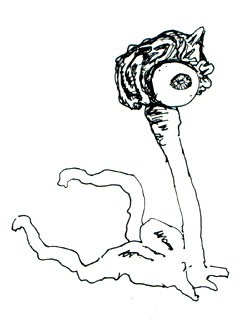
Perhaps some sort of brain that has escaped from its owner, taking one eye with it in the process? Or perhaps an alien species that just happens to have its primary wad of neurons located in a head-reminiscent part of the body? ...Beware those rear feelers -- I suspect they sting!
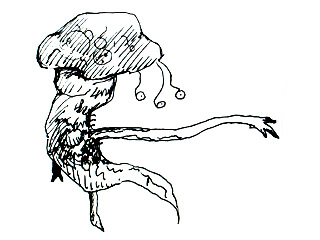
This creature seems to be largely composed of a gelatinous substance, as I'm clearly able to make out organs floating within... Organs that look somewhat like mitochondria. The head is mushroom shaped, and has three eyes waving on spaghetti stalks. The chest seems to be covered with a fine coat of cilia. There don't appear to be feet, but rather pointed pseudopods that stretch and recede as needed. The arm -- that hideous arm -- snaps outward elastically, providing a reach several times the length of the thing's main body.
posted by sven | permalink | categories: bestiary, sketchbook
October 10, 2006
october is monster month!
by sven at 4:28 pm
Stopmo buddy Jeffrey Roche has declared October "Monster Month!" 'Tis the season to draw many horrible things and then share them on your blog. The thought brings a big goofy grin to my face. :-D
The past few weeks have been insanely busy, what with building armatures at Bent Image Lab and then attending the H.P. Lovecraft Filmfest... But I've been doing my part to celebrate Jeffrey's vision. I've drawn dozens of creepy critters in my sketchbook so far -- and have many more yet to birth unto an unsuspecting world.
Today I uploaded the first 20. They're scheduled to appear two at a time on the Scarlet Letters blog, at 8:00am each morning for the next ten days. Enjoy!
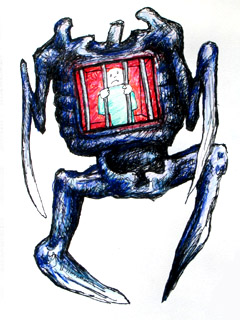
This is a variation on a monster I've been drawing for years: "Spikey." He has knives for legs, praying mantis scythes for arms, a chicken-with-its-head-cut-off neck stump, a barrel-chested ribcage, and an emaciated belly/pelvis. In the center of the chest -- where his heart should be -- there's usually a gaping hole. Sometimes there's a window where you can see someone trapped inside. This time I put a red velvet-lined cell in the chest, where an unhappy prisoner resides.
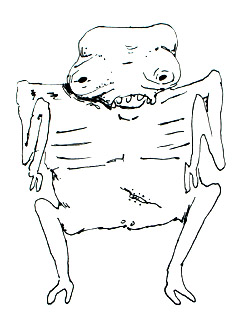
This ghoulish beastie has tiny black eyes set into a bulbous head, a severe under-bite, double-jointed arms, a frame that seems to be stretched twice as wide as a human's, and a scar on its belly where its mother tore off the umbilical cord in terror.
posted by sven | permalink | categories: bestiary, sketchbook